
Smart construction technology: A simple guide for modern jobsites


Last Updated Jun 10, 2026
Julia Tell
Contributing Writer
79 articles
Julia Tell is a freelance writer covering education, construction, healthcare, and digital transformation. She holds a Ph.D. in Media & Communications and has written for publications including Business Insider, GoodRx, and EdSurge, as well as nonprofits, international businesses, and educational institutions.
Sarah Dean
Senior Content Editor
Sarah Dean is the Senior Content Editor for Procore Technologies and has been writing and editing in the construction space since 2020.
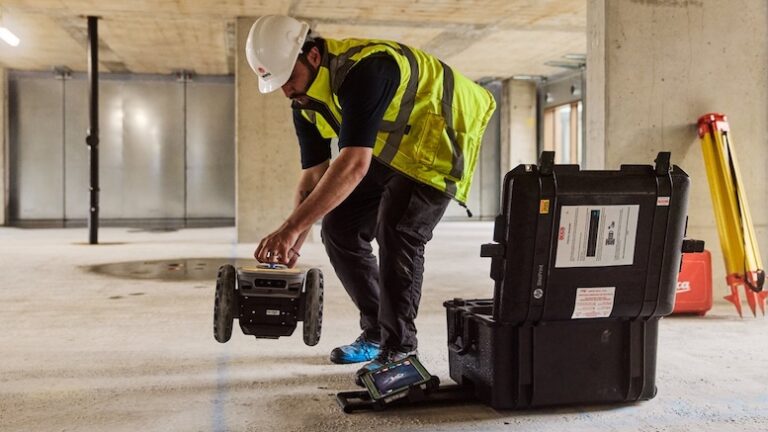
To keep clients happy and stay profitable, builders must use new tech to keep up with the competition. Smart construction technology can power up teams to build the massive and increasingly complex structures our world needs — faster and safer than ever before.
Keep reading to learn how smart construction tech like the Internet of Things (IoT), AI, and even robotics can help boost efficiency, safety, communication, and even sustainability in construction.
Table of contents
What is 'smart construction technology'?
"Smart construction technology" refers to the integration of advanced digital tools and innovative processes to enhance the efficiency, productivity, and even sustainability of construction projects.
Smart construction technology uses digital technologies, data analytics, and connected devices to automate, analyze, monitor, and improve project outcomes across all phases of construction.
This tech covers a wide range, from 3D virtual models and artificial intelligence to physical drones and robots.
According to a 2025 Deloitte report, smart construction technology has “moved from experimental to essential,” and companies are using these tools to improve efficiency and reduce costs to stay ahead in a competitive market.
These technologies improve project management through real-time data collection and analysis and boost collaboration across all facets of a project.
6 types of smart construction technology
Smart construction technology has the power to boost efficiency, accuracy, and collaboration by connecting diverse technologies to work as a team, for your team.
1. Building Information Modeling (BIM)
Building Information Modeling , or BIM, involves the creation of detailed 3D models that integrate information about a building's design, materials, and structure. Instead of just showing what a wall looks like, this 3D model knows exactly what materials the wall uses and where the pipes run. This lets architects and builders test everything on a screen before pouring real concrete — reducing the likelihood of mistakes and subsequent rework from the get-go.
2. Artificial Intelligence
AI in construction has a growing number of uses across the field and office.
In its most basic form, construction AI uses machine learning algorithms to analyze vast amounts of data for insights. It can aid in project planning and risk management through predictive analytics, optimizing resource allocation, and even monitoring safety.
3. Internet of Things
The Internet of Things (IoT) puts smart sensors directly onto tools, trucks, and materials. These systems enable real-time data collection to track equipment location, monitor operational status, and monitor worker safety, leading to more efficient and safe construction practices.
Historically, superintendents had to walk the jobsite all day to figure out what was done — and what wasn’t. With IoT in place, teams can gather near-instantaneous data about what’s happening on the job, and do so without any human effort required to collect that information. This means teams get alerted quickly when a pivot is needed to keep the project on schedule or budget.

Paul Hedgepath
Director of Virtual Construction
MJ Harris Construction
4. Drones
Drones are unmanned aerial vehicles equipped with cameras and sensors for site monitoring. They provide accurate site surveys, track progress, monitor materials, and identify hazards, significantly reducing survey time and labor costs while increasing safety and accuracy.
5. Robotics and autonomous systems
Construction robotics can automate repetitive, labor-intensive tasks such as bricklaying, welding, and excavation. This can boost productivity and help free up human workers to focus on more complex activities.
6. Digital twins
Digital twins are virtual replicas of physical construction sites or buildings, updated in real-time. They allow for real-time monitoring and progress tracking, enabling better decision-making and efficient management of construction projects.
Smart tech in the field
Smart watches and other wrist wearables are becoming commonplace across many fields, but there are pieces of smart tech specialized for construction, such as the smart helmet.
Smart helmets are equipped with sensors and augmented reality (AR) capabilities that can monitor a worker’s surroundings and detect potential hazards to the individual worker as well as on the jobsite around them, from equipment malfunctions to dangerous temperature fluctuations. Some smart helmets even have intuitive displays that allow workers to see real-time data without distracting them from their work.
How smart construction technology works
Smart construction technology combines various digital tools and processes to transform how construction projects are planned, executed, and managed.
Gather the data.
Sensors on heavy machinery, drones, and wearables gather real-time data on site conditions, equipment status, worker safety, and material usage. For example, IoT devices track the location and operational status of machinery, while drones capture aerial images to monitor site progress and identify hazards.
Bringing it all together.
The collected data is fed into cloud-based platforms, creating a central dashboard or "digital twin" of the construction site. BIM integrates this data into comprehensive 3D models, allowing for seamless collaboration across teams and providing a holistic view of the project. Construction project management software centralizes budget, schedule and other tracking data in one place for use by multiple stakeholders.
Analyze — and optimize — the data.
AI algorithms analyze the integrated data to generate insights on productivity levels, material consumption, and potential issues. For instance, AI helps predict delays by analyzing weather patterns and supply chain disruptions, optimizing resource allocation and scheduling.
Take action.
Project managers receive actionable insights to track progress and make informed adjustments to plans. With real-time data and analysis, managers can quickly address issues and keep projects on track.
Stay updated on what’s happening in construction.
Subscribe to Blueprint, Procore’s free construction newsletter, to get content from industry experts delivered straight to your inbox.

Benefits of using smart technology in construction
Implementing smart construction technology offers numerous advantages that enhance accuracy and efficiency for businesses. Here's how these technologies make a difference.
Keep workers safe.
Smart technology significantly reduces risks by removing workers from dangerous environments. Drones perform site surveys and inspections without exposing workers to potential hazards.
Wearable technology monitors worker health and alerts managers to potential safety risks in real time. Autonomous vehicles operate in dangerous areas, reducing the need for human presence in risky jobs.
The true power of AI is when it is fused with machinery, where AI and robotics come together and really augment our capabilities to build things faster, better, more efficiently, with less risk to us as organizations and less risk to our humans because we keep putting people in dangerous situations. And if we can fix that, which I think we can, now we’ve got a shot.

Jeff Sample
Founder
Ironman of IT
Never lose track of materials.
Advanced tracking systems ensure materials are managed efficiently, keeping projects on schedule. IoT Sensors track materials throughout the supply chain for timely delivery and reduced delays.
RFID tags provide precise location data for materials on the job site, enhancing inventory management. Cloud-based platforms allow real-time updates and communication with clients about project progress.
Build sustainably, intuitively.
Eco-friendly construction is achievable by integrating sustainable technologies and practices. Water conservation systems implement smart irrigation and plumbing systems to minimize water usage. Recyclable materials can be reused or recycled to reduce waste. Smart HVAC systems optimize energy use, enhancing building efficiency and comfort.
Save time and money.
Automation and predictive tools streamline construction processes, saving time and money. Autonomous machinery can automate repetitive tasks, increasing productivity and reducing labor costs. AI-Driven scheduling adjusts timelines dynamically based on real-time data to minimize downtime. 3D Printing speeds up the construction of components, allowing for quicker assembly and reduced waste.
Boost quality across builds.
Smart technology creates higher standards of quality through precision and consistency.
For example, robotics provide consistent and precise execution of tasks such as bricklaying and welding. BIM and digital twins allow for meticulous planning and monitoring, reducing errors and rework. Quality control software continuously monitors construction processes to ensure adherence to standards and specifications.
Future trends of smart construction technology
As the construction industry continues to progress and innovate, smart technology is set to play a growing role. Here are some specific predictions and areas where smart construction technology is expected to expand.
Advanced sensors
Companies and owners are increasingly deploying advanced technologies across multiple projects, advanced sensors will become more ubiquitous and sophisticated, providing precise data on structural health, environmental conditions, and worker safety. This can lead to proactive maintenance and improved safety protocols.
Expanding the cloud
Cloud technology is slated to keep expanding, offering more robust platforms for data storage, sharing, and analysis, promoting seamless collaboration among global teams. This continues the trend of the “expanding appetite for data,” which is driving data center construction, but challenges are forcing companies to use innovative technologies like hybrid cooling and forcing data centers to more remote locations, according to McKinsey.
Boosting design with AI
Firms are predicted to increasingly use AI in the design phase, moving firms from the traditional process of engineering design to “configuration and structural design,” according to Deloitte. For instance, integrating tech like digital twins with construction scheduling will improve visibility to drive operational improvements, helping companies become “insight-driven organizations.”
Smart sustainability
Smart technology has the power to drive sustainable practices, from energy-efficient building designs to the standardization of the use of eco-friendly materials. Innovations like smart grids and green building technologies will also become more common, and expanding needs for power will drive more renewable energy construction projects.
Smart materials
Smart materials are bringing exciting new possibilities into the industry, including self-healing concrete, sensor-embedded materials, and phase-change materials that absorb or release thermal energy.
Offsite innovations
Prefabrication and modular construction will attract more companies with the possibilities of a 30% reduction in costs. 3D printing is poised to help address the affordable housing shortage and higher quality and more personalization will be possible with the use of AI.
Enhanced VR
Virtual and augmented reality will expand beyond design visualization to include safety training, providing immersive experiences that enhance understanding and collaboration.
Faster data insights
Harnessing data insights will become increasingly necessary for process optimization and integrated delivery. Predictive analytics will move firms from reactive to proactive decision-making, allowing firms to outpace competitors.
Combining human intelligence with these advancements will push the construction industry towards greater efficiency, sustainability, and innovation. Training a workforce to build smarter with connected technology can help businesses remain competitive in an industry and world that necessitates innovation.
Was this article helpful?
Scroll less, learn more about construction.
Subscribe to The Blueprint, Procore’s construction newsletter, to get content from industry experts delivered straight to your inbox.
By clicking this button, you agree to our Privacy Notice and Terms of Service.
Categories:
Written by
Julia Tell
Contributing Writer | Procore Technologies
79 articles
Julia Tell is a freelance writer covering education, construction, healthcare, and digital transformation. She holds a Ph.D. in Media & Communications and has written for publications including Business Insider, GoodRx, and EdSurge, as well as nonprofits, international businesses, and educational institutions.
View profileSarah Dean
Senior Content Editor | Procore Technologies
Sarah Dean is the Senior Content Editor for Procore Technologies and has been writing and editing in the construction space since 2020.
View profileExplore more helpful resources

Does your asset management workflow actually work?
Every fixed asset installed on a project generates data long before handover. Is your team capturing it as it happens, or scrambling to reconstruct it after the fact? That question...
From spec book chaos to single source of truth
Picture this: An expansion is going in directly beside a high-volume line that cannot stop producing. Structural steel lands in March, mechanical completion is promised for August, and your only...
The hidden risk of relying on your EPC partner for project visibility
Many owners have thought some version of “We don’t need a capital project management platform — our EPC partner manages all of this for us.“ It’s a reasonable position. Your...

Why manufacturing owners are still managing capital projects like it’s 2010
There is a machine on your plant floor right now that knows it’s going to break. A sensor is reading a vibration signature on a bearing about three weeks before...
Free Tools
Calculators
Use our calculators to estimate the cost of construction materials for your next project.
Templates
Find a template to help you with your construction project tasks.
Material Price Tracker
Get the latest U.S. retail prices and view historical trends for common building materials.
Glossary
Explore key terms and phrases used in the industry.