
The Strategic Pillar of Portfolio Governance: From individual heroics to institutional advantage

Last Updated Aug 3, 2026
Tiffany LaBruno
Strategic Industry Advisor
Tiffany LaBruno serves as a Strategic Industry Advisor at Procore, where she amplifies the voice of Owners across the organization. A recognized subject matter expert in Owner market needs and technology adoption, she partners with product and technology teams to shape Procore’s platform strategy and innovation roadmap. Tiffany is a passionate advocate for harnessing data intelligence and AI to drive the next era of data-driven evolution in construction. With more than two decades of experience advising both public and private Owner organizations, Tiffany has led strategic initiatives in process optimization, program controls, PMIS modernization, and Next-Generation Digital Twin platform implementation. Her career reflects a deep commitment to advancing transparency, collaboration, and performance through technology across the built environment.

Making organizational decisions about technology and capital delivery can be overwhelming. When faced with volatile market conditions, persistent inflation, acute labor constraints, and rising project complexity, it is easy to feel the pressure to buy the latest software tool or risk falling behind. We need to lower the anxiety around these tools immediately.
Technology is not a magic fix; at its best, it is simply your best people and institutional judgment scaled exponentially across an entire capital program. Strategic readiness isn't about selecting the most expensive software, but about setting a direction that allows your leadership team to focus on high-value decisions and portfolio returns rather than rote administrative tasks.
For decades, the construction industry has rewarded a culture of "firefighting" – celebrating the heroic project manager who pulls an all-nighter to save a troubled job. However, heroics disguised as management do not scale.
Relying on individual intervention becomes an organizational liability as capital programs grow in size and complexity. The day an experienced project director walks out the door, leadership finds out how much of their "system" was actually just one person's judgment.
High-performing capital owners replace heroics with portfolio governance. A true strategy requires a cultural shift from reactive "firefighting" to proactive "smoke detecting" – moving away from a command-and-control style of project oversight toward true portfolio governance where the goal is preventing project variances, not reacting to them.
This article, the first in our three-part series on Portfolio Governance focuses on the people, processes, and leadership alignment that create these strategic capabilities.
Read the full series:
- The Strategic Pillar: From individual heroics to institutional advantage (You are here)
In this article, we explore how to shift your organization's mindset from relying on individual, isolated tools to governing entire capital portfolios, ensuring that your technology strategy serves your people and your business strategy -- not the other way around.
Table of contents
The Strategic Pillar: Setting the direction
Strategic capabilities define an organization’s ability to set the direction, clarify decision rights, and create the structures needed to sustain long-term performance across a capital portfolio. We frame this process in three consecutive areas of focus:
- Goals & culture
- Technology strategy
- Organizational design & talent
This approach shifts focus away from individual software tools and toward the broader strategic outcomes that protect the balance sheet and board credibility.
The Case for Portfolio Governance
The gap between managing projects and governing a portfolio is structural, not operational. The Case for Portfolio Governance proposes a different way of thinking about capital delivery -- and a framework for organizing that thinking into practice.

Some leaders make the mistake of halting modern technology initiatives until they achieve operational perfection across every project, including cleaning every standard operating procedure and standardizing every field setting. But in many ways, this is backward thinking.
Connected portfolio systems act as a diagnostic tool that helps surface blind spots and refine those very processes. Waiting for perfect conditions before governing your portfolio is a trap.
Goals & culture: Shifting from heroics to governance
Strategy starts with cultural alignment. Team members should:
- Know why new governance frameworks and tools are being adopted
- Understand what it means for their daily work
- Feel invested in working toward that strategic vision
Cultivating this environment starts at the top, with visible, communicative, and reflective executive leadership.
To succeed, leadership must deliberately guide the organization away from the "Hero Trap". While problem-solving and dedication will always be important, leaders must begin to recognize and reward people who establish systems that mitigate or eliminate variances early. Heroes who solved individual project crises carried the industry for decades; leaders who build systems to govern portfolios are going to carry us into the future.
Often, the biggest barrier to adoption is fear -- of blame, of micromanagement, or of losing autonomy. This can be addressed by leaders setting clear intent and formalizing trust across the organization:
Systems institutionalize judgment, not control
Explicitly frame connected tools as systems that remove tedious administrative work (stitching spreadsheets, chasing contractor updates, writing manual closeout summaries) so staff can focus on high-value strategic decisions, risk negotiation, and field coordination.
Interrogate "green" status reports
Executive leadership must challenge lagging indicators. If a project’s "green" status rests on the personal confidence of one PM rather than connected data the team can pull and defend independently, leadership is relying on a hero, not a system.
Model the behavior
If executives ignore portfolio insights or continue relying on legacy, disconnected spreadsheets and PDF reports, their teams will too. Executives must visibly use connected portfolio data to drive boardroom conversations and strategic decisions.
Technology strategy: The problem-first approach
It’s tempting to pick technologies simply because they are popular, offer flashy dashboards, or feature modern features, but that often results in a strategy focused on adjusting operational workflows to serve a tool. An effective technology strategy takes the opposite approach: identify a specific portfolio business risk and find the connected system that provides early visibility and control.
A problem-first approach deploys tools toward protecting the business case established during capital planning. Cost overruns, schedule delays, and scope creep do not announce themselves; they accumulate quietly in disconnected tools until the variance is too large to recover. The strategic goal is to reduce portfolio risk and eliminate complexity, not multiply it.
Instead of attempting to implement full-scale automation or overhaul every project at once, a successful strategy starts with low-stakes, high-value applications and gradually increases system trust as the platform proves its reliability. High-performing capital owners build maturity step-by-step through a four-part trust progression:
| Strategic Phase | System Trust Level | Value Proposition | Portfolio Governance Goal | Example |
|---|---|---|---|---|
| Assistance | Low | Immediate time savings | Instantly find, summarize, or query historical specs and project documents across the portfolio. | Instantly pulling safety specs or equipment records from past jobs. |
| Guidance | Medium | Informed human decisions | Recommend specific actions based on connected historical data. | Flagging a high-risk bid or scope change based on historical vendor and regional performance. |
| Automation | High | Process efficiency | Execute predefined governance rules and standardized escalation workflows. | Standardizing change-order thresholds and automatically routing variances. |
| Portfolio Intelligence | Highest | Proactive risk avoidance | Forecast cost overruns and schedule risk across active investments. | Surfacing leading indicators of cost growth weeks before they register in a monthly report. |
A strong strategy usually commits to a low-stakes pilot at the Assistance or Guidance levels. The organization can troubleshoot and prove the system works, building organizational trust before attempting higher-risk phases.
Organizational design and talent: The right people in the right roles
Because effective technology adoption and governance are overwhelmingly contingent on people, leaders must be strategic about positioning talent to effect change and clearly defining their roles.
In most capital programs, someone is accountable for each project and each program. But no one has explicit accountability for portfolio-level outcomes – i.e., whether the entire capital investment program is delivering the returns that justified it.
To build a scalable governance model, an organization should align three critical roles:
The accountable portfolio executive
A named executive with explicit responsibility over portfolio governance and portfolio-level performance. This leader has clear authority to escalate systemic risks that cross program boundaries and ensures the technology mission is funded and aligned with business goals.
Cross-functional influencers (champions)
People who have credibility with their peers across project management, controls, and operations. These peer champions drive adoption because others watch and copy their habits.
The impacted roles
The administrative, project controls, and field entry roles that feel the most immediate change in their daily routines. Their success must be prioritized to prevent anxiety and friction from spreading.
For generations, new project engineers learned the business through repetitive tasks, like manually sorting submittals, stitching spreadsheets, or re-keying data. As connected systems streamline that paperwork, training shifts toward analysis, field coordination, and judgment.
Instead of spending hours retyping data into lagging reports, junior staff spend their time on site investigating early variance signals and managing risk before it turns into a boardroom conversation.
Setting the direction: Three actions to take now
Adopting new technology and governance frameworks is only effective when people know what they’re working toward and how the system helps them get there. Strategic readiness is the foundation – it’s about aiming for business outcomes, enabling people through clear intent, and sustaining change through committed leadership.
To translate this strategy into immediate organizational action, consider starting with these three shifts adapted from our Portfolio Governance framework:
Convene leadership and name your stage
Convene the executive team responsible for capital allocation and answer a simple diagnostic question together: "If our lead PMs were unavailable for a month, could we independently defend the 'green' status of our key projects using connected system data?" The gap between what different leaders believe about portfolio health is itself a critical governance signal.
Designate an accountable portfolio executive
Formally appoint a single named executive with explicit authority over portfolio-level performance. Ensure this role has the authority to enforce master data standards and intervene when early cost or schedule risks cross project lines.
Turn past projects into future advisors
Stop letting project knowledge vanish into closeout reports no one reads. In your next capital planning session, literally point to an empty chair and ask your team: "If our last five completed projects were sitting right here, what would they tell us NOT to do on this upcoming program?" Require answers grounded in historical delivery data rather than personal anecdotes.
Technology adoption isn’t a quick fix or a software purchase; it’s a marathon of cultural alignment. Getting the strategic foundation right early on ensures every future operational and governance investment will compound into institutional advantage.
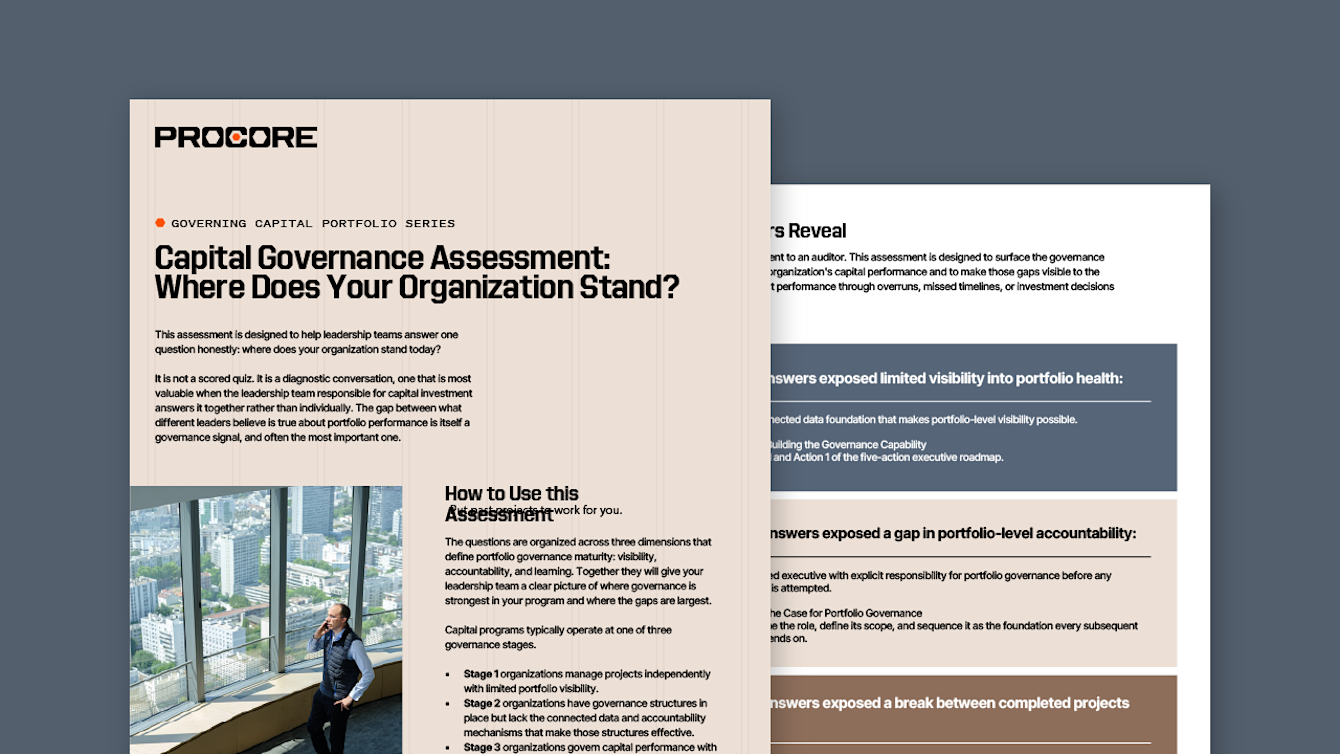
Take the Capital Governance Assessment
Get clear, unfiltered view of where your program stands today -- and the obstacles preventing predictable outcomes at scale. Take the Capital Governance Assessment to identify the hidden gaps in the way your capital program is governed across visibility, accountability, and learning.
this is part of the series
The 3 Pillars of Portfolio Governance
Was this article helpful?
Scroll less, learn more about construction.
Subscribe to The Blueprint, Procore’s construction newsletter, to get content from industry experts delivered straight to your inbox.
By clicking this button, you agree to our Privacy Notice and Terms of Service.
Categories:
Written by
Tiffany LaBruno
Strategic Industry Advisor | Procore Technologies
Tiffany LaBruno serves as a Strategic Industry Advisor at Procore, where she amplifies the voice of Owners across the organization. A recognized subject matter expert in Owner market needs and technology adoption, she partners with product and technology teams to shape Procore’s platform strategy and innovation roadmap. Tiffany is a passionate advocate for harnessing data intelligence and AI to drive the next era of data-driven evolution in construction. With more than two decades of experience advising both public and private Owner organizations, Tiffany has led strategic initiatives in process optimization, program controls, PMIS modernization, and Next-Generation Digital Twin platform implementation. Her career reflects a deep commitment to advancing transparency, collaboration, and performance through technology across the built environment.
View profileExplore more helpful resources

Does your asset management workflow actually work?
Every fixed asset installed on a project generates data long before handover. Is your team capturing it as it happens, or scrambling to reconstruct it after the fact? That question...

From spec book chaos to single source of truth
Picture this: An expansion is going in directly beside a high-volume line that cannot stop producing. Structural steel lands in March, mechanical completion is promised for August, and your only...
The hidden risk of relying on your EPC partner for project visibility
Many owners have thought some version of “We don’t need a capital project management platform — our EPC partner manages all of this for us.“ It’s a reasonable position. Your...

Why manufacturing owners are still managing capital projects like it’s 2010
There is a machine on your plant floor right now that knows it’s going to break. A sensor is reading a vibration signature on a bearing about three weeks before...
Free Tools
Calculators
Use our calculators to estimate the cost of construction materials for your next project.
Templates
Find a template to help you with your construction project tasks.
Material Price Tracker
Get the latest U.S. retail prices and view historical trends for common building materials.
Glossary
Explore key terms and phrases used in the industry.