
Why manufacturing owners are still managing capital projects like it’s 2010

Last Updated Aug 26, 2026

There is a machine on your plant floor right now that knows it's going to break.
A sensor is reading a vibration signature on a bearing about three weeks before that bearing fails. Your manufacturing execution system (MES) has already flagged it, scheduled the swap, used artificial intelligence (AI) to check whether the replacement part is on the shelf and modeled tariff scenarios to calculate should-cost. All with minimal burden on the team and zero disruption to the line.
Manufacturing has a longstanding legacy as the main driver of innovations like this in the U.S. The sector is responsible for 55% of all patents, and every dollar spent here generates another $2.69 elsewhere in the economy. By any reasonable standard, these facilities are the most efficiently instrumented environments on Earth.
So why haven’t the billion-dollar capital construction projects that build them caught up to the efficiency on the factory floor?
Table of contents
The 2010 tech stack is still running many capital programs
Most manufacturers don’t own their own capital execution platforms. Instead, lean internal engineering teams rely on external engineering, procurement and construction management (EPCM) partners, original equipment manufacturer (OEM) skid vendors and system integrators for visibility into build progress.
Project status lives in a contractor’s system rather than theirs, arriving on a cadence set by someone else’s reporting calendar.
Plainly: They’re at the end of the line in a game of telephone.
Once data finally reaches leadership, every decision about spend, schedule, and risk is a guess dressed up as a plan.
Incomplete data leaves a gap, and leadership can’t govern what it can’t see—so best guesswork fills the blind spots. Over multiple cycles, guessing becomes the strategy, and real-time risk mitigation is left in the rearview mirror.
Once a build is complete, delivery teams often dissolve, taking critical project knowledge with them. Lessons learned stay in closeout reports no one reads. Cost models carry forward assumptions that were outdated three projects ago.
What this lag can cost your team
A McKinsey review of more than 300 megaprojects valued above $1 billion found average cost overruns of roughly 79% and schedule delays of about 52%.
On a $1 billion facility, a 79% overrun is another $790 million. That's a second plant's worth of capital. A 52% delay turns a 30-month build into a 46-month one: sixteen months of production revenue that never arrives.
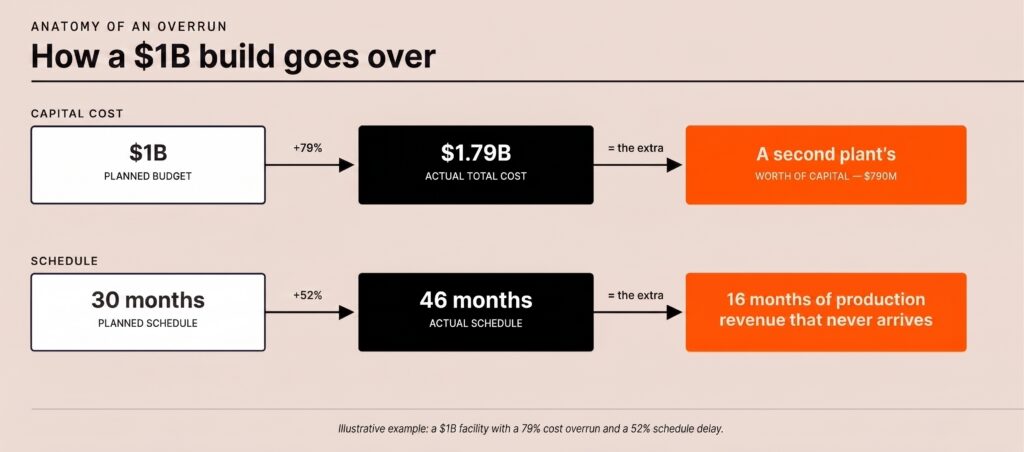
We’ve normalized a gap between mechanical completion and start of production (SOP) — the commissioning, qualification and ramp-up window — that no plant manager would tolerate on a live production line.
Without real-time portfolio visibility, a schedule slip surfaces only after it's already caused a delay. A budget variance surfaces at month-end, when it's already a variance. By the time it reaches an executive dashboard, the window to correct it within budget has closed.
It’s time to shift from reactive to proactive.
Removing the margin for error
Manufacturing capital is pivoting from greenfield build-out to strategic optimization—line expansions, equipment retrofits and automation upgrades—under persistent tariff and supply chain pressure.
Translated: There's fewer new plants, more work inside plants that are already running, and every capital expenditure dollar under harder executive scrutiny.
Executing brownfield work means sequencing heavy mechanical, electrical and plumbing (MEP) and process piping installations around live production. It means coordinating more partners, working within strict shutdown, turnaround and outage (STO) windows, and managing regulatory and incentive compliance obligations that outlast the project itself.
A fragmented operating model fails in more places at exactly the moment when there is the least margin to absorb it.
The problem is not volatility. It's fragmentation.
Closing the plan-build-operate lifecycle gap
You carry the risk, the cost, and the compliance obligation for these assets for decades. You should be able to govern all phases — plan, build, and operate — as they happen rather than renting that visibility from whoever ran delivery and losing it when the project closes.
Capital delivery should be a closed control loop.
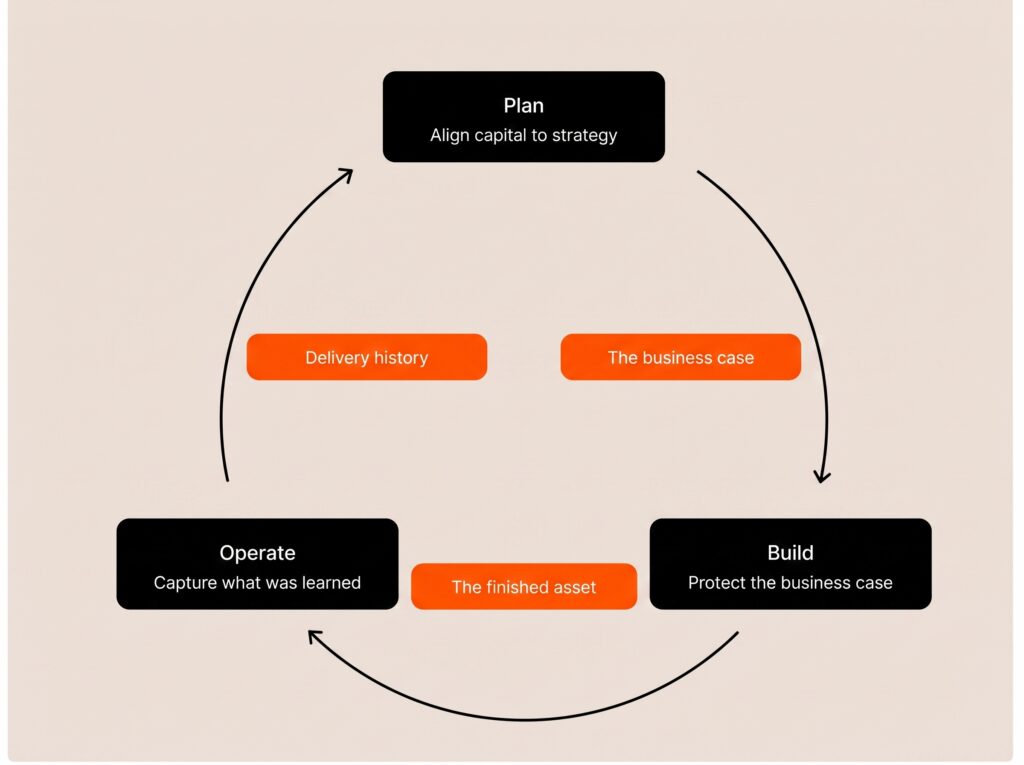
In a closed loop, every phase feeds the next—and the last feeds the first. Actual delivery performance becomes the baseline for the next investment decision. A single, current, portfolio-wide view that connects field execution directly to leadership across every plant and every external partner makes this possible.
But portfolio-wide visibility creates a second-order problem: more signal than any team can watch by hand. Dozens of concurrent work packages across multiple plants and partners generate a constant stream of production rates, procurement dates, change orders, and inspection results. Visibility only pays off if something is monitoring that stream continuously and surfacing what matters while there is still time to act.
That is the problem your plant floor already solved. The failing bearing doesn’t get caught because someone reviews a report at month-end; it gets caught because a system watches the signal continuously and escalates the exception.
Agentic AI can bring that same pattern to capital delivery—tracking leading indicators against plan and flagging variance in the week it starts rather than the month it lands in the financials.
On a capital project, labor production rate is one of the earliest of those indicators.
Production falling behind the estimate is exactly the kind of leading signal an agent can monitor continuously across an entire portfolio rather than one job at a time. With real-time visibility, those conversations happen sooner — and with better information — giving teams the room to correct course while correction is still cheap.
Working for the future, not in the past
The owners who pull ahead in this cycle won't be the ones working harder inside the 2010 model.
They'll be the ones who close the distance between what's happening on site and what leadership can actually see. The next decade of capital delivery belongs to manufacturers who can govern in real time with portfolio-wide visibility.
Was this article helpful?
Scroll less, learn more about construction.
Subscribe to The Blueprint, Procore’s construction newsletter, to get content from industry experts delivered straight to your inbox.
By clicking this button, you agree to our Privacy Notice and Terms of Service.
Categories:
Written by
Explore more helpful resources

What I Learned the Hard Way: Fred Mills on changing the narrative of construction
Fred Mills, founder of The B1M, set out to change how the world sees construction. What began as an ambitious idea on a Post-it note grew into one of the...

Does your asset management workflow actually work?
Every fixed asset installed on a project generates data long before handover. Is your team capturing it as it happens, or scrambling to reconstruct it after the fact? That question...
From spec book chaos to single source of truth
Picture this: An expansion is going in directly beside a high-volume line that cannot stop producing. Structural steel lands in March, mechanical completion is promised for August, and your only...
The hidden risk of relying on your EPC partner for project visibility
Many owners have thought some version of “We don’t need a capital project management platform — our EPC partner manages all of this for us.“ It’s a reasonable position. Your...
Free Tools
Calculators
Use our calculators to estimate the cost of construction materials for your next project.
Templates
Find a template to help you with your construction project tasks.
Material Price Tracker
Get the latest U.S. retail prices and view historical trends for common building materials.
Glossary
Explore key terms and phrases used in the industry.