
The Governance Pillar of Portfolio Governance: Institutionalizing trust and learning systems

Last Updated Aug 3, 2026
Tiffany LaBruno
Strategic Industry Advisor
Tiffany LaBruno serves as a Strategic Industry Advisor at Procore, where she amplifies the voice of Owners across the organization. A recognized subject matter expert in Owner market needs and technology adoption, she partners with product and technology teams to shape Procore’s platform strategy and innovation roadmap. Tiffany is a passionate advocate for harnessing data intelligence and AI to drive the next era of data-driven evolution in construction. With more than two decades of experience advising both public and private Owner organizations, Tiffany has led strategic initiatives in process optimization, program controls, PMIS modernization, and Next-Generation Digital Twin platform implementation. Her career reflects a deep commitment to advancing transparency, collaboration, and performance through technology across the built environment.

In capital delivery, the word "governance" often feels restrictive, like a rigid set of rules designed to police behavior. But in a high-performing capital organization, governance is actually about formalizing trust.
Just as physical guardrails exist on a job site to let crews work safely at heights, governance policies exist to give project teams the clarity and confidence they need to surface risks, share honest data, and admit mistakes early without fear of blame.
Without this trust, data stays hidden. If a team member fears that a cost variance or schedule delay will be used for personal critique rather than proactive risk mitigation, bad news goes underground. It stays buried in disconnected tools until it surfaces as an unrecoverable boardroom crisis.
Portfolio governance is the system that turns individual project consistency into organizational intelligence, ensuring that data flowing in from the field is trusted, protected, comparable, and continually feeding future decisions.
This final article in our three-part series on Portfolio Governance explores how to sustain portfolio performance through consistent data, clear accountability, and compounding learning systems.
Read the full series:
- The Governance Pillar: Institutionalizing trust and learning systems (You are here)
Here, we discuss how to move from reactive firefighting to proactive portfolio control, ensuring that your organization’s trust in its data – and its people – is built on a foundation of clarity.
Table of contents
The Governance Pillar: Sustaining Adoption and Mitigating Risk
Governance capabilities ensure that the data flowing in from active projects is comparable across the portfolio, usable for executive decision-making, and protected by clear organizational policies.
The Governance Chain
Governance is a system where capabilities compound over time:
- Governance without visibility produces rules without insight.
- Visibility without connected data produces reports without reality.
- Connected data without learning produces intelligence without wisdom.
The Cost of Fragmented Governance
Without standardized governance, individual project teams rely on their own systems and definitions. A change-order category used by a team in Dallas might mean something entirely different to a team in Seattle. Leadership cannot spot systemic risk, track contractor reliability, or predict portfolio-level cost growth when the foundational data definitions are inconsistent across projects.
Governance solves this structural gap through three core disciplines:
Creating a shared data foundation
Standardizing definitions so capital data is always comparable across projects, regions, and asset classes.
Defining KPIs for process adherence
Establishing key metrics and clear accountability leads to measuring adherence to organizational standards.
Formalizing trust & policy
Creating cultural safety and explicit policies to sustain adoption, protect data, and encourage early risk escalation.
The Case for Portfolio Governance
The gap between managing projects and governing a portfolio is structural, not operational. The Case for Portfolio Governance proposes a different way of thinking about capital delivery -- and a framework for organizing that thinking into practice.

Data visibility and standardization: Defining KPIs and data foundations
Governance ensures every project team, external contractor, and executive speaks the exact same operational language. Data becomes comparable across an entire portfolio only when anchored to a single, consistent data structure.
Consistent data for portfolio intelligence
Portfolio insights are deeply flawed when they rely on inconsistent baseline context (e.g., project types, budget structures, cost codes, geography). For example, an owner cannot accurately forecast risk on a new healthcare facility if the underlying delivery history is mixed with warehouse data.
Enforce entry standards
Standardize and require entry rules for all primary data types (e.g., cost code structures, variance reason codes, vendor directories, contract types).
Centralize governance
Data standards must be maintained centrally so data captured by field teams flows cleanly into portfolio-level intelligence.
Balance enforcements with usability
Governance requires establishing trust. If standards are overly bureaucratic or punitive, teams will find workarounds or game the system, re-creating the data blind spots you set out to eliminate.
Measuring process adherence (KPIs)
What isn’t measured cannot be governed. Effective portfolio governance requires tracking a small, focused set of metrics that measure workflow adherence (e.g., daily log completion rates, change-order review cycle times, RFI response times).
Assigning accountability leads to track process adherence ensures that data entry habits remain consistent across all active investments. When processes are followed consistently, leadership can trust that project status reports reflect real-world conditions rather than personal opinions.
Culture and policy
Governance focuses on the organizational policies and cultural habits necessary to turn new behaviors into institutional memory.
Creating a culture where bad news travels fast
The most human dimension of governance is psychological safety. Early warning signs of project failure – design omissions, material delays, cost growth – only travel upward when team members trust that surfacing a problem will not make them the target of blame.
When team members are criticized for flagging risks, bad news goes underground. The risk doesn't disappear -- it simply accumulates silently until it becomes a crisis. Effective governance formalizes trust, treating early warnings as the most valuable data an organization can receive.
When a culture rewards the person who raises their hand early, the entire organization operates as an early warning sensor network.
Establishing learning systems over one-off wins
In most capital programs, institutional knowledge is project-specific and perishable. When construction finishes, project teams dissolve, closeout reports are filed away unread, and historical assumptions carry forward uncorrected.
High-performing capital owners convert completed projects into institutional assets. The governance loop feeds actual cost performance, schedule variance, and delivery partner outcomes directly back into the planning baselines for future investments.
Data becomes information, information becomes insight, and insight compounds into wisdom – enabling the organization to get smarter with every dollar spent.
Moving forward: The 90-day governance roadmap
Governance is the key to connecting all three pillars – Strategic, Operational, and Governance readiness – into a single, compounding capability. To move from reactive firefighting to proactive portfolio control, leadership should sequence implementation across a 90-day roadmap:
Days 1 - 30: See clearly (diagnostics)
| Step | Action |
|---|---|
| Interrogate "green KPIs" status reports | Challenge project health indicators to confirm they are backed by connected system data rather than individual PM confidence. |
| Measure your Time-to-Answer | Run a cross-portfolio data query and benchmark how long it takes your team to deliver an accurate, defensible answer. |
| Read the room | Evaluate whether your culture encourages teams to surface bad news quickly or hide it until closeout. |
Days 31 - 60: Build the foundation (connected standards)
| Step | Action |
|---|---|
| Define Your Minimum Impact Dataset (MID) | Standardize the vital data points required across every project and mandate their entry across all contractors. |
| Designate the accountable portfolio executive | Formally name a single leader responsible for portfolio-level performance and cross-program risk escalation. |
| Align master data | Standardize cost codes, variance categories, and vendor structures across the entire enterprise. |
Days 61–90: Close the loop (compounding wisdom)
| Step | Action |
|---|---|
| Activate the portfolio learning loop | Feed actual delivery data from completed projects back into capital planning frameworks and contingency models for upcoming investments. |
| Formalize trust policies | Publish a clear policy confirming that portfolio data and early risk signals are used exclusively for root-cause analysis and process improvement. |
By executing this roadmap, capital owners close the governance gap, stop absorbing predictable project variances, and achieve true predictability across their entire portfolio.
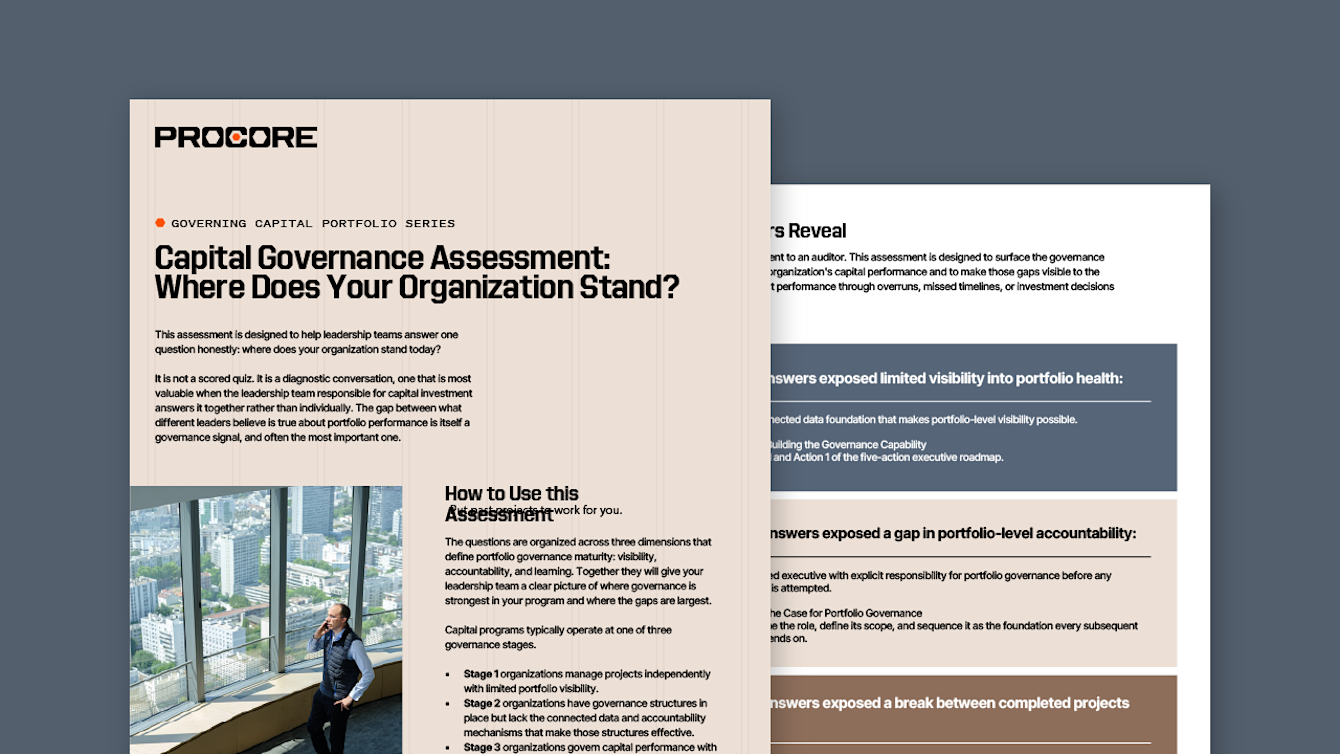
Take the Capital Governance Assessment
Get clear, unfiltered view of where your program stands today -- and the obstacles preventing predictable outcomes at scale. Take the Capital Governance Assessment to identify the hidden gaps in the way your capital program is governed across visibility, accountability, and learning.
this is part of the series
The 3 Pillars of Portfolio Governance
Was this article helpful?
Scroll less, learn more about construction.
Subscribe to The Blueprint, Procore’s construction newsletter, to get content from industry experts delivered straight to your inbox.
By clicking this button, you agree to our Privacy Notice and Terms of Service.
Categories:
Written by
Tiffany LaBruno
Strategic Industry Advisor | Procore Technologies
Tiffany LaBruno serves as a Strategic Industry Advisor at Procore, where she amplifies the voice of Owners across the organization. A recognized subject matter expert in Owner market needs and technology adoption, she partners with product and technology teams to shape Procore’s platform strategy and innovation roadmap. Tiffany is a passionate advocate for harnessing data intelligence and AI to drive the next era of data-driven evolution in construction. With more than two decades of experience advising both public and private Owner organizations, Tiffany has led strategic initiatives in process optimization, program controls, PMIS modernization, and Next-Generation Digital Twin platform implementation. Her career reflects a deep commitment to advancing transparency, collaboration, and performance through technology across the built environment.
View profileExplore more helpful resources

Does your asset management workflow actually work?
Every fixed asset installed on a project generates data long before handover. Is your team capturing it as it happens, or scrambling to reconstruct it after the fact? That question...

From spec book chaos to single source of truth
Picture this: An expansion is going in directly beside a high-volume line that cannot stop producing. Structural steel lands in March, mechanical completion is promised for August, and your only...
The hidden risk of relying on your EPC partner for project visibility
Many owners have thought some version of “We don’t need a capital project management platform — our EPC partner manages all of this for us.“ It’s a reasonable position. Your...

Why manufacturing owners are still managing capital projects like it’s 2010
There is a machine on your plant floor right now that knows it’s going to break. A sensor is reading a vibration signature on a bearing about three weeks before...
Free Tools
Calculators
Use our calculators to estimate the cost of construction materials for your next project.
Templates
Find a template to help you with your construction project tasks.
Material Price Tracker
Get the latest U.S. retail prices and view historical trends for common building materials.
Glossary
Explore key terms and phrases used in the industry.