
The Operational Pillar of Portfolio Governance: Making capital work measurable

Last Updated Aug 3, 2026
Tiffany LaBruno
Strategic Industry Advisor
Tiffany LaBruno serves as a Strategic Industry Advisor at Procore, where she amplifies the voice of Owners across the organization. A recognized subject matter expert in Owner market needs and technology adoption, she partners with product and technology teams to shape Procore’s platform strategy and innovation roadmap. Tiffany is a passionate advocate for harnessing data intelligence and AI to drive the next era of data-driven evolution in construction. With more than two decades of experience advising both public and private Owner organizations, Tiffany has led strategic initiatives in process optimization, program controls, PMIS modernization, and Next-Generation Digital Twin platform implementation. Her career reflects a deep commitment to advancing transparency, collaboration, and performance through technology across the built environment.

Currently, over 90% of the data captured on construction projects goes unanalyzed: It sits trapped in siloed systems, contractor-owned tools, or paper daily logs, never contributing to the project’s future intelligence or the portfolio's visibility. As a result, busy teams spend their days firefighting variances and reacting to crises rather than using connected data to predict and prevent them.
Operational readiness is the antidote to this chaos – it is the discipline of making work measurable so that your execution data actively protects the business case established during planning.
Operational readiness often sounds like a demand for endless data entry, but effective portfolio governance is actually about achieving small, repeatable operational wins that provide immediate clarity back to the field and the executive boardroom. It requires shifting our definition of a "hero" from the individual who steps in at the last minute to fix a cost overrun, to the team that consistently captures the connected data needed to spot the early warning signs before a variance compounds.
This second article in our three-part series on readiness focuses on the tactical execution of capital delivery in three areas: Project Management, Quality, and Cost.
Read the full series:
- The Operational Pillar: Making capital work measurable (You are here)
We will explore how to move from inconsistent project workflows to a Minimum Impact Dataset (MID) within an owner-governed data collection standard, prioritizing consistency over perfection so you can govern with confidence.
Table of contents
The operational pillar: Consistency over perfection
Operational capabilities focus on how work actually gets executed in the field and translated into portfolio intelligence. It is about aligning field and office workflows so the information captured across every active job is consistent, comparable, and usable for real-time analysis.
The goal isn’t to build a massive, complex database overnight. Instead, high-performing capital owners aim for small, targeted wins by establishing a Minimum Impact Dataset (MID). This approach eliminates administrative bloat for project teams and focuses strictly on the core data points required to surface risk early. Spotting critical delivery patterns and preventing cost overruns is the result of disciplined, standardized execution – not exhaustive paperwork.
The Case for Portfolio Governance
The gap between managing projects and governing a portfolio is structural, not operational. The Case for Portfolio Governance proposes a different way of thinking about capital delivery -- and a framework for organizing that thinking into practice.

Defining a standard operational baseline also bridges the gap between disparate project teams. In many capital programs, the estimating team operates with advanced systems while field teams use fragmented tools or daily logs that are not visible. In this environment, executive oversight is severely limited by the disconnected nature of jobsite data.
Operational capabilities span three interconnected domains: Project Management & Communication, Quality Control, and Change Management.
1. Project management & communication: Owner-governed data and the time-to-answer
When data collection feels like a burdensome chore, it is usually because the workflow was designed to generate periodic reports for management rather than real-time insight for delivery teams. A simple request ("Show me every supply chain delay across the portfolio in the last 24 months." ) often triggers a multi-week fire drill where teams manually extract numbers from PDFs and spreadsheets.
The operational goal
Transition from lagging, backward-looking reports to real-time portfolio intelligence by shrinking your organization's Time-to-Answer – the time required to generate defensible answers to cross-portfolio questions. A long Time-to-Answer means leadership is governing via lagging indicators – learning about cost growth or schedule slippage three weeks after it happened.
The problem
Capital owners are often forced to rely on a patchwork of tools: ERPs, P6, PDFs, or disconnected spreadsheets. Because data sits trapped across systems, basic portfolio queries trigger multi-week fire drills, leaving leadership to govern using data that is weeks out of date.
Operational consistency
Require all delivery partners to operate within data collection standards using a standardized Minimum Impact Dataset (MID). By normalizing core field inputs (such as change order or RFI attributes, variance categories, and schedule logs) across every project, data connects automatically in real time – shrinking your Time-to-Answer from weeks to minutes.
When execution data is connected in real time, financials, schedules, change orders, and field conditions align automatically – shrinking your Time-to-Answer from weeks to minutes and surfacing risk while correction is still possible.
2. Quality control: Closing the intervention gap
For quality management, operational discipline shifts data from being a historical record of rework into a leading indicator of risk.
The operational goal
The objective is to close the "Intervention Gap" – the time between when a quality defect or design error occurs on site and when it is formally recognized in cost forecasts. Operational readiness allows leadership to detect systemic patterns across project types rather than treating each quality issue as an isolated event.
The problem
Cost growth and rework are rarely caused by isolated mistakes. They are driven by systemic inconsistencies: outdated draw sets, non-standard material specifications, or repeated execution gaps by specific trade partners across multiple jobsites. Without connected data, these patterns remain invisible until change orders compound.
Operational consistency
Capital owners must standardize quality assurance inputs across all active jobs (e.g., standardizing inspection checklists, photo logs, and deficiency workflows).
When quality inputs are standardized across an owner's portfolio, pattern recognition becomes possible early. Leadership can identify vendor or design issues on Project A and intervene proactively on Projects B and C before rework costs hit the balance sheet.
3. Change management: From reactive accounting to proactive control
Contingency and cost management are direct reflections of operational discipline across a capital program.
The operational goal
Shift variance tracking from lagging financial accounting (logging cost overruns after invoices or claims arrive) to leading indicator risk management – capturing scope changes and potential cost events at the moment of discovery in the field.
The problem
Cost growth and scope creep rarely announce themselves in a single dramatic event. Instead, they accumulate quietly through uncommitted scope, untracked field directives, and delayed change-order processing.
When project teams hide or delay logging potential cost changes out of fear or administrative burden, contingency is consumed in secret until the variance is too large to recover.Operational consistency
Standardize variance reason codes, potential change item (PCI) workflows, and contingency drawdown tracking across every project in the portfolio. Require all delivery partners to log field-level potential cost events into a single, owner-governed environment in real time.
Consistent change gives leadership continuous portfolio-level visibility into the areas in which contingency is consumed fastest, allowing executive intervention before budget variances hit the balance sheet.
Getting to work: Three operational actions for immediate control
Without consistent, standardized inputs – flowing from Project Management, Quality, and Cost – capital owners are simply automating chaos. Operational readiness provides discipline at the point of data capture – the vital link between setting a strategic capital plan and protecting project returns.
To achieve immediate control across your capital program, take these three operational steps:
Establish a Minimum Impact Dataset (MID)
Stop attempting to capture every conceivable field detail. Identify the critical 5 to 10 data points required across every project – such as standard variance reason codes, and standardized change order categories – and mandate their consistent capture across all delivery partners.
Benchmark Your "Time-to-Answer"
Pick a specific, cross-portfolio question today (e.g., "Show me all pending change orders tied to design revisions across all active infrastructure projects"). Hand it to your team and start a timer. The time it takes to deliver an accurate, defensible answer is your operational readiness baseline. Work systematically to shrink that timeframe.
Establish a set of standards
Require all contractors, consultants, and internal teams to input operational data directly aligned to consistent data collection standards. Consider issuing data capture standards or data-flow diagrams into bid docs or RFPs to ensure expectations are set early. Moving away from a patchwork of tools and data collection techniques ensures your business case is protected by continuous, real-time portfolio intelligence.
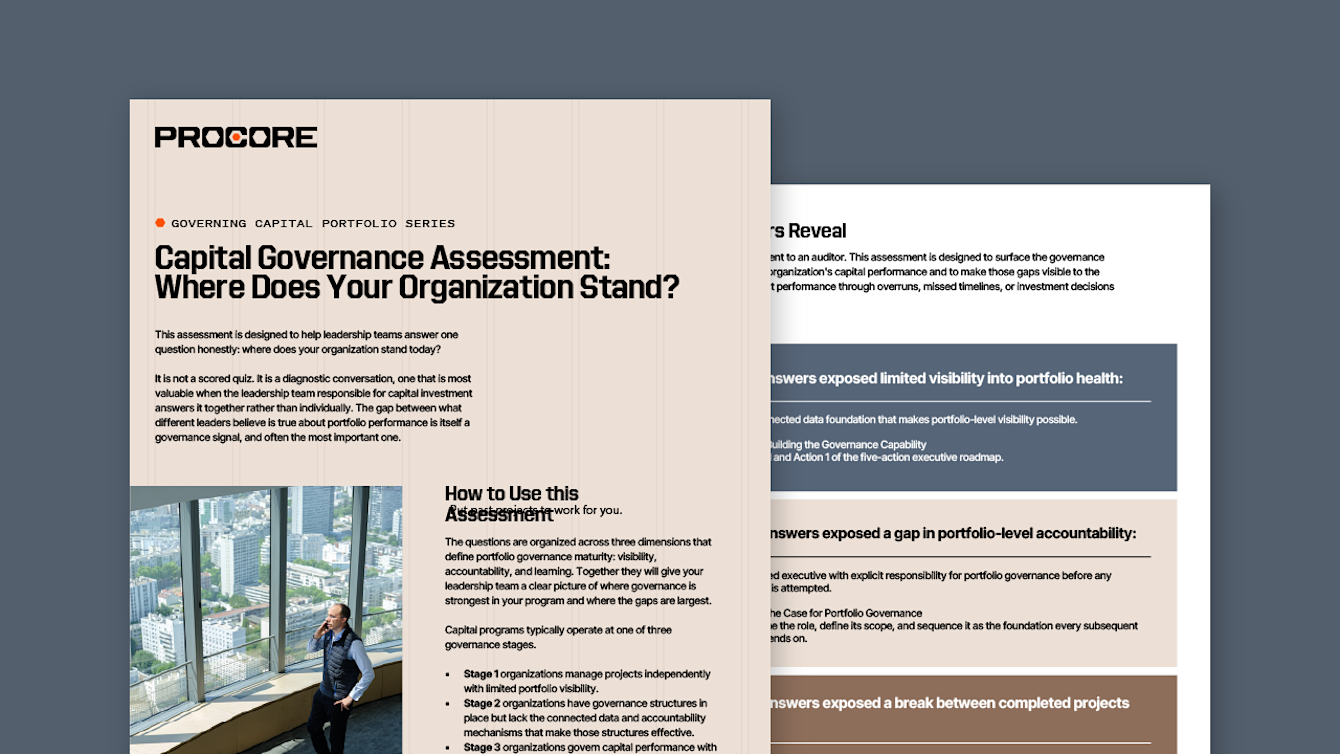
Take the Capital Governance Assessment
Get clear, unfiltered view of where your program stands today -- and the obstacles preventing predictable outcomes at scale. Take the Capital Governance Assessment to identify the hidden gaps in the way your capital program is governed across visibility, accountability, and learning.
this is part of the series
The 3 Pillars of Portfolio Governance
Was this article helpful?
Scroll less, learn more about construction.
Subscribe to The Blueprint, Procore’s construction newsletter, to get content from industry experts delivered straight to your inbox.
By clicking this button, you agree to our Privacy Notice and Terms of Service.
Categories:
Written by
Tiffany LaBruno
Strategic Industry Advisor | Procore Technologies
Tiffany LaBruno serves as a Strategic Industry Advisor at Procore, where she amplifies the voice of Owners across the organization. A recognized subject matter expert in Owner market needs and technology adoption, she partners with product and technology teams to shape Procore’s platform strategy and innovation roadmap. Tiffany is a passionate advocate for harnessing data intelligence and AI to drive the next era of data-driven evolution in construction. With more than two decades of experience advising both public and private Owner organizations, Tiffany has led strategic initiatives in process optimization, program controls, PMIS modernization, and Next-Generation Digital Twin platform implementation. Her career reflects a deep commitment to advancing transparency, collaboration, and performance through technology across the built environment.
View profileExplore more helpful resources

Does your asset management workflow actually work?
Every fixed asset installed on a project generates data long before handover. Is your team capturing it as it happens, or scrambling to reconstruct it after the fact? That question...
From spec book chaos to single source of truth
Picture this: An expansion is going in directly beside a high-volume line that cannot stop producing. Structural steel lands in March, mechanical completion is promised for August, and your only...
The hidden risk of relying on your EPC partner for project visibility
Many owners have thought some version of “We don’t need a capital project management platform — our EPC partner manages all of this for us.“ It’s a reasonable position. Your...

Why manufacturing owners are still managing capital projects like it’s 2010
There is a machine on your plant floor right now that knows it’s going to break. A sensor is reading a vibration signature on a bearing about three weeks before...
Free Tools
Calculators
Use our calculators to estimate the cost of construction materials for your next project.
Templates
Find a template to help you with your construction project tasks.
Material Price Tracker
Get the latest U.S. retail prices and view historical trends for common building materials.
Glossary
Explore key terms and phrases used in the industry.