
AI Construction Tools: Optimizing Every Stage of Construction

Last Updated Dec 12, 2025
Julia Tell
Contributing Writer
79 articles
Julia Tell is a freelance writer covering education, construction, healthcare, and digital transformation. She holds a Ph.D. in Media & Communications and has written for publications including Business Insider, GoodRx, and EdSurge, as well as nonprofits, international businesses, and educational institutions.
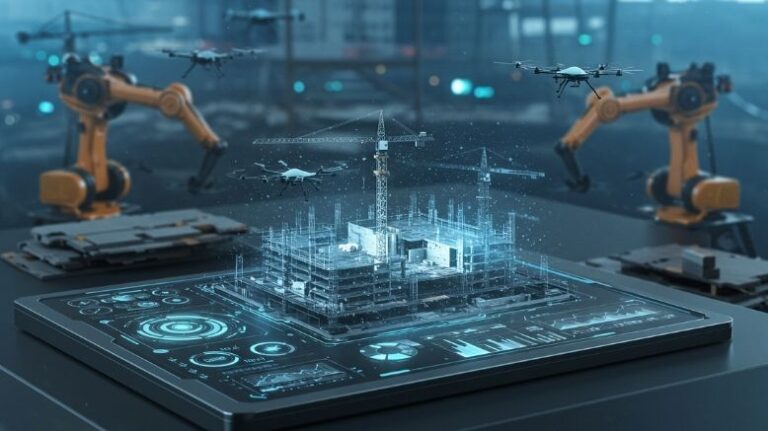
Builders, like everyone else, are being bombarded with information about incorporating AI into their work. However, determining which areas to automate can be challenging. This article explores the features of AI construction tools and how to apply these technologies to improve construction management.
Table of contents
Understanding AI Construction Tools
Remaining competitive in construction requires contractors to stay current with best practices, which now means implementing AI construction software. Clients expect companies to use technology to complete complex projects efficiently and to the highest quality standards.
The digitization of construction benefits owners once structures are operational, as construction data can simplify facility management, which, in turn, enhances a builder’s reputation long after project completion.
AI construction tools are specialized applications that leverage artificial intelligence to automate, optimize and enhance various aspects of construction projects. These tools are designed to address complex processes, streamline tasks, analyze data, and improve pre-construction, execution and post-construction phases.
Key Features of AI Construction Tools
Machine Learning (ML)
AI construction tools use ML algorithms to learn from historical data, identify patterns, and make predictions. This capability helps optimize schedules, resource allocation and risk management.
Natural Language Processing (NLP)
NLP empowers these tools to process and understand human language, which supports better communication and documentation, helping with contracts, project documentation and stakeholder communications.
Predictive Analytics
By analyzing vast amounts of data, AI tools can anticipate potential issues, such as cost overruns or project delays, allowing teams to take proactive measures.
Construction tools powered by AI can automate labor-intensive tasks, enhance decision-making, minimize errors and streamline operations. These tools automate repetitive tasks like data entry, provide data-driven insights for better decision-making, reduce human error, and optimize project timelines and resource use.
They can also monitor sites and safety, reducing risks for companies and the public.
Applications for AI Construction Tools
AI construction tools are revolutionizing various functions by automating tasks, boosting team efficiency, and improving accuracy. Below are some key categories where AI is making a significant impact.
Preconstruction and Estimating
AI automates early-stage tasks such as quantity takeoff and bid management. This dramatically improves accuracy and can cut weeks off the preconstruction timeline, reducing the potential for human error and ensuring that projects start on the right foot.
Design and Planning Tools
Modern design tools powered by AI streamline workflows and deliver actionable insights during early project stages. Building Information Modeling (BIM) platforms now integrate AI algorithms to predict construction costs and optimize design layouts based on project constraints. This enhances design efficiency and keeps projects within budget while meeting all necessary specifications.
Construction software integrated with BIM, real-time data analytics, and AI is rapidly becoming the industry standard. These platforms act as centralized command centers — offering real-time visibility into budgets, schedules, subcontractor activity, procurement and more. With the ability to analyze over 250 terabytes of project data monthly, construction teams can uncover patterns, flag risk areas and make data-informed decisions across the entire lifecycle.

Scott Bornman
Principal, Operational Excellence
Procore Technologies
Project Management Solutions
AI-driven solutions can help simplify complex project coordination and make management seamless across teams. Dynamic scheduling software adjusts timelines in real time based on progress updates, supply chain disruptions, and weather forecasts. This adaptability and project visibility help keep projects on track despite unforeseen changes, improving overall project management efficiency.
Financial Management
AI tools can automate cost tracking and financial reporting, providing real-time insights into expenses. More accurate budget forecasts improve decision-making, resulting in significant cost savings. By streamlining accounting processes, AI keeps financial data consistently up to date, reducing errors and improving overall budget management.
Scheduling and Planning
Advanced algorithms analyze vast datasets from thousands of projects to create optimized schedules and predict potential delays. These tools identify critical path dependencies and impacts from shortages or weather impacts that human planners might miss.
Field Management and Site Monitoring
Managing a construction site efficiently requires real-time insights, accurate, up-to-the-minute documentation, and seamless communication between teams. AI construction site monitoring tools give a new level of visibility — allowing for improvements in safety and more streamlined progress tracking.
Supply Chain Management and Procurement
AI tools optimize procurement processes by forecasting demand, analyzing supplier performance and managing inventory levels. This leads to more efficient supply chains, reducing waste, and helping make sure the right materials are available exactly when needed.
Safety for Workers On-site
Real-time monitoring, IoT devices, and predictive analytics significantly enhance worker safety on construction sites. Wearable devices equipped with AI can track worker movements and vital signs, alerting supervisors to potential hazards or health issues.
AI-driven surveillance systems can identify unsafe practices or conditions, allowing for immediate corrective actions to prevent accidents.
Proactive Equipment Maintenance
AI-driven predictive maintenance tools monitor construction equipment in real time, analyzing sensor data to predict potential failures before they occur.
By identifying wear and tear early, these tools enable timely maintenance, reducing unexpected breakdowns and extending machinery's lifespan. This proactive approach minimizes downtime, keeping equipment always ready for use and improving overall project efficiency.
Operating Robotic Equipment
Robotic equipment powered by AI can perform repetitive or hazardous tasks—such as bricklaying, welding and demolition—with precision and consistency. AI algorithms allow these machines to adapt to changing environments and optimize their operations in real time. By taking on labor-intensive tasks, robotic equipment enhances productivity and reduces human exposure to dangerous conditions.
When we think about how robotics actually works on a jobsite, what is making it more relevant, acceptable, and flexible is the incorporation of AI into those robotics.

Kris Lengieza
Vice President, Global Technology Evangelist
Procore Technologies
Benefits of AI Tools in Construction
AI construction tools are not just theoretical advancements; they are delivering tangible results that directly impact profitability, safety, and project outcomes. Here are some specific benefits companies can expect.
Increased Efficiency
AI automates time-consuming manual tasks that previously required hours or days to complete. Advanced scheduling algorithms can evaluate thousands of scenarios simultaneously, identifying the optimal resource allocation in seconds rather than days.
This rapid analysis allows construction managers to make quick, informed decisions that keep projects on schedule and within budget.
Cost Reduction
By identifying potential issues before they become costly problems, AI helps prevent the budget overruns that often affect construction projects. Predictive scheduling tools can flag potential delays weeks in advance, enabling teams to proactively adjust resources. This foresight minimizes disruptions and keeps projects financially on track.
Enhanced Safety
Computer vision systems can identify safety hazards faster and more consistently than human observers. Real-time monitoring detects missing personal protective equipment (PPE), unsafe working conditions, physical hazards, and potential accident scenarios before incidents occur.
Data-Driven Insights
Construction projects generate massive amounts of data that often go unused. AI tools transform this raw information into actionable insights that improve project performance. Performance analytics identify inefficiencies in workflows, allowing teams to optimize processes on future projects and continually improve efficiency and effectiveness.
Using AI for construction management uncovers efficiencies across all phases of construction, driving improvements that are both practical and profitable.
Free AI in Construction Course with Hugh Seaton
Start learning today with industry expert Hugh Seaton and discover how AI can boost efficiency, reduce risk, and transform your projects.

The Future of AI Construction Tools
As the construction industry continues to embrace technological advancements, emerging technologies are set to revolutionize traditional practices, bringing about more innovative and data-driven approaches that AI can aid.
Autonomous robots and drones are already revolutionizing tasks such as site surveying, material transportation, and bricklaying, reducing human error and boosting productivity and safety. And AI-powered predictive maintenance tools are becoming more advanced, extending machinery lifespans and lowering costs.
The future of AI construction tools is marked by increased automation, more precise builds, better communication and collaboration — a new era where teams can work smarter, not harder.
Was this article helpful?
Scroll less, learn more about construction.
Subscribe to The Blueprint, Procore’s construction newsletter, to get content from industry experts delivered straight to your inbox.
By clicking this button, you agree to our Privacy Notice and Terms of Service.
Categories:
Written by
Julia Tell
Contributing Writer | Procore Technologies
79 articles
Julia Tell is a freelance writer covering education, construction, healthcare, and digital transformation. She holds a Ph.D. in Media & Communications and has written for publications including Business Insider, GoodRx, and EdSurge, as well as nonprofits, international businesses, and educational institutions.
View profileExplore more helpful resources

Does your asset management workflow actually work?
Every fixed asset installed on a project generates data long before handover. Is your team capturing it as it happens, or scrambling to reconstruct it after the fact? That question...

From spec book chaos to single source of truth
Picture this: An expansion is going in directly beside a high-volume line that cannot stop producing. Structural steel lands in March, mechanical completion is promised for August, and your only...
The hidden risk of relying on your EPC partner for project visibility
Many owners have thought some version of “We don’t need a capital project management platform — our EPC partner manages all of this for us.“ It’s a reasonable position. Your...

Why manufacturing owners are still managing capital projects like it’s 2010
There is a machine on your plant floor right now that knows it’s going to break. A sensor is reading a vibration signature on a bearing about three weeks before...
Free Tools
Calculators
Use our calculators to estimate the cost of construction materials for your next project.
Templates
Find a template to help you with your construction project tasks.
Material Price Tracker
Get the latest U.S. retail prices and view historical trends for common building materials.
Glossary
Explore key terms and phrases used in the industry.