
Understanding the types of road construction equipment


Last Updated May 18, 2026
Julia Tell
Contributing Writer
79 articles
Julia Tell is a freelance writer covering education, construction, healthcare, and digital transformation. She holds a Ph.D. in Media & Communications and has written for publications including Business Insider, GoodRx, and EdSurge, as well as nonprofits, international businesses, and educational institutions.
Tamara Aspeling
Writer & Construction Estimator
16 articles
Tamara Aspeling is a trained construction estimator and project manager with 25 years of industry experience. She started writing professionally in 2008 and has since written extensively for the construction industry, including publications like Modular Advantage magazine. She is also a traditionally published nonfiction author and the owner of The Construction Writer Inc. Tamara studied at Western Province Technical College in South Africa and completed her national certificate in 1999. She also holds an SEO Certification from Google and a Content Marketing Certification from HubSpot.
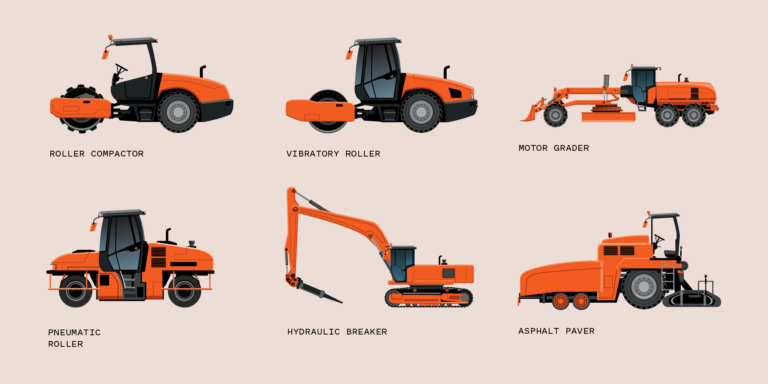
Although roadway construction may appear straightforward, it involves precise engineering and processes that require specialized equipment beyond that typically used for other projects. This article will explore the various types of paving and road-building equipment by category and type, their uses, and how to choose and manage this equipment.
Table of contents
Choosing and Managing Road Construction Equipment
The process of preparing for, building, surfacing, and maintaining something that is exposed to the elements and to enormous moving forces every day is every bit as complex as any high-rise, and these projects actually require a wide variety of construction equipment at each stage.
Road building projects vary in type and size, so choosing the right equipment can save time and money. Companies can flexibly expand their road construction equipment with rentals as business in this specialized trade fluctuates or increases. Rentals also provide a way to field-test equipment to determine what works best before purchasing.
Whether they buy or rent, companies undertaking road-building projects will almost certainly require a wide range of machines, sometimes in varying sizes and with specialist capabilities and accessories.
To determine the appropriate equipment, consider the features, power and capacity in relation to the size and scope of upcoming projects. Many pieces of equipment can be fitted with attachments, so standard construction machines with specialized accessories can be used in roadway construction to save costs. However, paving generally requires machinery explicitly designed for that function.
Construction management software offers planning and resource management modules that help track road construction equipment needs, placement and the workers required to operate it. Whether rental or company-owned roadway equipment, a central and accessible software solution can help contractors schedule work and equipment efficiently and cost-effectively.
Construction equipment commonly used in roadway construction
Road construction happens in layers, and while many of the machines and road construction equipment used to build those layers are also used in other types of construction, some are unique to this highly specialized process.
Likewise, many pieces of road maintenance equipment are essential for keeping roads in good condition and extending their usable lifespan.
Most of this equipment falls into one of several broad categories.
Earthmoving and clearing land: Heavy construction equipment for roads
The first step in building any new road is to prepare the road route. This is a process that often includes vegetation clearing, cut-and-fill, and other earthworks, and usually involves moving large amounts of dirt from one place to another.

The road construction equipment used in this part of the building process is usually large and powerful, and designed to make the process of preparing the foundation for the road as fast, easy, and accurate as possible. Some of the common earthmoving and clearing equipment used to build roads include:
Bulldozers
Bulldozers are used for soil excavation and to push weak soil or rock strata to level the road area. This type of earth-moving equipment ranges from smaller machines weighing about 15,000 lbs to enormous 200,000 lb versions used in mining. When used as road construction equipment, bulldozers are typically between 25,000 and 100,000 lbs, but even these smaller units can move tons of material in a matter of minutes.
Excavators
Excavators are versatile heavy construction equipment used primarily for digging and removing earth and rocks. They are also sometimes used for heavy lifting, hauling, demolition, and clearing brush.
Backhoes
Backhoes are versatile tools for excavating, loading materials, breaking up asphalt, digging up trees, and minor demolition. These versatile machines feature both a front bucket and a rear-mounted digging arm, making them among the most useful, multifunctional pieces of road-building equipment.
Scrapers
Wheel tractor scrapers are used to level surfaces and have a sharp blade and conveyor belt to collect material. They can spread or remove large amounts of material and increase efficiency.
Trenchers
As the name suggests, trenchers dig trenches for cables or pipes, and they can also dig trenches for drainage of roadways. Because road builders often have to work closely with utility structures, trenchers are common on road projects.
Grading and compacting: Achieving smoothness with compaction and paving equipment
Some of the most important work in constructing roads happens under the surface. But just because you can’t see it doesn’t mean it’s not critical to well-built, durable roads.
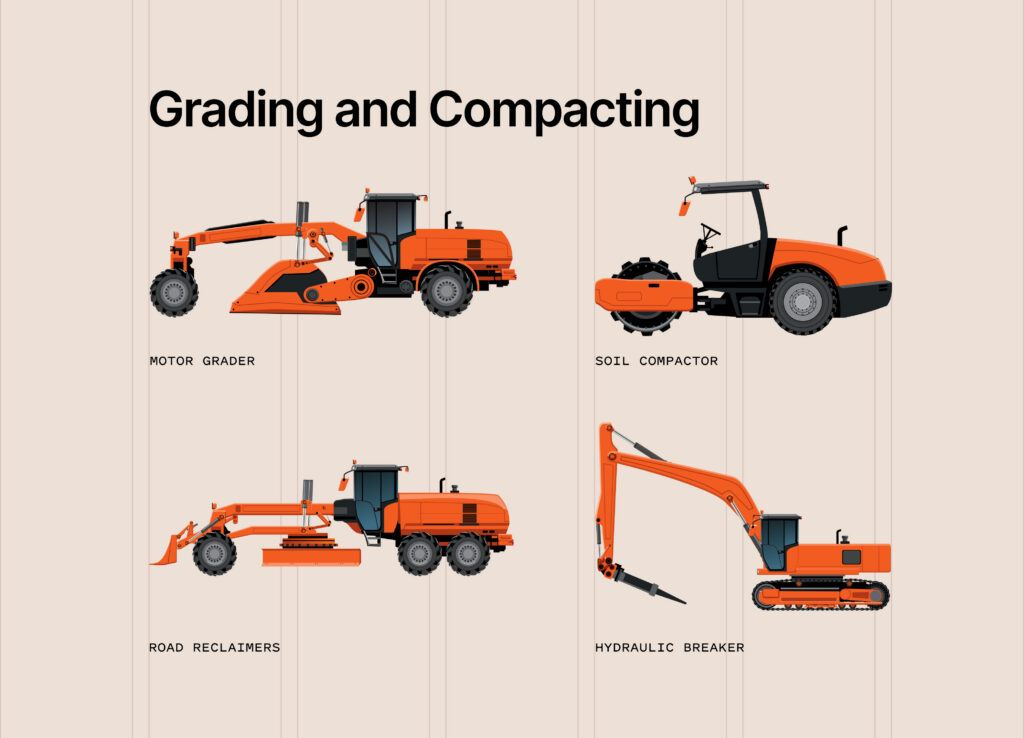
Grading and compacting equipment is used to spread sub-base and base materials and then to compact them to the required density for road construction.
This is an important step in the process because those base layers act as a foundation and do most of the heavy lifting roads are required to handle day in and day out. Some of the equipment used to complete this part of the process includes:
Motor graders
Motor graders — also called road graders — are used for leveling surfaces. They have a blade between the front and rear wheels that is lowered to flatten the soil surface.
Soil compactors
Soil compactors are used to compact dirt to prepare for laying the roadway. Various other types of rollers are used to compact gravel, crushed rock and sand. Pneumatic tire compactors, rubber tire rollers and vibratory rollers are the types most suited to smoothing asphalt.
Hydraulic breakers
Hydraulic breakers are attachments to excavators that break up concrete or asphalt for demolition. They are sometimes called percussion hammers and can also break up rocks or large obstacles.
Road reclaimers
Road reclaimers pulverize the existing asphalt layer and mix it with the underlying base to create a stable, rejuvenated roadway. Sometimes, asphalt binders, emulsions, or cement are added to the mix.
Paving and construction equipment: machines for building and surfacing
Once a solid base has been laid, graded, and compacted, it’s time to add a durable surface to the new road under construction.
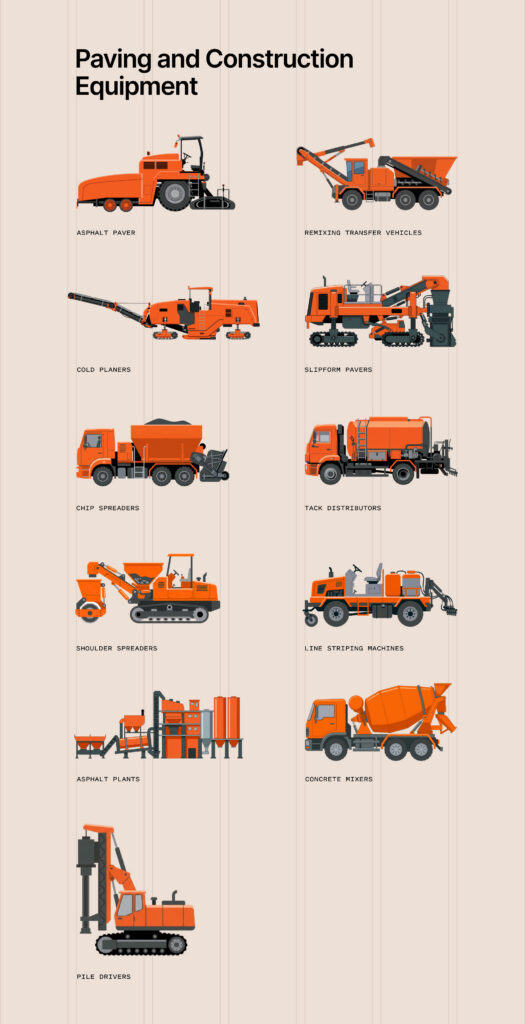
That usually means concrete, asphalt, or both, and there is some specialized equipment that does that, as well as other equipment for road marking and finishing.
Those often include:
Asphalt pavers
Asphalt pavers, also called asphalt finishers, distribute the asphalt layer evenly and provide initial compaction. Dump trucks continuously load asphalt to the hopper of the paver, where it is then moved by a conveyor belt, spread onto the roadway, and flattened.
Remixing transfer vehicles
Remixing transfer vehicles are sometimes used to actively remix asphalt between the dump truck and the paver for temperature uniformity. This creates a smoother and more consistent roadway surface.
Cold planers
Sometimes also called milling machines, cold planers are designed to remove the top layer of asphalt or concrete to create a level, textured roadway surface. The roadway can be opened to traffic before a new asphalt layer is applied.
Slipform pavers
Slipform pavers continuously mold concrete through extrusion to form curbs, gutters, medians, barriers and roadways. They create neat, uniform structures and can reduce the need for manual labor.
Chip spreaders
Chip spreaders distribute a layer of gravel or crushed stone over a freshly applied layer of asphalt or tar to create a chip seal surface, providing skid resistance and waterproofing.
Tack distributors
Tack distributors, also called tack trailers, spread a thin layer of asphalt emulsion to bind old and new road surfaces together to make road surfaces more durable.
Shoulder spreaders
Shoulder spreaders are usually attached to a loader, skid steer or grader and used to distribute and grade asphalt or aggregate on the shoulder of a roadway.
Line striping machines
Line striping machines apply paint for traffic direction, parking lot lines and other pavement markings.
Asphalt plants
For large projects, an on-site asphalt plant can mix and heat asphalt, aggregates, and additives precisely for the type of blacktop needed.
Concrete mixers
Concrete mixers are used in roadway construction to mix cement, water and aggregate to form roadways, sidewalks and curbs.
Pile drivers
Pile drivers help create stable foundations for roadways and bridges by driving piles into the ground to support heavy loads and withstand environmental challenges.
Material handling and compact equipment
Throughout the road construction process, a long list of equipment is used to move and handle materials, as well as smaller machines that can fit into spaces where large loaders, excavators, and other heavy equipment might not.
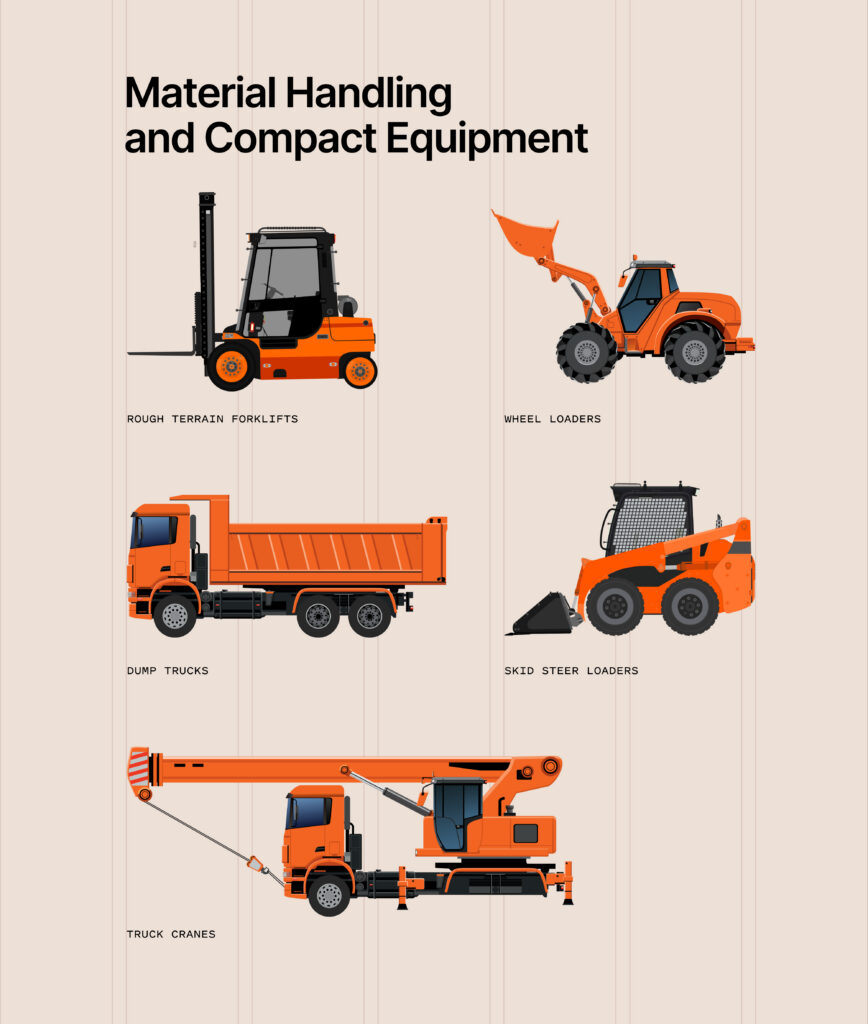
These include:
Rough terrain forklifts
Forklifts move heavy materials around a site, and rough terrain forklifts are especially useful on road construction sites to move materials or equipment on uneven surfaces.
Wheel loaders
Wheel loaders move soil, rock and other materials around the roadway site, depositing larger loads into dump trucks. These machines can be used with a variety of accessories and attachments, and are surprisingly maneuverable for their size.
Skid steer loaders
Skid steer loaders are versatile machines that can be fitted with attachments for demolition, grading and paving in roadbuilding projects. Unlike some of the other road construction equipment mentioned here, skid steer loaders are small and nimble, allowing them to work in tight quarters when necessary.
Truck cranes
Truck cranes are used in road building to lift and move concrete barriers, signage, and other infrastructure. They can also position heavy construction equipment, such as pavers and rollers.
Dump trucks
Dump trucks move demolition debris, soil, rocks and other materials around the site and remove them from the area.
The Road Construction Process Simplified
After planning and preconstruction, the active phases of road construction can begin; this is where road-building equipment comes into play. Here is a summary of the process.
Site preparation
Before digging and leveling the surface for a roadway, vegetation, debris and any other obstructions must be cleared from the site. Earthworks and excavation then shape the level surface to place the roadway.
Aggregate placement
Next is creating a stable base for the road. Aggregate, which consists of crushed stone or gravel, is placed on top of the leveled subgrade and compacted to ensure road stability.
Paving and drainage
Placing the top layer of the road requires making the correct mixture of concrete or asphalt and then laying and smoothing the pavement. Proper drainage makes roadways safe to drive on, so placing gutters, curbs and storm drains can direct water away from the road.
Additional steps may include lighting, signage, sidewalks and markings. Each step requires a mix of equipment types, and the specifications of the project roadway will help determine the number and capacity of equipment appropriate to complete the work.
Effective site logistics help manage the movement and placement of equipment during the build to support a safe and productive working environment.
Courses about construction.
For construction.
Unlock your career potential with our free educational courses on Health & Safety, Data in Construction, and more.

Advancements in road construction equipment and processes
Automation promises to increase productivity and accuracy while reducing costs and time in road construction. Geolocation and digital models may soon help automate more road construction equipment and make managing and overseeing the construction process more efficient. With GPS, machinery can operate in precise locations to construct roadways and other infrastructure accurately.
Advancements in semi-autonomous equipment can allow one operator to control multiple machines, requiring fewer workers and decreasing site risk and expense. Prototypes are being tested, but labor shortages in the industry may compel wider adoption of this technology in the near future.
Digitization and analytics are poised to impact road design and construction. Sensors can monitor traffic and roadway conditions for predictive maintenance. In addition, software platforms incorporating AI are shifting the construction process toward greater efficiency, upending traditional workflows. Advanced materials like plastic can improve road strength but may require changes in the equipment and process used to lay down roads.
Understanding the array of equipment used in road construction can be valuable for companies looking to expand their capabilities or collaborate effectively on projects involving roadways. With the high demand for new and upgraded infrastructure, particularly roads and bridges, efficient site management can improve productivity in roadway construction.
Was this article helpful?
Scroll less, learn more about construction.
Subscribe to The Blueprint, Procore’s construction newsletter, to get content from industry experts delivered straight to your inbox.
By clicking this button, you agree to our Privacy Notice and Terms of Service.
Categories:
Written by
Julia Tell
Contributing Writer | Procore Technologies
79 articles
Julia Tell is a freelance writer covering education, construction, healthcare, and digital transformation. She holds a Ph.D. in Media & Communications and has written for publications including Business Insider, GoodRx, and EdSurge, as well as nonprofits, international businesses, and educational institutions.
View profileTamara Aspeling
Writer & Construction Estimator
16 articles
Tamara Aspeling is a trained construction estimator and project manager with 25 years of industry experience. She started writing professionally in 2008 and has since written extensively for the construction industry, including publications like Modular Advantage magazine. She is also a traditionally published nonfiction author and the owner of The Construction Writer Inc. Tamara studied at Western Province Technical College in South Africa and completed her national certificate in 1999. She also holds an SEO Certification from Google and a Content Marketing Certification from HubSpot.
View profileExplore more helpful resources

Does your asset management workflow actually work?
Every fixed asset installed on a project generates data long before handover. Is your team capturing it as it happens, or scrambling to reconstruct it after the fact? That question...

From spec book chaos to single source of truth
Picture this: An expansion is going in directly beside a high-volume line that cannot stop producing. Structural steel lands in March, mechanical completion is promised for August, and your only...
The hidden risk of relying on your EPC partner for project visibility
Many owners have thought some version of “We don’t need a capital project management platform — our EPC partner manages all of this for us.“ It’s a reasonable position. Your...

Why manufacturing owners are still managing capital projects like it’s 2010
There is a machine on your plant floor right now that knows it’s going to break. A sensor is reading a vibration signature on a bearing about three weeks before...
Free Tools
Calculators
Use our calculators to estimate the cost of construction materials for your next project.
Templates
Find a template to help you with your construction project tasks.
Material Price Tracker
Get the latest U.S. retail prices and view historical trends for common building materials.
Glossary
Explore key terms and phrases used in the industry.