
Bridging the knowledge gap: Replacing fragmented legacies with a single source of truth

Last Updated Apr 17, 2026
Marlissa Collier
42 articles
Marlissa Collier is a journalist whose work focuses on the intersections of business, technology, policy and culture. Her work has been featured in digital and print formats with publications such as the Dallas Weekly, XO Necole, NBCU Comcast, the Dallas Nomad, CNBC, Word in Black and Dallas Free Press. Marlissa holds an undergraduate degree in Construction Engineering from California State University, Long Beach and an MBA from Southern Methodist University’s Cox School of Business.

The "Silver Tsunami" of retiring veteran construction professionals is reaching its peak, and the industry is losing decades of specialized institutional knowledge. This article is part of a series exploring how specialty contractors can leverage digital foundations to capture this vanishing expertise — and even turn this demographic shift into a lasting competitive advantage.
The construction industry is facing a demographic shift that has the opportunity to redefine how projects are run. A wave of retirements among veteran superintendents, project managers, estimators, and financial controllers is taking decades of jobsite knowledge with it.
For specialty contractors, this isn’t just a staffing challenge — it’s almost a certain knowledge crisis. When seasoned employees exit, firms lose “head-knowledge," also known as the tacit understanding of processes, subcontractor nuances, and site-specific best practices that aren’t captured in drawings, spreadsheets, or manuals.
The solution? A single source of truth that transcends time and that remains accessible even after the original experts depart.
Table of contents
The crisis of head-knowledge
Veteran project leaders often act as walking and talking archives. They know why one detail was value-engineered, which subcontractor always needs extra oversight, or which inspection sequence will more than likely prevent costly rework.
That kind of wisdom comes through time and trial by fire, and it’s stored in human memories rather than encrypted memory cards. So when these professionals retire, that context often disappears with them. As a result, new teams inherit stacks of sticky notes, binders, fragmented spreadsheets, and scattered emails.
But what doesn’t transfer is the reasoning behind past decisions. Guesswork in these scenarios can easily lead directly to errors and costly rework. Several industry studies show that poor information flow contributes significantly to rework, costing the U.S. construction industry billions annually. I
n other words, the brain drain that comes with the Silver Tsunami is costly. But documentation and information tracking can help.
The fragmented process trap
One issue is that many specialty contractors still rely on outdated, fragmented processes. One superintendent may have binders stored on trailers, another may use localized spreadsheets, while a third’s documented knowledge sits in siloed inboxes that often serve as project records.
While they may work for the individual project czars, these approaches are bound to fail when the employee who “owns” the knowledge leaves. A spreadsheet without context is just numbers. An email thread without the backstory is indecipherable. Physical binders show outcomes but rarely the reasoning behind decisions.
This fragmentation of information doesn't just increase the likelihood of rework — it slows onboarding and reduces productivity, creating an urgent risk as the labor market and competition tighten.
From 'tribal knowledge' to a single source of truth
The solution lies in creating a single source of truth (SSOT). The idea is to centralize project intelligence, including documents, decisions, communications, and financials, into one accessible, searchable system.
Digital common data environments (CDEs) make sure knowledge outlasts individual employees. When drawings, RFIs, submittals, daily logs, and budgets reside in one cloud-based platform, project history becomes durable and accessible, regardless of personnel.
SSOT platforms do more than store files. Configurable to their client’s needs, SSOT platforms can create a searchable audit trail, documenting why each decision was made, who approved changes, and when updates occurred.
All of a sudden, new project managers can understand prior choices instead of guessing, foremen can trace instructions back to their source, and leadership gains visibility into patterns and risks across multiple projects.
Digital centralization transforms “tribal knowledge” into institutional intelligence, allowing firms to scale without losing the benefits of veteran experience.
Case in point: Faulconer Construction centralized its field and office data, enabling project leads to track changes in real time and reducing delays caused by miscommunication. Meanwhile, RDP Electric leveraged similar systems to preserve institutional knowledge across crews, streamline communication, and capture decisions in a searchable history, effectively preventing repeated errors across projects.
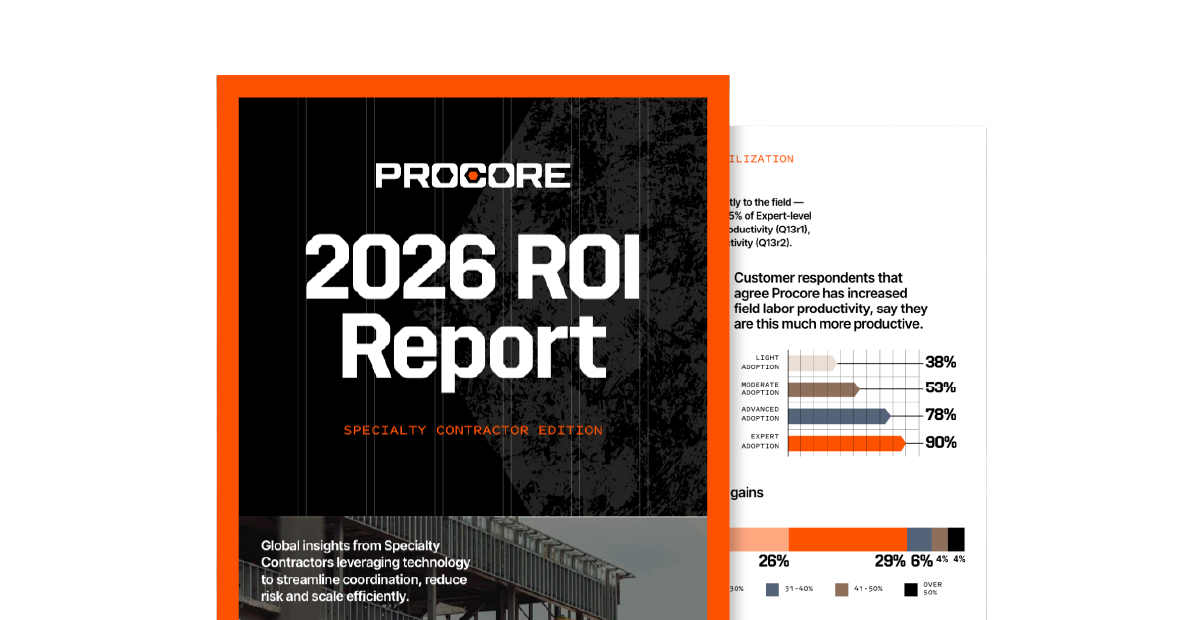
Turn tech adoption into real ROI.
In this exclusive 2026 ROI report from Procore and Dodge Analytics, learn the strategies of top specialty contractors who are achieving measurable gains through data ownership, management, and analysis.
Preserving knowledge through digital centralization
The construction sector is facing a hard truth: The Silver Tsunami is inevitable. People are aging out of the industry. But the impact of the tsunami doesn’t have to be catastrophic for contractors. Firms are learning that capturing knowledge digitally preserves continuity, protects margins, and reduces the hidden costs of rework.
By embracing a single source of truth, specialty contractors are making sure institutional memory survives turnover, creating a resilient foundation for growth in the years to come.
In a market reshaped by the Silver Tsunami, contractors who are opting into adopting digital field productivity solutions aren’t just surviving; they’re gaining a competitive advantage. The tech isn’t replacing experience — it’s amplifying it.
this is part of the series
The Construction Silver Tsunami
Was this article helpful?
Scroll less, learn more about construction.
Subscribe to The Blueprint, Procore’s construction newsletter, to get content from industry experts delivered straight to your inbox.
By clicking this button, you agree to our Privacy Notice and Terms of Service.
Categories:
Written by
Marlissa Collier
42 articles
Marlissa Collier is a journalist whose work focuses on the intersections of business, technology, policy and culture. Her work has been featured in digital and print formats with publications such as the Dallas Weekly, XO Necole, NBCU Comcast, the Dallas Nomad, CNBC, Word in Black and Dallas Free Press. Marlissa holds an undergraduate degree in Construction Engineering from California State University, Long Beach and an MBA from Southern Methodist University’s Cox School of Business.
View profileExplore more helpful resources

Does your asset management workflow actually work?
Every fixed asset installed on a project generates data long before handover. Is your team capturing it as it happens, or scrambling to reconstruct it after the fact? That question...

From spec book chaos to single source of truth
Picture this: An expansion is going in directly beside a high-volume line that cannot stop producing. Structural steel lands in March, mechanical completion is promised for August, and your only...
The hidden risk of relying on your EPC partner for project visibility
Many owners have thought some version of “We don’t need a capital project management platform — our EPC partner manages all of this for us.“ It’s a reasonable position. Your...

Why manufacturing owners are still managing capital projects like it’s 2010
There is a machine on your plant floor right now that knows it’s going to break. A sensor is reading a vibration signature on a bearing about three weeks before...
Free Tools
Calculators
Use our calculators to estimate the cost of construction materials for your next project.
Templates
Find a template to help you with your construction project tasks.
Material Price Tracker
Get the latest U.S. retail prices and view historical trends for common building materials.
Glossary
Explore key terms and phrases used in the industry.