For the organizations that own and operate hospitals, data centers, and other complex facilities, project completion is just the beginning. A hospital needs to provide a safe, reliable environment for patient care. A data center’s value isn't measured when construction ends, but by its ability to reliably deliver the technology people depend on every day. Achieving that reliability requires more than a finished building. Facility teams need to understand how systems were designed and installed, what equipment is in place, and how to maintain it to keep operations running smoothly.
The payoff of capturing this information during construction shows up in daily operations. When each piece of equipment carries its commissioning baseline, warranty dates, and as-built location from the start, facility teams can make informed decisions without having to reconstruct an asset's history. A technician can pull an approved model and installation date instead of relying on a drawing that may be several revisions old. A facility manager who sees that a warranty expires in four months can schedule an inspection before the window closes. Individually, these may seem like small advantages. But in a data center where even an hour of unplanned downtime can be costly, knowing an asset's history rather than rediscovering it during an incident can mean the difference between a planned repair and an outage.
The challenge is that this information rarely follows the asset as seamlessly as it should.
By the time operations teams take over, critical knowledge captured during construction is often fragmented across:
Design files that no longer reflect what's been built
Construction records scattered across emails and disconnected systems
Closeout packages that can become outdated almost as soon as they're delivered
Procore is connecting the phases of managing these capital projects, from plan to build to operate, so owners can carry critical information across the entire asset lifecycle. Procore is evolving into a system of intelligence powered by Procore AI that helps teams see what's happening, understand risks, and act with confidence. The result is smarter decisions and a living record of the asset that continues delivering value long after construction ends.
Plan: Test decisions before construction begins
For owners, some of the most consequential decisions happen before construction begins. What to build, where to build it, and how to sequence the work can shape cost, schedule, and performance for years to come. Making those decisions requires a clear understanding of the project and the conditions that could affect it.
Procore helps owners bring the information they need into those decisions, from evaluating potential projects and sites to planning their delivery. Procore Model Manager brings 3D models and project information together to help teams understand a project before construction begins.
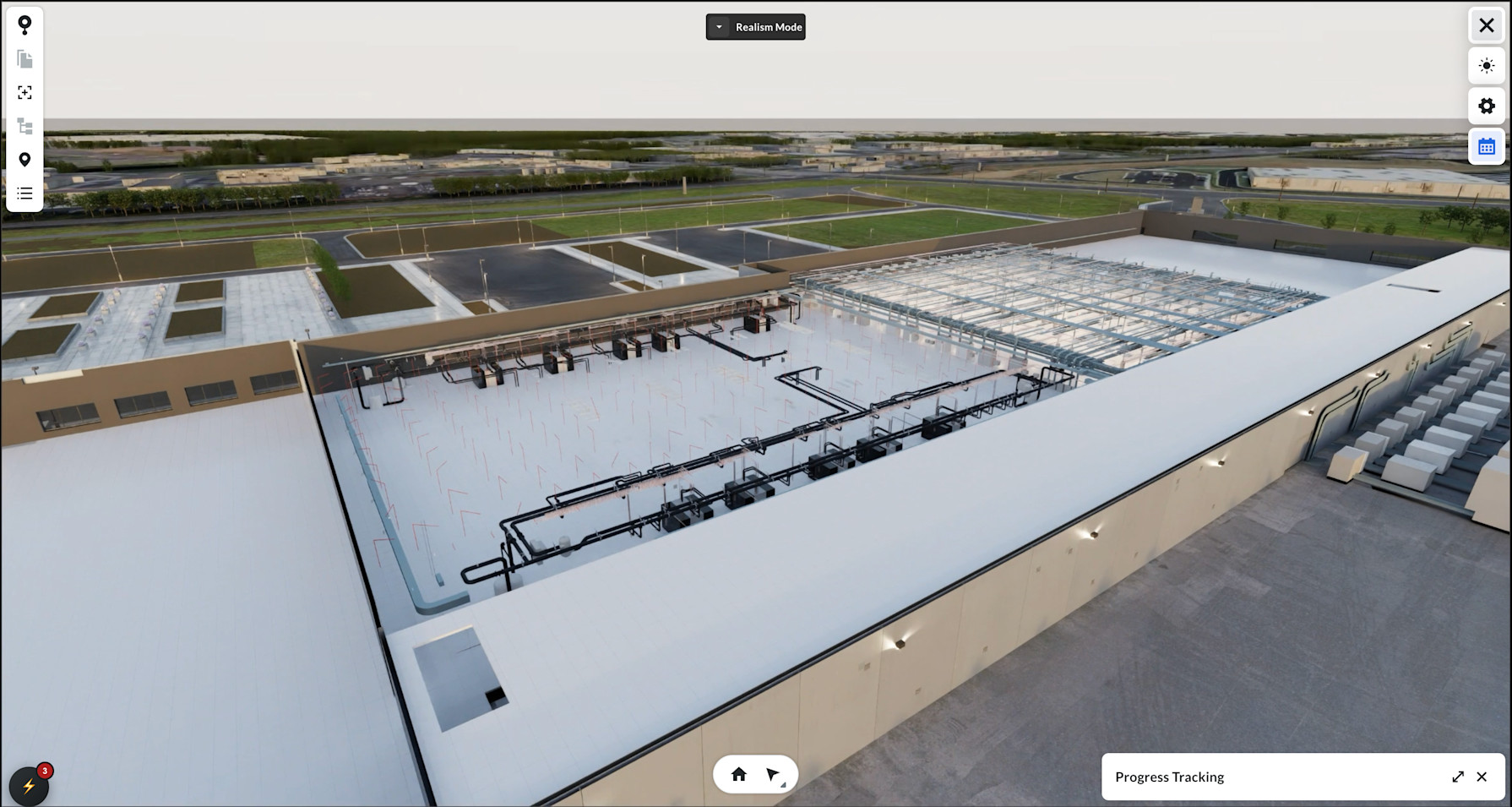
Our collaboration with NVIDIA adds another dimension. Currently in closed beta, teams can now move seamlessly between Procore’s Model Manager and Realism Mode, powered by NVIDIA Omniverse libraries, to visualize projects in a physically accurate 3D environment. Looking ahead, simulation capabilities could help teams explore how real-world conditions might affect construction before those scenarios unfold onsite.
Consider a complex data center project in which multiple trades need to work in the same confined space. Congestion between crews, equipment, and materials can create safety risks, disrupt sequencing, and delay critical installations. The ability to simulate these conditions virtually could help teams identify potential conflicts before they occur, coordinate work more effectively, and avoid costly rework and schedule delays.
Build: Connect the model to the real jobsite
Even the most detailed plan is only useful if teams can see how it compares with what is actually happening. On a large capital project, conditions change daily, and owners can't be everywhere at once.
This is where reality capture becomes critical, which is why Procore recently completed its acquisition of DroneDeploy. DroneDeploy uses drones, robots, and cameras to create a visual record of actual jobsite conditions, allowing teams to compare progress against what was designed. Owners gain greater visibility into what is being built, while project teams can identify discrepancies earlier, before they become more costly to address.
Consider a critical piece of equipment installed in a different location than originally planned. Without an accurate picture of what's happening onsite, that discrepancy might not surface until subsequent work is underway. Connecting reality capture with project models and records can help teams identify those differences earlier, understand their potential impact, and make adjustments before small issues become costly delays.
Operate: Keep construction information working
A building doesn't stop changing when construction crews leave. Equipment needs maintenance, systems are upgraded, and facilities evolve to meet new demands. Yet the teams responsible for keeping those buildings running often inherit surprisingly little of the knowledge accumulated during construction.
Procore Asset Management and Commissioning are designed to help build that operational record during construction, capturing critical asset information and verifying that systems are ready to perform as intended before handover. DroneDeploy’s reality capture adds another dimension, preserving visual information that would otherwise disappear as construction progresses. Imagine a maintenance team being able to see the pipes, electrical systems, or structural components hidden behind finished walls using images captured before they were enclosed. Years later, thermal inspections can help identify heat loss, moisture issues, or failing equipment before they lead to costly repairs. Together, these records give owners a clearer picture of what was built, how it's performing, and what needs attention.
That knowledge becomes even more valuable when connected to the systems used to operate and maintain a facility. Through its collaboration with IBM, Procore is working toward connecting Procore Asset Management with IBM Maximo Application Suite to help bring reliable asset information into ongoing operations. In the future, a technician servicing a critical cooling unit could access its installation history, inspection records, and warranty information without searching through years of disconnected documentation.
The opportunity is to turn construction information into operational intelligence, helping owners maintain facilities more effectively while making better decisions about upgrades and future capital investments. Over time, this connection could support a more continuous flow of information, with construction context informing operations and operational insights helping shape future renovations and capital projects.
One connected lifecycle
In a hospital, the systems behind the walls can be just as critical as the medical equipment inside them. From air filtration in operating rooms to backup power in intensive care units, the way a facility is built, maintained, and operated can directly affect patient safety. Knowing exactly what was installed, where it lives, and how it functions isn't just a matter of efficiency. It can be essential to delivering uninterrupted care.
Data centers face similarly high stakes. As demand for computing power accelerates, every day a facility remains offline represents lost capacity and potential revenue. In both environments, the ability to carry accurate information from construction into operations can have consequences far beyond the project schedule.
For owners, the real measure of a successful project isn't simply what gets built. It's how well that investment performs over the decades that follow. The era of the static building file is over. As AI, digital twins, and predictive analytics reshape facility operations, construction information must become living intelligence that owners can act on. When the data captured on day one of construction helps teams make better decisions on day 10,000, true lifecycle management begins. That's the future we're building at Procore.
The Procore and NVIDIA integration is currently in closed beta. Additional Procore spatial and asset capabilities, including Model Manager and Commissioning, are progressing through beta, alongside Procore’s planned integration with IBM Maximo.
Written by

SVP Product Management, Procore, Procore
Start growing with Procore today
With tools to make every part of your process more human and a support team excited to help you, getting started with any project has never been easier.