
Construction financial management 101

Last Updated May 4, 2026
Kristen Frisa
Contributing Writer
126 articles
Kristen Frisa is a contributing writer for Procore. She also contributes to a variety of industry publications as a freelance writer focused on finance and construction technology. Kristen holds a Bachelor of Arts in Philosophy and History from Western University, with a post-graduate certificate in journalism from Sheridan College. She lives in Ontario, Canada.

Construction projects have notoriously tight profit margins. As many working parts as a typical construction project has, managing limited resources, finances, and labor is a fine balancing act. Mastering these elements is critical to the success of the project.
This article will outline the different aspects of financial management in construction, provide insight into the role of finance managers, and discuss the types of construction finances.
Table of contents
What is construction financial management?
Construction financial management is the process of planning, monitoring, and controlling the money involved in a construction project. It encompasses budgeting and planning to establish project budgets and financial plans, as well as cost management to monitor and control expenses, ensuring projects stay within budget.
Because of construction’s many unique characteristics, financial management in this industry builds on the basic concepts known to business accountants to develop processes to handle the fluctuating costs and changing project scopes that consistently impact building projects.
The role of the construction financial manager
A construction financial manager is responsible for creating and executing the financial plan on a construction project. Success in construction hinges on successful financial management, including establishing budgets, assessing risks, and overseeing project spending, as well as managing communication with any financial stakeholders the project depends on.
A construction financial manager’s daily tasks revolve around financial oversight and strategic planning. They review financial reports, budgets, and project forecasts to ensure alignment with financial goals. They monitor cash flow and manage expenses, working closely with project managers to address any financial issues.
Further, financial managers communicate with stakeholders, preparing financial statements and reports to maintain transparency and informed decision-making.
Because of the many aspects of the role, construction financial managers need to be skilled in managing money, but also able leaders who can strategize, negotiate, and steer through complex scenarios that may arise on construction projects.
CFMA certification
Construction professionals hoping to become construction financial managers may come across the term “CFMA certification,” which refers to the Certified Construction Industry Financial Professional (CCIFP) designation.
CCIFP is a credential that financial professionals within the construction industry can earn to demonstrate their expertise and competence in construction financial management. The certification covers areas such as accounting, risk management, budgeting, cash management, and compliance specific to construction.
While earning the CCIFP designation signifies a high level of knowledge and commitment to the field, and may lead to increased credibility, it may not be necessary to become a construction financial manager.
Exploring key types of construction financial management
Financial management in construction goes beyond traditional financial management practices to encompass a great deal of strategic planning and profit maximization strategies.
Professionals in this field need to understand how to tailor financial management for the dynamic and often unpredictable nature of construction projects. Here are some of the responsibilities of the construction financial manager.
Budgeting and financial planning
One unique aspect of construction projects is their length. They can last for months or even years, and may be affected during that time by many kinds of external influences, including weather, elections, or policy changes.
Careful budgeting, regular reviews, and accurate cost estimations can all help construction teams to ensure projects are completed within financial constraints. Financial managers develop and maintain these budgets and forecast financial outcomes.
Cost control and management
Financial managers continuously monitor expenses to prevent cost overruns and ensure spending aligns with the budget, driving overall cost efficiency. This can include working with project managers on comprehensive resource management to optimize labor and significantly reduce waste and added costs.
On a day-to-day basis, construction financial managers help manage cash flow. Construction projects need enough cash on hand to pay out project expenses as they come. The financial manager handles cash inflows and outflows to maintain project liquidity.
Managing payroll
Labor costs are often among the largest expenses on construction projects, and one of the most complex expenses to manage. Most construction projects involve a diverse workforce, made up of full-time, part-time, and contract workers, all with varying pay rates and schedules.
Further complexity emerges as labor laws, union agreements, and tax regulations can differ by location and type of worker, and the workforce may be spread over multiple project sites.
Effective management of construction payroll helps maintain compliance while controlling labor costs by implementing best practices to manage labor costs effectively.
Procurement and supply chain finances
Effective procurement and supply chain management are vital for maintaining the financial health of construction projects.
Financial managers work to ensure strategic planning and execution so that materials, equipment, and services are purchased cost-effectively to balance cost and quality.
Free Download
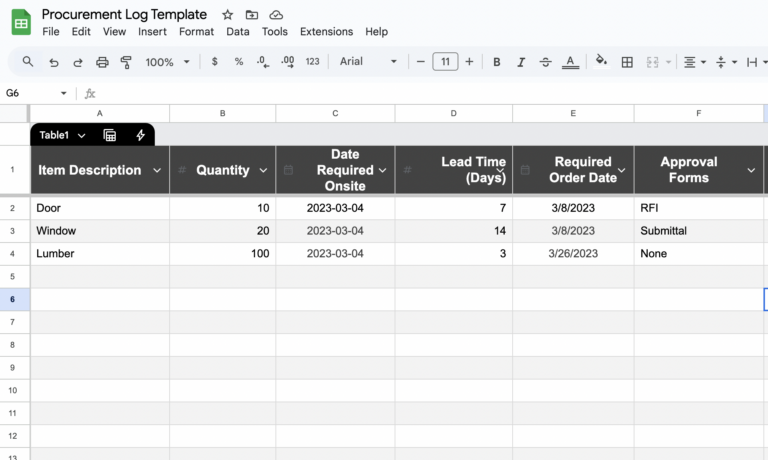
Construction Procurement Log Template
This free procurement log template can be downloaded to use in Excel or Numbers — and is customizable to fit any project.
- Free starter template
- Ready-to-use
- Created especially for construction
Project financial reporting and analysis
Financial managers put together accurate and timely financial reports and analyses to provide stakeholders with essential information for informed decision-making. These reports help to identify potential issues before they become problematic and ensure the project remains financially viable and compliant.
Compliance and risk management
Financial managers identify financial risks and implement strategies to mitigate them, using technology to support compliance efforts. They also review financial terms of contracts to ensure compliance and profitability.
Important benefits of quality construction financial management
Effective financial management gives a construction project the resources to succeed, improves overall efficiency, boosts transparency and accountability, and, of course, protects profits — all of which give construction teams the chance to deliver successful projects.
Comprehensive isk mitigation
Effective financial management helps identify and address the unique financial risks that can challenge construction projects. By detecting and dealing with risks like project delays, scope changes, and fluctuating material costs before they happen, project teams can minimize any financial setbacks they could cause.
Informed decision-making
Regular, accurate financial reporting gives construction teams the information they need to plan strategically and adjust project plans as needed, leading to better outcomes overall.
Increased accountability
Construction financial managers continually monitor costs and adjust budgets to ensure a project stays on track. Their reports and analysis keep owners, investors, and other stakeholders apprised of the financial health of the project, keeping construction teams to task with good project stewardship.
More profitability
Effective financial management helps construction teams to become more profitable, from contract negotiation all through to project handover. Financial managers improve overall financial health by managing costs, maintaining a consistent eye on budgets and adjusting course when necessary, and identifying and avoiding risks that could affect project liquidity.
Creating financial success in construction
Quality financial management in construction is a critical component of successful project execution and long-term business sustainability. It encompasses various aspects of planning and execution management, including budgeting, cost control, cash flow management, and financial reporting, all of which are essential to keeping projects on track and within financial constraints.
Was this article helpful?
Scroll less, learn more about construction.
Subscribe to The Blueprint, Procore’s construction newsletter, to get content from industry experts delivered straight to your inbox.
By clicking this button, you agree to our Privacy Notice and Terms of Service.
Categories:
Written by
Kristen Frisa
Contributing Writer | Procore
126 articles
Kristen Frisa is a contributing writer for Procore. She also contributes to a variety of industry publications as a freelance writer focused on finance and construction technology. Kristen holds a Bachelor of Arts in Philosophy and History from Western University, with a post-graduate certificate in journalism from Sheridan College. She lives in Ontario, Canada.
View profileExplore more helpful resources

Does your asset management workflow actually work?
Every fixed asset installed on a project generates data long before handover. Is your team capturing it as it happens, or scrambling to reconstruct it after the fact? That question...

From spec book chaos to single source of truth
Picture this: An expansion is going in directly beside a high-volume line that cannot stop producing. Structural steel lands in March, mechanical completion is promised for August, and your only...
The hidden risk of relying on your EPC partner for project visibility
Many owners have thought some version of “We don’t need a capital project management platform — our EPC partner manages all of this for us.“ It’s a reasonable position. Your...

Why manufacturing owners are still managing capital projects like it’s 2010
There is a machine on your plant floor right now that knows it’s going to break. A sensor is reading a vibration signature on a bearing about three weeks before...
Free Tools
Calculators
Use our calculators to estimate the cost of construction materials for your next project.
Templates
Find a template to help you with your construction project tasks.
Material Price Tracker
Get the latest U.S. retail prices and view historical trends for common building materials.
Glossary
Explore key terms and phrases used in the industry.