
Building Certainty with the Critical Path Method: Controlling Time, Cost, and Risk in Australian Construction

Last Updated Jan 22, 2026
Samantha Nemeny
36 articles
Sam has spent a decade in content marketing, with eight years focused on Australia’s construction industry. She has a knack for making complex ideas easy to understand, turning industry jargon into clear, engaging stories. With a background in SEO and marketing, she’s spent the past four years at Procore, helping industry professionals navigate the world of construction with content that’s both insightful and easy to digest.
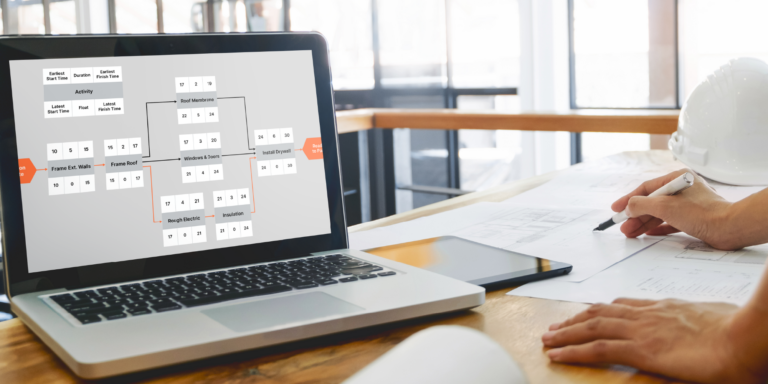
Australia is in the midst of a construction boom defined by complexity and scale.
Multi-billion-dollar transport and energy megaprojects are reshaping cities and regional networks alike.
But, as a study from Grattan Institute notes, as the scope of these projects expands, so does the risk.
The Critical Path Method gives project leaders a way to bring structure to massively complex projects and mitigate risk, allowing teams to prioritise what matters most, allocate resources efficiently, and make timely decisions that protect cost and schedule performance.
This article examines the Critical Path Method, its significance in large-scale construction, and how Australian builders can utilize it to enhance control, predictability, and profitability.
Table of contents
What Is the Critical Path (and Why Does It Matter in Construction)?
The critical path is the sequence of interdependent tasks that determines the minimum time required to complete a construction project. Activities on this path have zero float, which means there’s no flexibility in the task’s schedule. As such, any delay directly extends the overall program.
Project managers use the Critical Path Method (CPM) to see which activities drive completion and where schedule risk sits. With this overview, they can then make decisions that prioritise labour, equipment, and material allocation for maximum impact.
Consider this simplified example:
On a high-rise project, “foundation → framing → façade” might form the critical path of interdependent tasks. So a delay in steel delivery would stall framing, but it wouldn’t stop there. The subsequent delay would then also push back façade installation and ultimately extend the project’s completion date.
The Building Blocks of the Critical Path Method in Construction
Infrastructure Australia provides a financial justification for using CPM, reporting that large energy projects exceeding $350 million are more than twice as likely to run over budget as smaller ones.
CPM’s success and efficacy are built on a series of interrelated components that turn complex project scopes into structured, measurable programs. Together, they create the framework that enables teams to plan confidently, coordinate effectively, and maintain control throughout the delivery process.
Activities and Work Breakdown Structure (WBS)
A clear Work Breakdown Structure converts the project scope into measurable activities that can be tracked and reported.
Following the 100% rule ensures every deliverable is captured within the structure, while well-defined work packages make progress easier to measure and manage across disciplines.Dependencies
Dependencies establish the logical relationships between activities and determine sequencing.
Standard types, such as finish-to-start, start-to-start, and finish-to-finish, define how work progresses from one task to the next. Factoring in lead and lag times, like curing periods or inspection approvals, helps ensure the schedule reflects real-world construction conditions.Durations
Credible durations are the foundation of any reliable program. Timeframes should be based on historical performance data, subcontractor input, and established productivity benchmarks.
Where uncertainty exists, data ranges or estimation methods, such as Program Evaluation and Review Technique (PERT), can enhance forecasting accuracy.Float
Float represents the amount of time an activity can be delayed without affecting its completion.
Activities with zero float sit on the critical path and must be managed closely. Monitoring near-critical tasks provides early warning of potential risks that could alter the path and disrupt delivery.Forward and Backward Pass
Forward and backward pass calculations reveal the earliest and latest possible start and finish dates for each activity. The sequence with zero total float and the longest duration defines the critical path.
These insights provide project managers with clear visibility into schedule risk and the necessary information to make timely, informed decisions.
How to Apply CPM to a Construction Project
Applying the Critical Path Method in construction requires more than generating a timeline. It requires a structured, evidence-based approach that integrates design, procurement, and site delivery within a single, logical framework.
The process outlined below explains how experienced project teams can utilize CPM to create and maintain a reliable, contractually defensible schedule.
List All Tasks
Begin by compiling a comprehensive inventory of tasks using design documentation, trade inputs, and the engineering scope.
Convert these into a Work Breakdown Structure (WBS) that captures 100% of project deliverables. Each work package should be measurable, clearly owned, and capable of independent progress tracking.
On large civil projects, for example, separating earthworks, drainage, and pavement packages helps isolate risk, assign responsibility, and simplify reporting across subcontractorsDefine Dependencies
Establish logical relationships between activities to map how the work progresses and flows through the project lifecycle.
Use standard dependency types (finish-to-start, start-to-start, or finish-to-finish) and include realistic lead and lag times, such as curing periods, inspection windows, or equipment relocation.
Ensure sequencing reflects site realities, such as crane access and trade interfaces, to facilitate efficient construction. For instance, on a high-rise project, façade installation should follow structural completion, but also allow lag for scaffold repositioning and QA testing before progressing to interior works.Develop Program Logic
Link all activities into a network logic diagram using scheduling software. The visual output (whether a network or Gantt chart) is secondary to the underlying logic driving the program. Validate that logic through multidisciplinary coordination sessions before setting a baseline.
For example, during preconstruction, review how service installation aligns with structural and façade work to confirm simultaneous access and avoid bottlenecks around shared riser zones.Estimate Durations
Assign realistic durations to each activity based on historical data, subcontractor input, and productivity benchmarks.
Factor in local influences such as regional weather patterns, permit timelines, and material lead times. For instance, scheduling major concrete pours or façade works outside the wet season is essential to maintain schedule credibility.
Validate assumptions collaboratively with estimators and site supervisors to ensure they are both achievable and contractually defensible.Run CPM Calculations
Perform forward and backward pass calculations to determine the earliest and latest start and finish dates for each task. Identify total float and confirm which sequence of activities has zero float. This is the project’s critical path.
Recalculate regularly to capture changes from delays or variations. A delivery issue with switchboards, for instance, may push commissioning onto the critical path, requiring adjustments to procurement sequencing and inspection schedules.Validate and Optimise
Perform forward and backward pass calculations to determine the earliest and latest start and finish dates for each task. Identify total float and confirm which sequence of activities has zero float. This is the project’s critical path.
Recalculate regularly to capture changes from delays or variations. A delivery issue with switchboards, for instance, may push commissioning onto the critical path, requiring adjustments to procurement sequencing and inspection schedules.Monitor and Update
Update logic, durations, and floats regularly (monthly for client reporting and fortnightly for internal control) to ensure they reflect actual progress. Use digital platforms to centralise updates and maintain a single source of truth across all teams.
When supply chain delays or design changes occur, update the schedule promptly to assess the downstream effects and ensure compliance with notice requirements under Australian contractsCompress if Required
When the project slips behind schedule, apply acceleration techniques such as fast-tracking or crashing only after thorough cost and risk evaluation.
Prioritise recovery actions that protect safety, quality, and commercial integrity.
If extreme rainfall delays civil works, for example, running multiple drainage crews in parallel may help recover lost time; however, the associated cost exposure and EOT implications should be formally documented to protect both schedule integrity and contractual position.
The Value of CPM Scheduling in Construction Projects
The Critical Path Method combines structure, data, and foresight to transform scheduling from a compliance requirement into a core driver of project certainty, site efficiency, and profitability.
Reliable Timelines
The logical sequencing of tasks produces programs that are both realistic and achievable, thereby reducing the likelihood of unforeseen delays.
A meta-analysis of global construction projects reveals that structured scheduling methods, such as the Critical Path Method, yield stronger time and cost performance than traditional planning approaches. CPM enhances schedule reliability and cost predictability, fostering client confidence and bolstering project credibility.
Resource Efficiency
CPM identifies where labour, plant, and materials should be concentrated for maximum impact. It enables precise workforce scheduling that prioritises zero-float activities and reduces idle time.
Linking resources to critical milestones enhances coordination across trades and procurement, improving overall productivity and delivery flow.
Risk Visibility and Control
Structured CPM schedules highlight bottlenecks early, enabling managers to take action before delays escalate.
This visibility supports proactive mitigation strategies such as resequencing or reallocating resources to protect key dates. It also provides the documentation required to manage time-related risks through formal notices and Extensions of Time under Australian contract frameworks.
Improved Communication and Accountability
CPM programs and Gantt charts clarify expectations for all parties, from clients to subcontractors. A shared, data-driven schedule improves transparency and accountability across the project team.
Comparing actual progress against the baseline program gives executives accurate oversight and early warning of emerging risks.
Financial Discipline and Contractual Integrity
CPM integrates time and cost control, reducing the risk of extended equipment hire, labour overruns, and liquidated damages. Reliable scheduling supports cash flow forecasting by linking milestone achievement to payment claims.
When integrated with 4D and 5D BIM, CPM enables teams to monitor cost and schedule data simultaneously, driving stronger financial performance and safeguarding project margins.
Limitations and Challenges of the Critical Path Method
While the Critical Path Method provides structure and clarity, its effectiveness depends on the quality of data and the discipline of those maintaining it. Understanding its limitations helps teams apply the method more effectively and avoid common pitfalls in live project environments.
Data Accuracy
CPM is only as reliable as the information that underpins it. Inaccurate durations, incomplete activity lists, or poorly defined scopes can create false critical paths and unrealistic delivery forecasts.
Maintaining reliability requires consistent validation of inputs, transparent communication between planning and field teams, and routine audits of schedule logic and data integrity.Fixed Durations and Limited Flexibility
CPM assumes all task durations are fixed, which limits adaptability when productivity fluctuates. Real-world factors such as rework, delayed approvals, or weather interruptions often require recalculation to maintain the program validity.
Supplementing CPM with probabilistic tools such as PERT can introduce flexibility and provide a more realistic view of potential time outcomes.Resource Constraints
Standard CPM calculations assume unlimited access to labour and plant, which rarely reflects site conditions. When resources are constrained, the logic must be adjusted through resource levelling to represent actual capacity.
This process often extends the program, so close coordination between the planning team and site operations is essential to maintain feasibility.Rigidity and Change Management
A CPM schedule loses accuracy when it is not updated to reflect progress, design changes, or approved variations. Because CPM models are static, any shift in task relationships or durations requires manual recalculation.
Effective change management, focused on maintaining discipline in update cycles and version control is crucial to keep the program reliable, transparent, and defensible for contractual reporting.
How to Strengthen CPM Scheduling for Australian Construction
Strong CPM performance depends on more than technical accuracy. It requires consistent frameworks, disciplined governance, and a deliberate focus on how programs are built, maintained, and communicated.
The following practices strengthen control, transparency, and accountability across Australian construction projects.
Standardise Scheduling
Establish a company-wide scheduling framework that defines how every program is created and maintained. Enforce uniform logic structures, calendars, and coding conventions so performance can be compared across projects and analysed at the portfolio level. Consistency fosters trust in the data, enabling executives to make informed decisions with confidence.
Accuracy starts with realism.
Apply contract-specific calendars that capture regional working hours, shutdown periods, and statutory holidays. Use them from tender through delivery to ensure the schedule reflects how work is actually performed.
Embed governance early during mobilisation so deviations from approved methodologies are corrected before they affect progress.
Maintain Program Discipline
Keep the CPM program alive and aligned with site conditions. Outdated schedules erode decision-making, so updates must be routine and precise. Implement monthly cycles for client reporting and fortnightly internal reviews to identify slippage early.
Require planners to document every logic revision, float change, and re-baselining event.
Treat this documentation as part of operational risk control, not administration. A disciplined update regime turns the CPM schedule into a reliable management tool that safeguards delivery performance and commercial credibility.
Protect and Manage Float Strategically
Float is shared contingency, not spare time.
Define its ownership clearly during contract negotiations and maintain that structure through project delivery. Use float intentionally to manage collective risk and preserve key dates.
Track near-critical tasks alongside zero-float activities to catch emerging risks early. Establish escalation thresholds for float consumption so teams act before the critical path shifts.
This approach maintains schedule integrity while reinforcing accountability across trades.
Pro Tip
Do not accept a CPM schedule that only works on paper. Pressure-test the logic with the supervisors and subcontractors who will actually deliver the work to confirm access constraints, sequencing, and productivity assumptions. When the logic reflects site reality, the critical path becomes a reliable management tool rather than an optimistic forecast.
Account for Australian Conditions and Market Realities
Design the program around Australia’s unique operating conditions.
Build allowances for wet-season shutdowns, extreme heat, and restricted logistics capacity in regional areas. Sequencing critical operations around these realities prevents predictable disruptions from derailing delivery.
Integrate long-lead procurement and material transport into the CPM logic to reflect supply volatility and distance. Use historical weather and productivity data to validate durations for high-risk work such as earthworks and façade installation.
Programs built on local data withstand scrutiny better and are more resilient to real-world pressures.
Communicate and Enforce the Program Logic
Align every delivery partner to the logic behind the program, not just the output.
Present the reasoning behind the sequence so that teams understand the dependencies, interfaces, and associated risks. This alignment builds ownership and consistency in execution.
Use CPM tools such as Gantt charts, lookahead schedules, and logic reports to coordinate daily work effectively. Maintain a single source of truth for all schedule data to prevent shadow programs from emerging. Require that any proposed changes be validated against the CPM logic before implementation to protect accuracy and accountability.
Build Organisational Capability
Treat scheduling as a leadership competency, not just a technical role. Build internal CPM training pathways for site engineers, foremen, and commercial staff to strengthen planning literacy across all functions.
Run post-completion reviews comparing planned versus actual durations to identify lessons and refine future programs. Encourage mentorship between experienced planners and project managers to share best practices in logical design and risk management across projects.
Integrate Technology for Dynamic Control
Adopt technology that transforms CPM from a reporting tool into a live control system. Use integrated management platforms that track progress in real time, recalculate critical paths automatically, and display clear visual dashboards for decision-makers.
Connect scheduling data with cost and procurement systems to link time performance with financial outcomes. Use predictive analytics to identify deviation trends early, allowing proactive intervention before float is exhausted or milestones are missed.
Building certainty starts with control of time and cost through the Critical Path Method
Apply CPM with discipline, standardisation, and local awareness, and you can manage complexity with confidence. Structured scheduling enhances program reliability, mitigates risk, and fosters predictable, profitable project outcomes.
Categories:
Written by
Samantha Nemeny
36 articles
Sam has spent a decade in content marketing, with eight years focused on Australia’s construction industry. She has a knack for making complex ideas easy to understand, turning industry jargon into clear, engaging stories. With a background in SEO and marketing, she’s spent the past four years at Procore, helping industry professionals navigate the world of construction with content that’s both insightful and easy to digest.
View profileExplore more helpful resources

Scaling with SIERA: Building for now and what comes next
SIERA Founder and Director Brent Thompson has always known that the right people, systems and hands-on approach are fundamental to scaling his business successfully. In Part 1, Brent and Head...
Getting Your Construction Data Ready for AI – What Every Business Needs to Consider Before Launching AI
This is the first of two articles. This part sets out the considerations: what clean and trusted data actually means, how to measure it, how the two systems most businesses...

The Contractor’s Guide to Concrete Inspections
Concrete: It’s the key building block of nearly every structure’s foundation — and it’s the world’s most widely used building material. For most head contractors, understanding how to assess concrete...

Computer-Aided Design (CAD): What It Is — and Why It’s Important
When most people envision a construction worker, they see a person at a construction site wearing a hard hat and a high-vis vest. Perhaps this person is putting up plasterboard,...