As a general contractor, many formerly “normal” baselines are gone. They’re lost in today’s unpredictable stew of volatile prices, extreme market shocks, and even high tariffs.
Costs of materials and components for constructiona are up by 43% since 2020 (per data from the U.S. Bureau of Labor Statistics). And project abandonments are skyrocketing: up 88% year over year (per an industry Project Stress Index).
The cost of not knowing and acting sooner on risk is the biggest line item that contractors never see in their budgets.
GCs have a choice: Cling to outdated, margin-eroding structures, or embrace technology to surface and control hidden risk, becoming too competitive to beat. At Procore’s 2026 Innovation Summit, industry leaders explored precisely this topic.
“On almost every construction project that goes sideways, the information that could have prevented it was somewhere in the system. A delivery date, a schedule conflict, a budget exposure—it just wasn't visible in time to act on it.”
– Kristen Riley, VP, Product Management, Procore Technologies
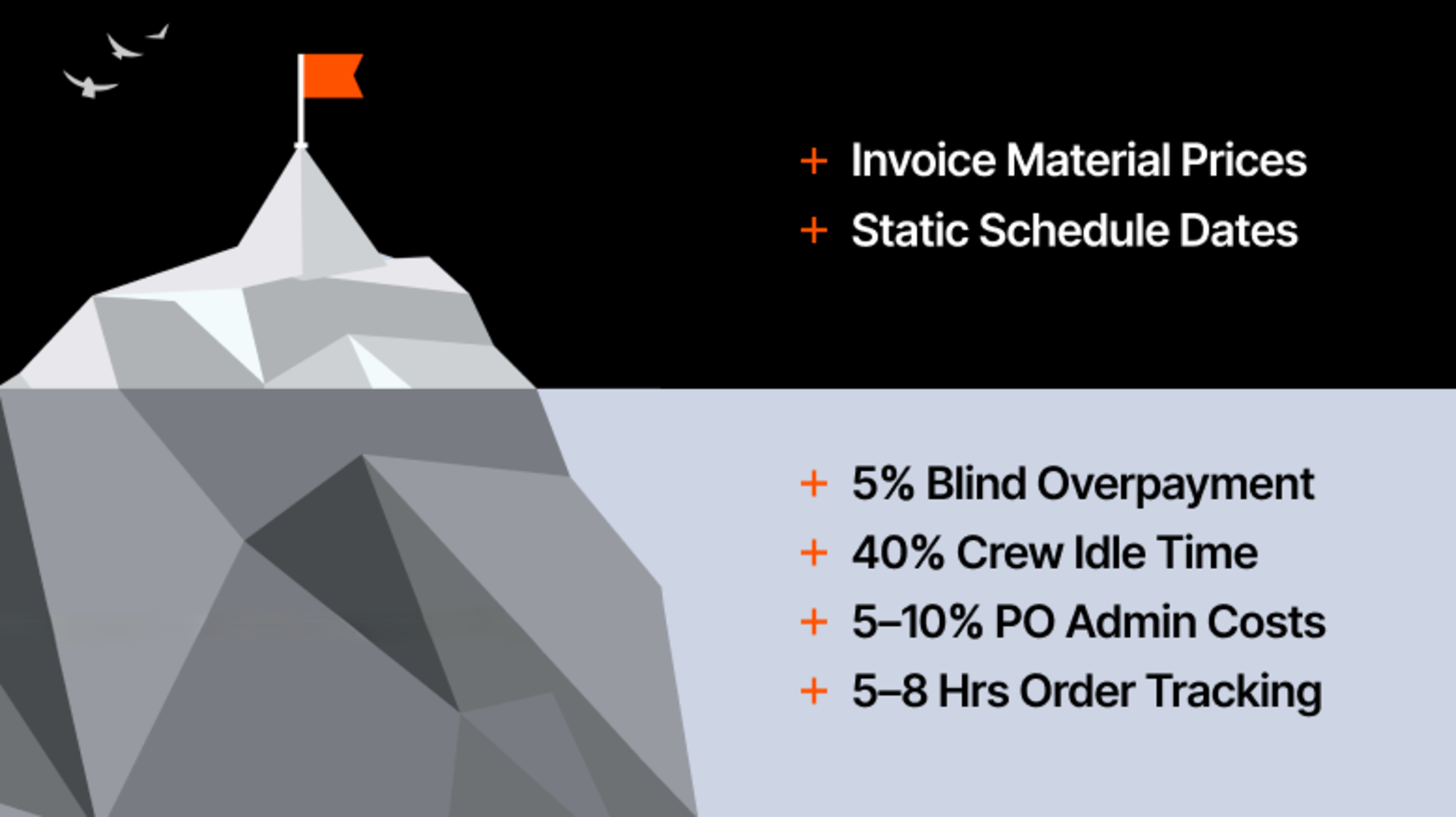
Your procurement iceberg: Risk biding its time
Construction’s everyday icebergs are nothing new, but today’s skyrocketing input costs, constrained supplies, and compressed timelines leave zero room to absorb sudden hits.
During the Innovation Summit, Owen Drury, co-founder of Bricks and Bytes Intelligence, applied this to a practical example: procurement. All too often, he says, the price on a supplier invoice conceals margin-busting costs:
5–10% overhead lost in processing purchase orders
5% average overpayment from the inability to compare prices across suppliers and regions
40% labor idle time caused directly by material issues, with foremen spending 5–8 hours every week chasing down deliveries instead of driving progress
“The price on the invoice is what you see above the waterline. Everything below it, that's the part most contractors have never fully quantified.”
– Owen Drury, co-founder of Bricks and Bytes Intelligence, and author of “Material Advantage: A Report on How Technology is Reshaping Construction Procurement”
Where small data gaps become big surprises
Data that’s unseen and fragmented can’t be connected. That means things slip through the cracks unnoticed, leaving little time for corrective action. GCs feel the pain in every part of operations:
Materials: An SC orders electrical switchgear, but the order isn’t tied to your live schedule. Days before installation, you learn that the shipment is stuck overseas. Now, you’re tearing up schedules as crews idle.
RFIs: A discrepancy appears on a drawing. Work stops. The foreman logs an RFI. Without visibility and the reminders that busy construction pros need, there it sits, a lagging paper trail siloed for 6–10 days. Risk is compounding in idle labor costs and budget exposure.
Safety and compliance: It’s Monday morning. The crew starts work, but a lapsed safety certification goes unnoticed. Finally, it surfaces—when a costly stop-work order or safety violation hits your desk.
Seeing below the waterline with real-time collaboration
The information gap between GCs and specialty contractors means too much data lives below the waterline. But you have a way to get a view of what’s going on under the surface.
GCs who use real-time collaborative technology like Procore Connect can create single, centralized hubs for surfacing and averting risk. Here, drawings, RFIs, and submittals sync across both accounts to help close the GC-to-SC gap.
When GCs transition from manual download/upload of workflows to directly syncing across accounts, they see major efficiency gains: Maria Gonyou, Project Coordinator at Mandere Construction, reported during the Innovation Summit that her team slashed up to two hours of drawing management time to just 30 seconds.
Are you caught off guard or ahead of the curve?
Audit your data gaps today. Is your data unified enough to catch below-the-waterline risk weeks before impact? Or are you waiting for the call that throws the schedule into chaos?
“The best projects aren't won alone. They're won by GCs and specialty contractors who work as one team and who do it again on the next project and the one after that.”
– Shelly Duggal, Group Product Manager, Product Management, Procore Technologies
Technology is a tool for building trust and transparency. Real-time data sharing with trade partners turns potential disputes into joint problem-solving. GCs who create visibility at the speed and scale of modern construction build the trust that protects margins, defends reputations, and wins top jobs.
In a competitive, unpredictable market, one GC leads while the other stumbles. Which one are you?
Written by

Senior Product Marketing Manager, Procore
Start growing with Procore today
With tools to make every part of your process more human and a support team excited to help you, getting started with any project has never been easier.