
Implementing Digital Tools for Capital Project Delivery


Last Updated Mar 9, 2026
Tara Cohn
Director
13 articles
Tara Cohn is a director with over 15 years of experience in providing healthcare data analytics services. She helps leaders improve decision-making and achieve success with the use of data analytics. Tara’s experience includes provider practice, hospital/health system and healthcare startup/technology. She is a healthcare subject matter expert and has supported initiatives across operations, clinical care, quality, compliance, patient experience, population health, marketing, strategic planning, finance, revenue cycle and human resources. Tara’s passion is in leveraging data analytics to help organizations achieve their full potential with a focus on transparency, optimization and automation via the power of data storytelling.
Jonathan Greene
Writer
17 articles
Jon Greene is a freelance educator, writer, and award winning theater maker. As an educational writer he has created content, lessons, and led seminars for Young Audiences of Louisiana, Hynes Charter System in New Orleans, Centre Stage School of the Arts in Singapore, 'Friends of The Museum' Docent Workshop in Singapore, The Prague Public High School System, Moleac Pharmaceuticals, and with the Grand Portage Ojibwa Tribe. His work and writing for theater has been featured in Howlround and American Theater Magazine and he is the recipient of 2 regional theater awards in his home of New Orleans. He is a BFA Graduate of Boston University and a previous Kennedy Center Fellow.

This article is the first in a series focused on the need for a thoughtful implementation strategy for new digital solutions in construction management and execution. In this article series, we'll uncover the four key components of implementation that can help owners minimize risk, maximize value, and improve quality across their portfolio.
As digital solutions, their capabilities, and the user base across capital programs continue to grow one constant remains: Technology shouldn’t be purchased solely for the sake of having it.
While the extra steps required to implement these technologies can be costly and time‑consuming — putting pressure on the classic cost‑schedule triangle — owners and developers too often make the capital investment without an equal commitment to implementation.
This results in organizations being bogged down with tools that add burden instead of reducing it, as well as fragmented data and decisions made on assumptions rather than facts.
4 Components of Effective Implementation
The best reason to invest is to improve how an organization plans, delivers, and operates projects and portfolios — simplifying processes and refining workflows that can help lead to better decisions.
A successful implementation strategy for digital tools relies on four main interconnected components working in a cyclical loop as opposed to a straight line.
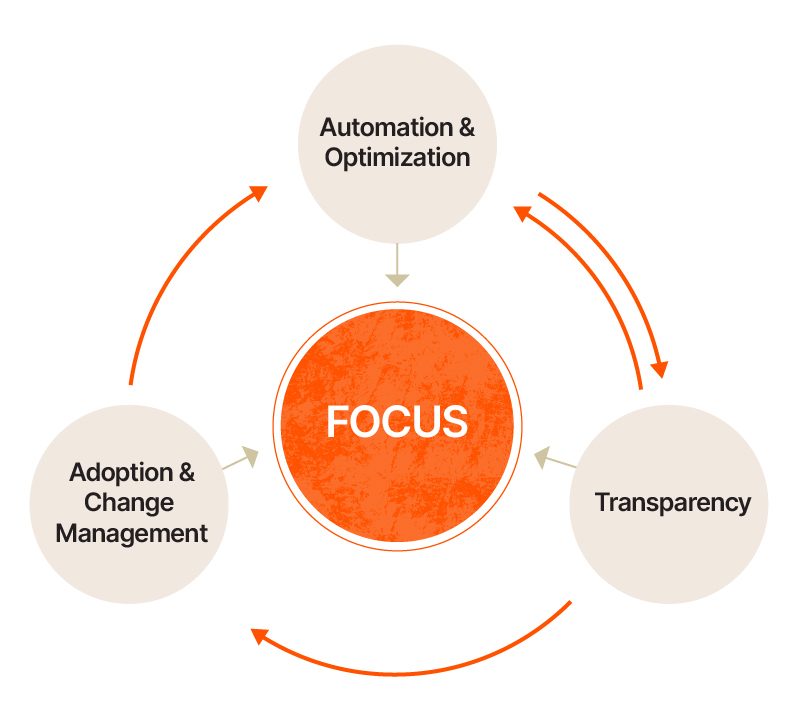
Together, these create a solid foundation that drives consistent value, reduces exposure to risk, and sustains quality at scale.
Automation and Optimization
Objective: Automate routine steps like document routing, status updates, photo captures and budget syncs. Teams working in fewer systems and having reliable integrations instead of manually reconciling data.
Outcome: Simplified workflows and clear collaboration across internal teams, GCs and specialty contractors.
Transparency
Objective: Create a single source of truth for scope, costs, and project status. Field context (photos, RFIs, inspections) is visible without hunting and reporting points leaders to the few items that matter now.
Outcome: All stakeholders have timely access to data, creating shared awareness, alignment, and faster issue resolution.
The more transparency you can have, the fewer assumptions you have to make—and the less burden it takes to get that transparency, the more effective the process is.
Tara Cohn
Director
Wipfli LLP
Adoption and User Enablement
Objective: Facilitate role-based training during rollout and afterwards. Tracking use and value against established KPIs. Leaders establish a feedback loop for improvements, including resources for ongoing admin and integrations.
Outcome: Once workflows are standardized and transparency is in place, leaders roll out tools that fit their KPIs and business needs, making sure there is consistent role-based use and configure the system to fit organizational needs.
To see the value technology can bring, it is important to know what gaps an organization is facing, which parts of the technical process prove too difficult, and opportunities they’re not able to take advantage of yet because they don’t have this tech in place.
Tara Cohn
Director
Wipfli LLP
Focus
Objective: Share information where work actually happens, with integrations that reduce context-switching. This allows owners to spend less time in the weeds and more time making decisions.
Outcome: Noise is minimized so leaders can focus their attention on execution and prioritize high-impact decisions.
Stay updated on what’s happening in construction.
Subscribe to Blueprint, Procore’s free construction newsletter, to get content from industry experts delivered straight to your inbox.

Turning Investment into Impact
Technology can almost always bring greater value to a project, but that doesn’t happen in isolation.
Owners sit at the intersection of people and technology across multiple projects, partners and tech stacks. Being involved and invested in implementation can limit manual burdens and prevent stalls between CPM tools and ERP systems. This effort can also prevent field and office teams from reverting back to old processes in an attempt to stay on schedule.
this is part of the series
Implementing Digital Tools for Capital Project Delivery
Was this article helpful?
Scroll less, learn more about construction.
Subscribe to The Blueprint, Procore’s construction newsletter, to get content from industry experts delivered straight to your inbox.
By clicking this button, you agree to our Privacy Notice and Terms of Service.
Categories:
Written by
Tara Cohn
Director | Wipfli LLP
13 articles
Tara Cohn is a director with over 15 years of experience in providing healthcare data analytics services. She helps leaders improve decision-making and achieve success with the use of data analytics. Tara’s experience includes provider practice, hospital/health system and healthcare startup/technology. She is a healthcare subject matter expert and has supported initiatives across operations, clinical care, quality, compliance, patient experience, population health, marketing, strategic planning, finance, revenue cycle and human resources. Tara’s passion is in leveraging data analytics to help organizations achieve their full potential with a focus on transparency, optimization and automation via the power of data storytelling.
View profileJonathan Greene
Writer
17 articles
Jon Greene is a freelance educator, writer, and award winning theater maker. As an educational writer he has created content, lessons, and led seminars for Young Audiences of Louisiana, Hynes Charter System in New Orleans, Centre Stage School of the Arts in Singapore, 'Friends of The Museum' Docent Workshop in Singapore, The Prague Public High School System, Moleac Pharmaceuticals, and with the Grand Portage Ojibwa Tribe. His work and writing for theater has been featured in Howlround and American Theater Magazine and he is the recipient of 2 regional theater awards in his home of New Orleans. He is a BFA Graduate of Boston University and a previous Kennedy Center Fellow.
View profileExplore more helpful resources

Does your asset management workflow actually work?
Every fixed asset installed on a project generates data long before handover. Is your team capturing it as it happens, or scrambling to reconstruct it after the fact? That question...

From spec book chaos to single source of truth
Picture this: An expansion is going in directly beside a high-volume line that cannot stop producing. Structural steel lands in March, mechanical completion is promised for August, and your only...
The hidden risk of relying on your EPC partner for project visibility
Many owners have thought some version of “We don’t need a capital project management platform — our EPC partner manages all of this for us.“ It’s a reasonable position. Your...

Why manufacturing owners are still managing capital projects like it’s 2010
There is a machine on your plant floor right now that knows it’s going to break. A sensor is reading a vibration signature on a bearing about three weeks before...
Free Tools
Calculators
Use our calculators to estimate the cost of construction materials for your next project.
Templates
Find a template to help you with your construction project tasks.
Material Price Tracker
Get the latest U.S. retail prices and view historical trends for common building materials.
Glossary
Explore key terms and phrases used in the industry.