
Customer Story
A shell contractor changes the game with connected platforms
Procore Connect let KD Construction stop re-entering data and start taking control of its projects and productivity.

The Challenge
As a national shell contractor, KD Construction’s teams were constantly switching between their own Procore instance and those of their GC partners. That meant duplicate data entry, disconnected workflows and a greater risk of documentation errors that could impact work in the field — and no guaranteed access to records in case of future disputes.

The Solution
After years of advocating for a system to connect Procore instances, KD Construction adopted Procore Connect to link RFIs and submittals directly between systems, allowing teams to maintain ownership of their own records while streamlining workflows. Connected workflows helped project teams move information, improve accuracy and keep field crews working from the latest information.

The Results
- Supported PMs and PEs productivity in maximizing their impact on critical, high-value work
- Modernized administrative workflows by transitioning away from traditional, multi-step manual entry processes
- Gained control of documentation to aid with dispute resolution
- Improved data integrity and consistency across RFI and attachment submissions
- Strengthened collaboration and relationships with GC partners
“I’d say Procore Connect led to a 10–20% productivity improvement for a typical project manager or project engineer role. Now they spend that time on work that actually matters instead of repetitive administrative tasks.”

Jason Grafton
VP of Operations
KD Construction
Building connected workflows at scale
When Jason Grafton joined KD Construction, the company had barely scratched the surface of what Procore could do — despite its project teams spending hours upon hours working inside the platform.
The problem was connectivity. Roughly 70% of KD’s projects involved GCs already using Procore. But without an easy way to connect to a GC’s instance, project teams were forced to repeatedly re-enter information just to keep everything aligned.
“We were constantly jumping in and out of GC Procore environments across all those projects, downloading attachments, copying and pasting information and re-uploading documents between systems,” says Grafton, VP of Operations, Tunnel Division. Despite all that time spent in the platform, “we were only scratching the surface, utilizing maybe 20–30% of Procore’s full capabilities.”
Grafton had been here before. Having started his career as a Project Engineer who was also tasked with managing the local IT support, Grafton was deeply familiar with construction industry technology, and had been asking Procore for years to develop a tool that would help specialty contractors and GCs link their Procore instances.
From Grafton’s perspective, such a tool could greatly enhance the accuracy of project data. “Maybe somebody uploads the wrong sketch with the RFI. Maybe there are five attachments and only four get uploaded into KD’s Procore environment. Maybe the missing attachment turns out to be the one detail that changes the wall location.”
“Those kinds of mistakes are hard to quantify,” he says, “but the impact can be massive.”
An even greater risk stemmed from a lack of operational control. In an industry where documentation can determine the outcome of disputes, storing all your data on a general contractor-controlled instance means leaving your fate in the hands of another company. “I’m dumping all of our records on a GC’s Procore,” Grafton says. “Meanwhile, they can just remove my permission at any time, and all of the daily logs, all of those notes get taken away. Or they can edit them!”
He adds. “As specialty contractors, we needed to own our own destiny.”
‘We were ready to dance in the streets’
The day that Procore Connect became available was a memorable one at KD. “We’re standing there in the middle of the office, connecting our first RFI, and everybody around us just completely lost it,” Grafton says. “We were ready to dance in the streets, because we instantly understood how much time it was going to save.”
Instead of recreating information manually across systems, teams could now connect RFIs directly between environments and manage work primarily from KD’s own Procore instance. That greatly reduced administrative work and the likelihood of errors.
“I’d say Procore Connect led to a 10–20% productivity improvement for a typical project manager or project engineer role,” Grafton says. “Now they spend that time on work that actually matters instead of repetitive administrative tasks.” And the frequency with which information is wrongly copied into an RFI has “gone down significantly.”
That extra time created ripple effects across projects. “That extra 20% allows us to take on more volume, reduce mistakes, improve project outcomes and ultimately improve the bottom line.”
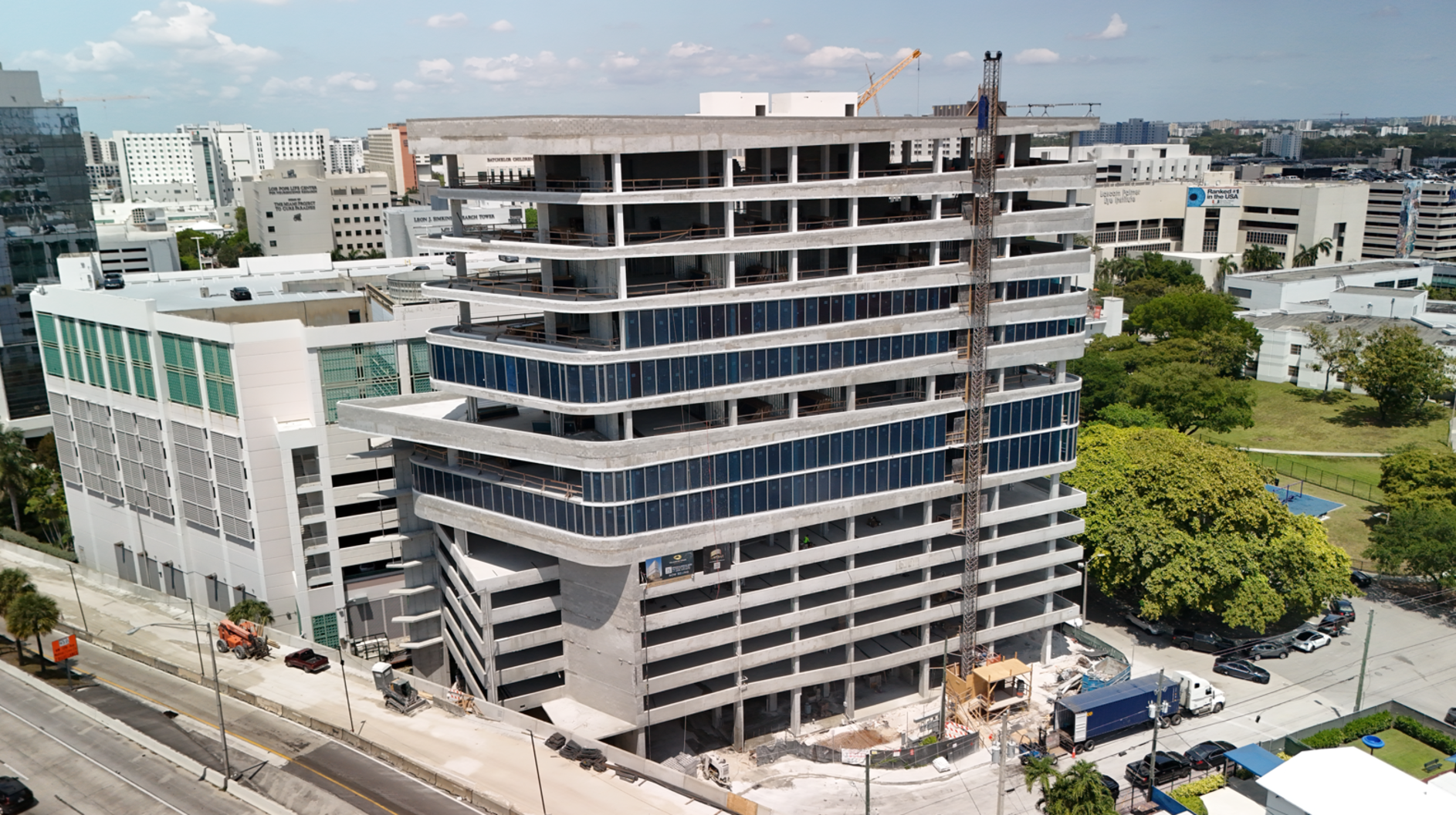
Faster information, fewer mistakes
For KD, one of the greatest advantages of connected workflows is speed — particularly on projects where changing information can quickly impact work in the field. “If information is available 24, 48 or 72 hours faster, the field team is less likely to make mistakes,” Grafton says.
That proved critical on a recent project where shifting RFI responses repeatedly changed the location of trash chutes during layout and installation. “At one point, we actually had trash chutes shown in two locations, even though there was only supposed to be one,” Grafton says. “The initial direction was basically, ‘Install both.’ Then they decided they only wanted the one on the right. Then on the next floor, they moved it back to the left.”
Because those updates flowed through connected workflows, KD’s teams were able to maintain continuous visibility into evolving project requirements. “We were able to stay ahead of it during layout and installation,” Grafton says. “And just as importantly, we had a very clear record showing that we had followed every direction exactly as instructed at every stage.”
That documentation later helped to prevent disputes when portions of the work had to be revised.
“There really wasn’t an argument, because the documentation clearly showed the sequence of changes and responses,” he says.
The next big leap
Today, subcontractor-GC collaboration through Procore Connect has become standard practice across KD’s projects, streamlining construction project management at scale. And in Grafton’s view, connected workflows are still only in their early stages. “The next big leap is going to be when we can fully push RFIs downstream to upstream automatically,” he says. “Once that happens, we’re really cooking with gas.”