The most expensive problems on a construction project rarely live in a single record. They live in clusters of disconnected records, where the critical facts are trapped in hard-to-find places like PDF spec sheets, jobsite photos, and complex drawing sets.
When a trade arrives to hang drywall along a corridor, an experienced superintendent does not view the framing in isolation. They instinctively connect three separate data points: a recent architectural revision that shifted an in-wall pipe, a subcontractor RFI flagging a duct clash at that new coordinate, and the fact that the RFI remains open. Halting the crew prevents closing a wall that would inevitably be cut back open.
That intervention is driven by relational context—the understanding of how drawings, specifications, RFIs, schedules, and physical site conditions relate to one another.
General-purpose frontier AI models evaluate construction through generic text patterns. While they may understand the theory of building as if they’ve memorized a textbook, anyone who has run a project knows the jobsite rarely goes by the book. When prompted with an RFI, a standard LLM parses the document as an isolated text file. It lacks the spatial and structural context required to understand which drawing sheet governs the request, which trades are affected downstream, or how an unresolved question threatens the critical path.
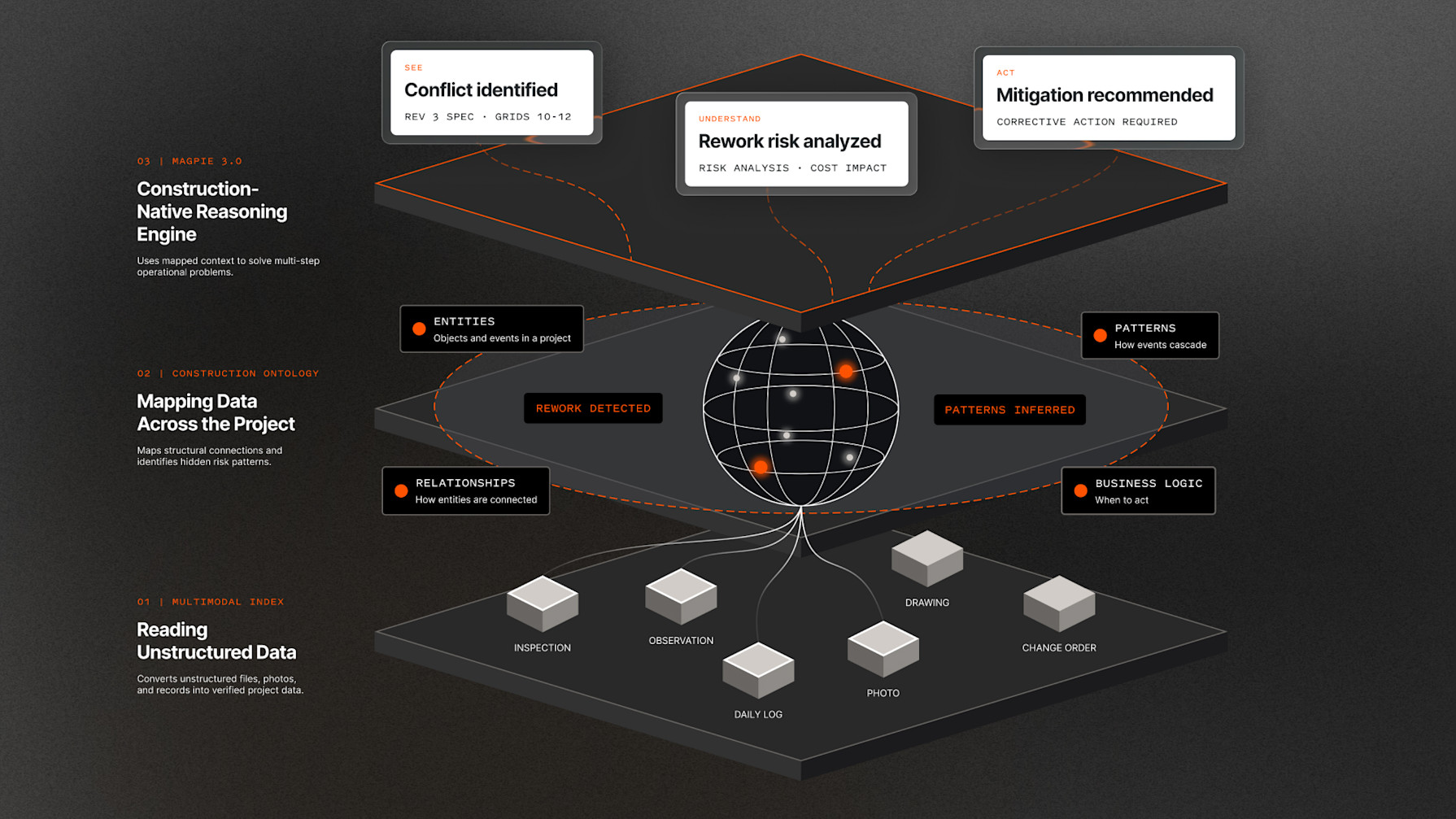
At Groundbreak, we shared our vision for evolving Procore into a system of intelligence—a solution that can See, Understand, and Act. To give Procore AI the comprehension of a veteran superintendent, we built an architecture tailored to the physical realities of the job: our multimodal index, our construction ontology, and Magpie 3.0, our proprietary reasoning engine.
The foundation for construction intelligence: reading, connecting, and reasoning
Understanding requires three distinct layers: reading project files, mapping the relationships between those data points, and reasoning through what they mean for the project.
1. Multimodal index: reading unstructured data
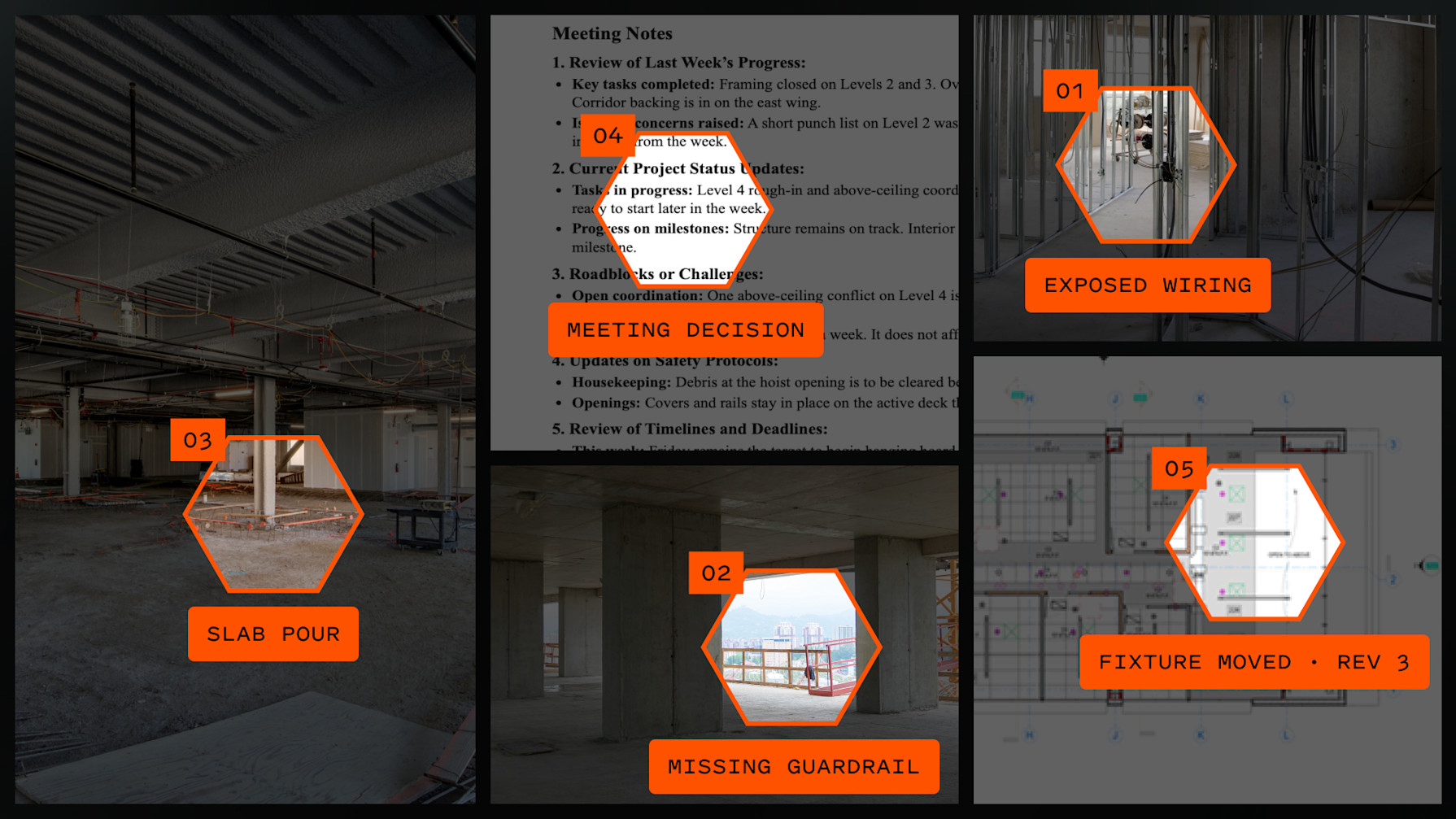
Over 90% of construction data is trapped in unstructured formats, including drawing sets, field photos, submittals, and meeting minutes. Generic AI solutions can struggle when interpreting drawings because they process PDFs as flat text or unsegmented images. As a result, they burn tokens, lose orientation, or miss key details embedded across sheets.
The heart of Procore AI is a purpose-built multimodal index. Instead of treating a drawing as an image, our index reads what the sheet actually represents: the gridlines, fixture symbols, dimension strings, and revision clouds. It processes site photos to identify rough-ins, missing safety rails, or poured slabs. It parses meeting minutes to pull out commitments, delays, and directives.
Critical details are lifted out of its file and transformed into a verified, queryable project data.
2. Construction ontology: connecting data across the project
A collection of isolated facts does not provide actionable insight. Knowing a wall is framed means nothing unless the system knows where that wall lives in the schedule, which trades are assigned to it, and whether the design behind it is settled.
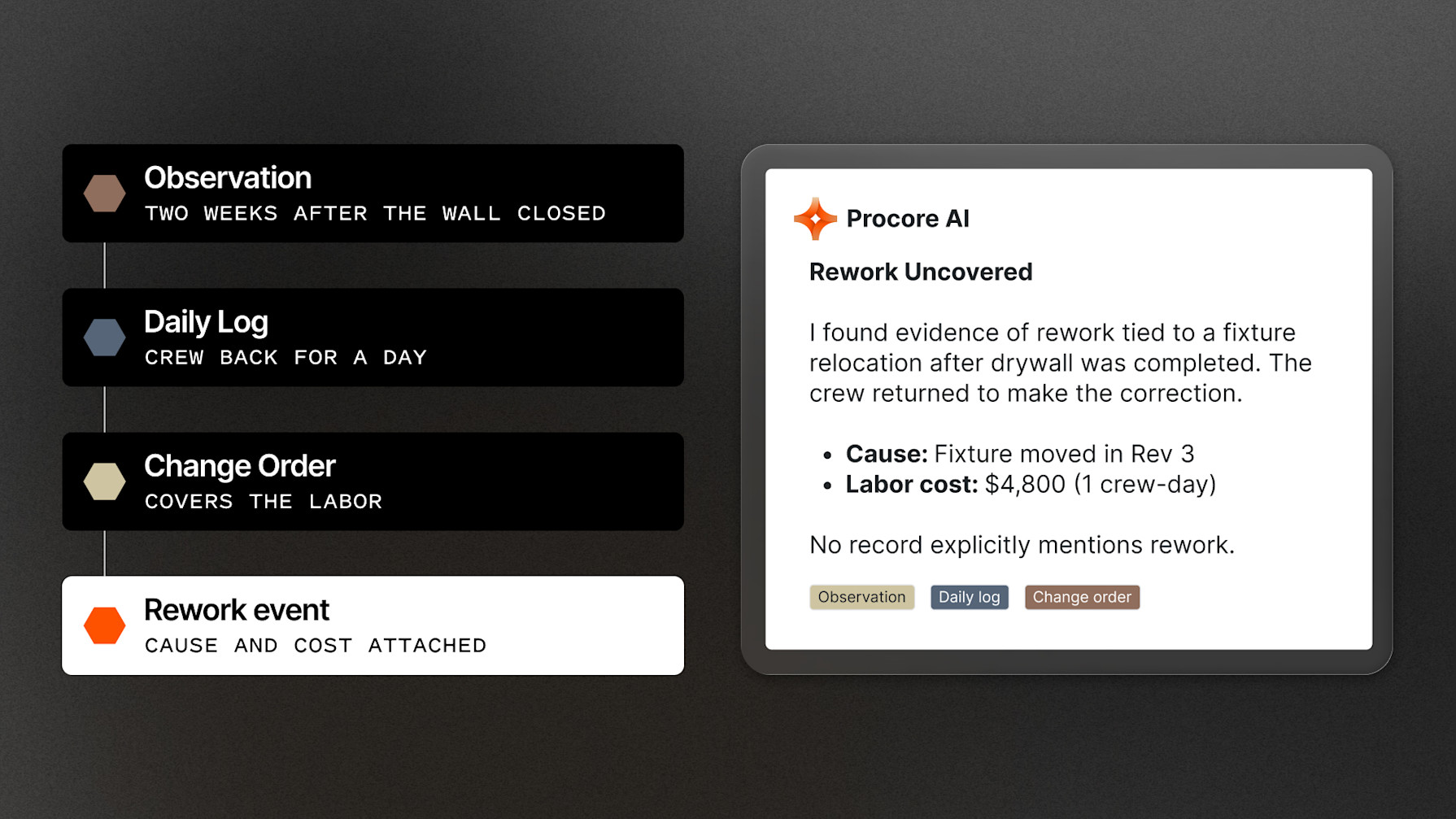
The construction ontology provides the relational intelligence of Procore AI. The ontology serves as a live map of construction logic built from over 20 years of industry experience. It connects static records with the real-world language, logic, and relationships of the jobsite. It establishes this map across primary tools like RFIs, Submittals, Observations, Daily Logs, Meetings, Drawings, Photos, and Change Events. From there, it expands to capture critical information that isn’t listed in formal database records at all, like risks or decisions from meeting minutes, visual conditions in site photos, or section callouts on a plan, weaving these fragmented dots into a project’s living context. It also deciphers jobsite terminology and shorthand contextually, naturally distinguishing whether “subs” refers to subcontractors or submittals based on the surrounding workflow context.
Crucially, the ontology does not just map relationships—it identifies patterns. Just as a veteran superintendent recognizes recurring warning signs based on decades on site, the ontology can uncover systemic patterns and event chains across disparate field data before they can escalate into rework. If an inspection notes concrete honeycombing, a daily log documents patching, and a change event tracks extra labor, the ontology connects them to the same trade, assembly, and location, allowing Procore AI to surface the emerging rework risk and quantify the financial impact while teams still have time to intervene.
3. Magpie 3.0: construction-native reasoning engine
The reasoning engine is the part of Procore AI that thinks through complex problems. Where general AI grabs the first match it finds, Magpie uses the ontology's relational map to evaluate the entire project picture before delivering an answer.
Magpie 3.0 is rebuilt from the ground up to be faster, more accurate, and more cost-efficient. It excels at multi-step problems that span disparate records, such as cross-referencing submittal packages against complex spec divisions and multiple drawing revisions simultaneously. Behind the scenes, Magpie intelligently picks the right tool for each step, dynamically determining whether an image analyzer, a drawing vectorizer, or a document parser will produce the cleanest result. It then grounds every conclusion with direct citations pointing straight to the governing drawing detail, spec section, or project record.
This reasoning in the field was recently demonstrated on an active project with California-based builder Bernards. Project Manager Joseph Kim used Procore AI to review an emergency generator submittal. While the submittal satisfied the primary mechanical specification, Procore AI flagged a requirement buried in a completely separate electrical spec section: the automatic transfer switch was mandated to come from the exact same manufacturer as the generator.
“It caught something from a different spec. I probably would have missed that.”
Joseph Kim — Project Manager, Bernards
Typically, that kind of manufacturer mismatch only surfaces during installation or commissioning, triggering costly change orders and schedule delays. Because Procore AI connects and reasons across all project data, it surfaced the conflict before it became a fire drill.
Putting Procore AI to the test: proving AI on real work
The broader technology sector evaluates AI using academic benchmarks or generic coding exams. But an AI's ability to answer trivia or pass a bar exam tells you nothing about whether it can identify a missing structural tie or assess downstream schedule exposure.
To establish a benchmark for our industry, we created a system-agnostic evaluation framework that measures how well AI systems execute real-world construction workflows.
The primary question our benchmark answers is: "Can the AI successfully complete the construction task?"
Methodology and framework
Our construction benchmark evaluates the complete, end-to-end AI model under realistic conditions: retrieval, reasoning, cross-document tracing, and professional output generation.
Over 200 real-world tasks: Tasks were built directly from questions and jobs-to-be-done contributed by practicing superintendents, project managers, and project executives.
Five priority workflow families:
RFI management: Investigating root causes, identifying linked drawing callouts, catching duplicates, and evaluating schedule impacts.
Submittal management: Cross-checking submittals against complex spec divisions, identifying non-approved substitutions, and flagging lead-time risks.
Drawings and specifications: Resolving revision-sensitive details, tracing section cuts across sheets, and detecting constructability clashes.
Schedule and delay: Evaluating float, identifying critical-path impacts from field observations, and analyzing trade sequencing.
Cost and change: Identifying unapproved scope changes, calculating budget exposure across cost codes, and validating potential change orders.
Multi-tier difficulty rubric: Tasks are classified as Easy, Medium, Hard, and Expert. Expert tasks generally require cross-record investigations where obvious surface answers are incomplete and professional judgment is required.
Equal footing for frontier models: We compared Procore AI against leading flagship models—OpenAI's GPT, Anthropic's Claude, and Google's Gemini™. All systems were given the same project data and tasks. The frontier models were connected through Procore’s public API, the same route a customer integrating them today would use.
Measuring success: The primary metric is Task Success Rate. A task only passes if it is correct and supported by the project record. Execution speed and cost are measured independently.
To help ensure the framework reflects rigorous professional standards, the task scenarios, rubrics, and ground-truth answers were independently reviewed by Thomas Kommer from the California Center for Construction Education at California Polytechnic State University (Cal Poly), San Luis Obispo.
"Construction isn’t a series of isolated text files; it’s a dynamic web of interdependencies where a single detail on a structural sheet can ripple across schedules, subcontract obligations, and project budgets. When reviewing the benchmark tasks, what stood out was the demand for authentic jobsite logic—not just interpreting drawings, but understanding how revisions can trigger change orders, disrupt sequencing, affect payment rights, and expose parties to contractual liability and financial loss. AI that can trace callouts across revised drawing sets and assess the downstream schedule, contractual, and financial risks reflects the kind of critical thinking experienced builders rely on every day."
Thomas Kommer JD, SHRM-SCP — Faculty, California Center for Construction Education, Construction Management Department at Cal Poly San Luis Obispo
Benchmark in action: real tasks, head-to-head
Here is a look at two tasks from the evaluation, featuring representative sample outputs from the test suite.
Task 1 (hard difficulty): tracing egress path
This task evaluates whether an AI system can resolve drawing callouts across multiple project sheets:
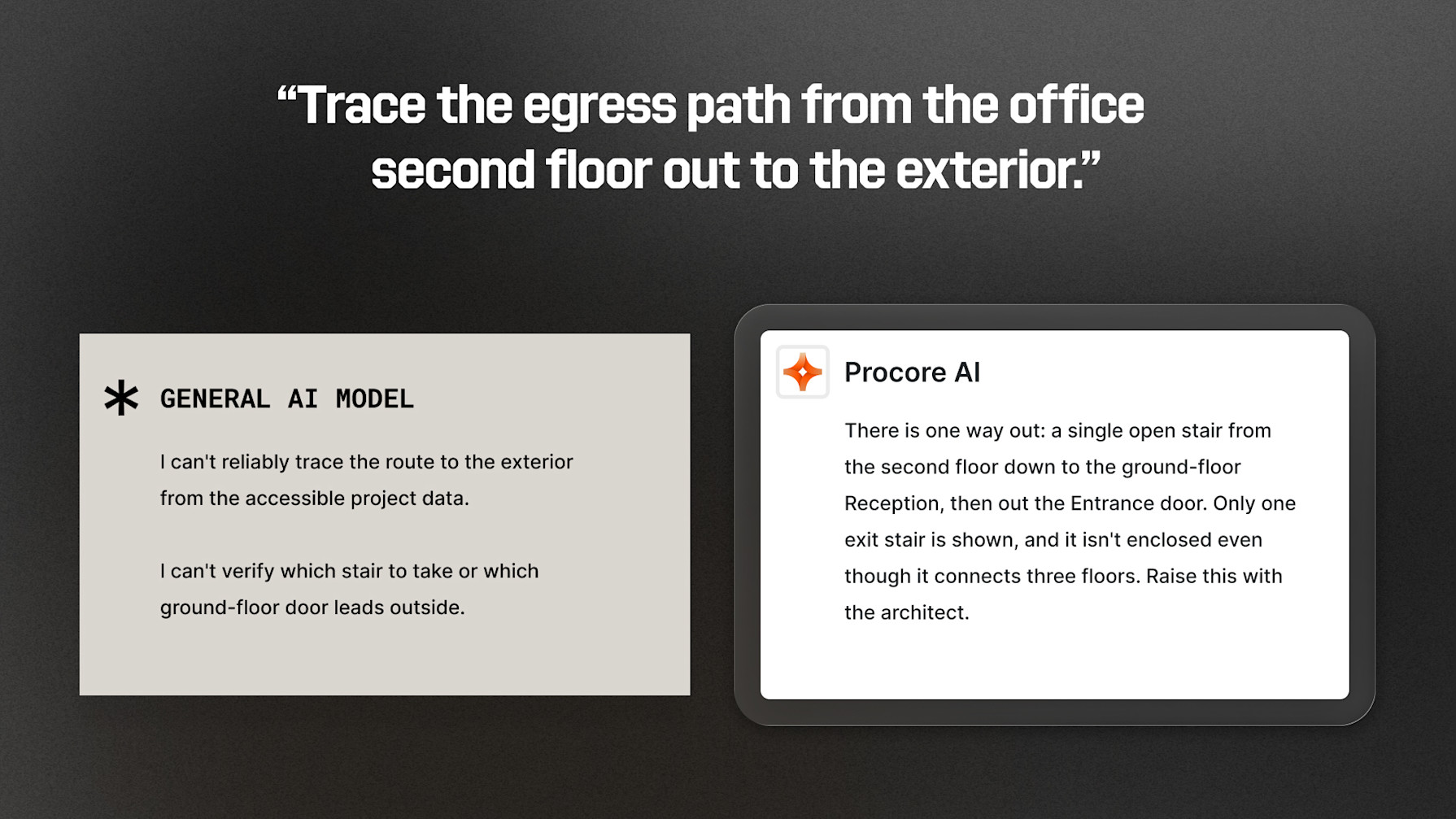
Task prompt: "Trace the egress path from the office second floor out to the exterior."
Leading frontier model (direct API access): “I can't reliably trace the route to the exterior from the accessible project data. I can't verify which stair to take or which ground-floor door leads outside.”
The egress path is not documented, so the general model isn't able to trace the route.
Procore AI (Magpie 3.0): “There is one way out: a single open stair from the second floor down to the ground-floor Reception, then out the Entrance door. Only one exit stair is shown, and it isn't enclosed even though it connects three floors. Raise this with the architect.”
Procore AI correctly identifies the stair path on the second floor and traces it to the entrance. It even told the user exactly what to confirm with the architect.
Task 2 (hard difficulty): resolving conflicting drawing revisions
This task evaluates whether an AI system can resolve contradictory drawings sets and determine the current governing revision:
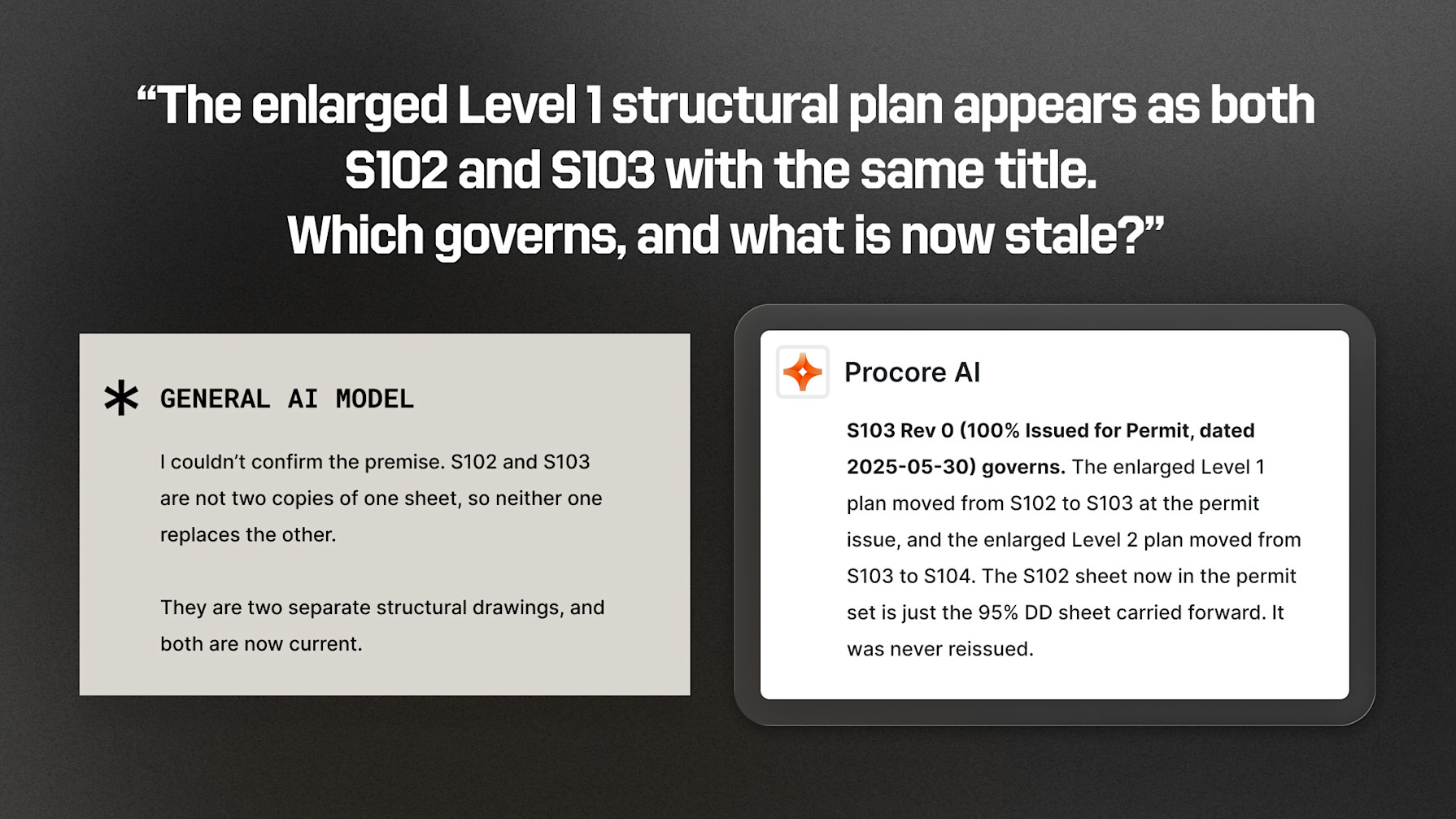
Task prompt: "The enlarged Level 1 structural plan appears as both S102 and S103 with the same title. Which governs, and what is now stale?
Leading frontier model (direct API access): "I couldn’t confirm the premise. S102 and S103 are not two copies of one sheet, so neither one replaces the other. They are two separate structural drawings, and both are now current.”
The model performed a simple document index on titles and numbers, failing to identify the governing sheet.
Procore AI (Magpie 3.0): "**S103 Rev 0 (100% Issued for Permit, dated 2025-05-30) governs.** The enlarged Level 1 plan moved from S102 to S103 at the permit issue, and the enlarged Level 2 plan moved from S103 to S104. The S102 sheet now in the permit set is just the 95% DD sheet carried forward. It was never reissued.”
Procore AI traced drawing issue sets, revision dates, and plan migration history to identify the stale 95% DD carry-forward in S102.
The results: Procore AI vs. leading frontier models
When run across the full test suite under identical, controlled conditions, the difference between general-purpose models and construction-native AI is substantial:
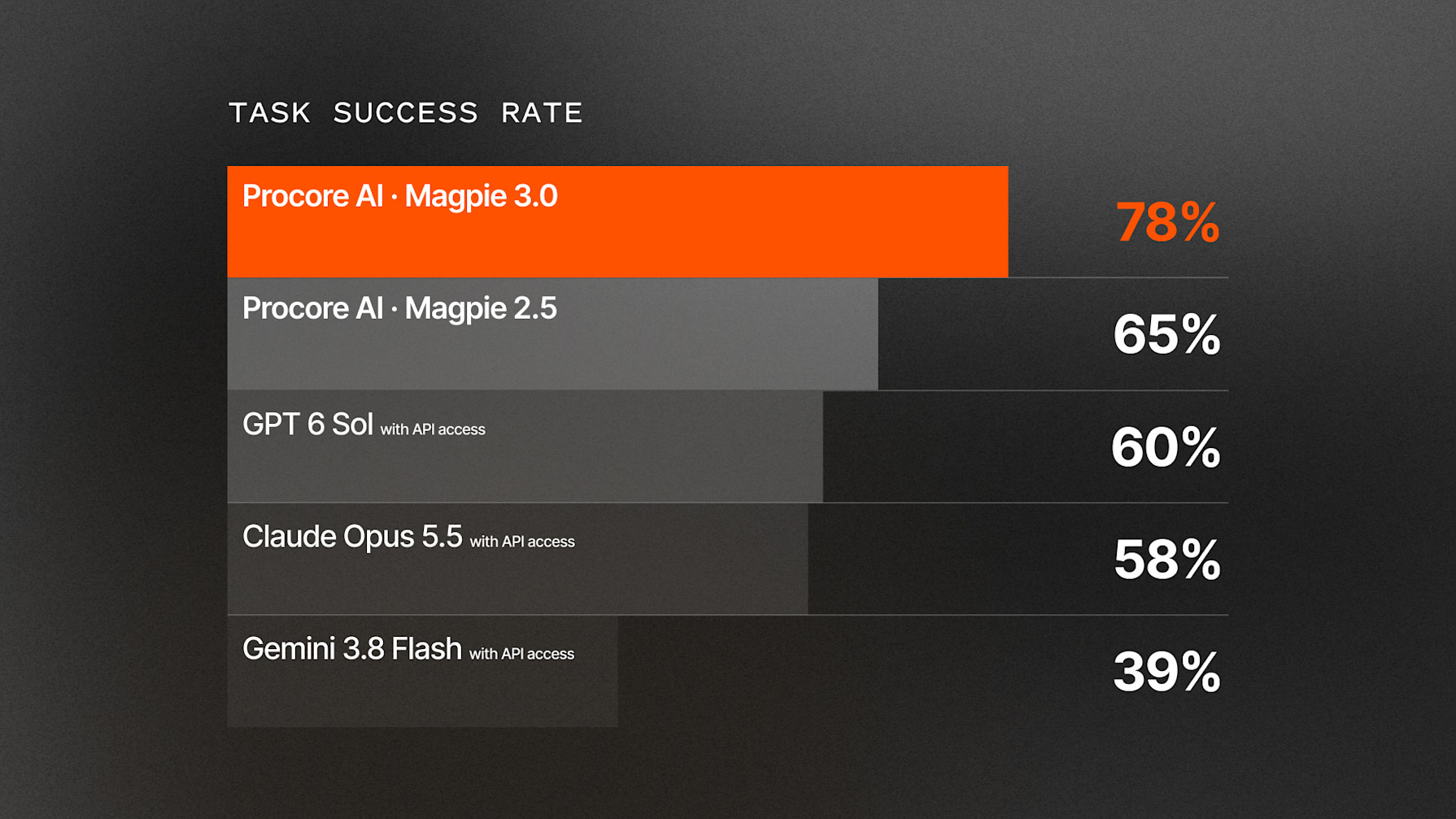
Magpie 3.0 achieved a 78% task success rate, outperforming the closest general-purpose frontier model by an 18 percentage point margin.
This performance gap underscores why general-purpose LLMs hit a ceiling on the jobsite. General-purpose models attempt to solve construction problems by brute-forcing text search across unorganized files. Because Procore's multimodal index and construction ontology organize project context upfront, Magpie 3.0 understands drawing callouts, spec hierarchies, and schedule connections before reasoning through the task.
To understand the weight of that 78% metric, it is important to remember the difficulty of the tasks and the strict pass/fail criteria. Most tasks are not simple document retrieval queries. Our internal industry experts noted that tracking down answers for some of our hard or expert questions would take a seasoned professional hours to complete.
Because the benchmark requires a complete and correct answer, a “failure” simply means the final response wasn’t field-ready. But in the real world, where your team can use their judgment with outputs, an AI + human workflow is immensely powerful. Even if a digital coworker successfully searches thousands of documents, cross-references the right specification, and tees up the exact drawing but misses a minor citation, it still can save the project manager hours of manual hunting. That is the true advantage of AI built specifically for construction: doing the heavy operational lifting so human experts can apply their judgment, review the findings, and make the final call.
This is an early preview of benchmark results that we shared at Groundbreak 2026. In the near future, we will publish the full results. As leading frontier models evolve, we are committed to updating our task suites and sharing these results transparently.
Putting construction intelligence to work
The promise of AI in construction isn't writing generic emails or summarizing PDFs. It is about building an intelligent digital coworker that understands how your project connects, helping spot errors before they can become change orders, protecting schedule milestones, and freeing your best people to focus on the craft of building. We are committed to building the best AI solution in construction.
Multimodal Index is generally available across all Procore AI packages today.
Magpie 3.0 is available now in open beta for Procore AI customers via Procore Explore.
Construction Ontology is already built into Procore AI, providing the foundational relational map for project records. Certain capabilities previewed at Groundbreak—including linking drawings and photos, spatial intelligence, and automated rework pattern detection—will roll out continuously over the coming year.
To explore our construction-native AI and learn how our Digital Coworker packages can support your teams, visit procore.com/ai.
To watch our AI product keynote “From Intelligence to Impact” and hear more from Procore leadership on the future of Procore AI, register for Groundbreak+.
Written by