
How real-time AI and standardized workflows are transforming construction productivity



Last Updated Aug 5, 2026
Scott Bornman
Principal, Operational Excellence
17 articles
Scott Bornman is a managing strategic product consultant at Procore Technologies. Scott began his long construction career after a successful 8+ years in the U.S. Army, where he selected to be U.S. Army Recruiter following Desert Shield/Desert Storm. Scott has had many roles in the construction field since then, working his way from a project superintendent, to an owner's rep, to a senior project manager and even Vice President of Construction at Bognet Construction and Director of Construction at Plaza Construction before joining the team at Procore.
Albert Fadel
CEO
After 10+ years working in the construction industry in the glazing trade, Albert Bou Fadel dedicated his life to one mission: to transform the way contractors manage their workforce and lead their crews. On jobsites, Albert saw first-hand the constant struggles with inaccurate timesheets, payroll disputes, and the endless stress of managing labor. He realized the problem wasn’t just lost hours — it was lost leadership. Contractors were buried in paperwork instead of leading their people. That realization shaped the vision for SmartBarrel. Under his leadership, SmartBarrel was built as more than a timeclock. It’s a rugged, construction-first system that captures 100% accurate labor data and feeds it back in real time, giving every contractor — from foreman to executive — the clarity to make faster, smarter decisions. But Albert’s vision goes far beyond time tracking. His dream is to build the ultimate workforce management co-pilot: a solution where hardware, software, and AI work together to turn contractors into exceptional leaders. SmartBarrel doesn’t just remove the stress and guesswork from managing workers — it empowers teams to perform at their best and helps leaders grow into the role they always aspired to be. He’s committed to building tools that contractors don’t just use — they depend on to build stronger crews, stronger companies, and a stronger industry.
Marlissa Collier
42 articles
Marlissa Collier is a journalist whose work focuses on the intersections of business, technology, policy and culture. Her work has been featured in digital and print formats with publications such as the Dallas Weekly, XO Necole, NBCU Comcast, the Dallas Nomad, CNBC, Word in Black and Dallas Free Press. Marlissa holds an undergraduate degree in Construction Engineering from California State University, Long Beach and an MBA from Southern Methodist University’s Cox School of Business.
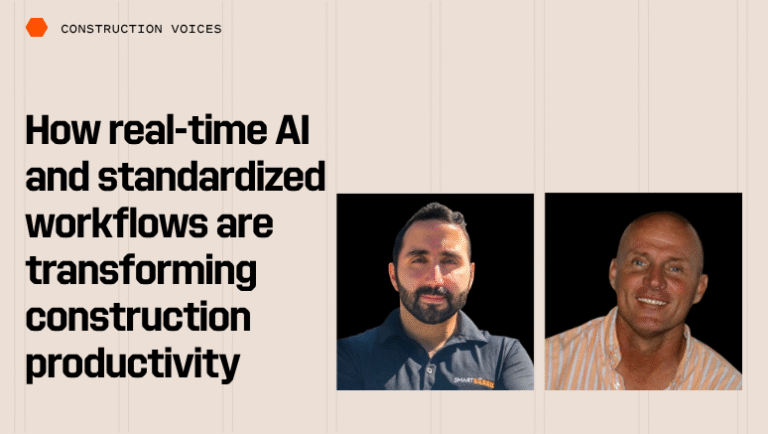
In a candid discussion, construction data expert Scott Bornman and SmartBarrel CEO Albert Bou Fadel explore the massive challenge facing the industry: bridging the gap between overwhelming data volume and actionable, real-time decisions.

Scott Bornman, Strategic Business Architect & Data Expert, Procore Technologies

Albert Bou Fadel, CEO, SmartBarrel
Their consensus highlights that AI's success hinges not on advanced robotics, but on establishing rigorous data standards and winning over the worker in the field.
Table of contents
The productivity trap: When unique projects meet slow data
Construction projects produce enormous amounts of data, but much of it arrives too late to be useful.
Scott: We are dealing with an overwhelming amount of information. I see 250 terabytes of fresh data every month. There is simply no way that I, or anybody, can sort all of that data.
We’ve always recognized in construction that there’s more data available than a human can consume. The data you finally get is retrospective and already too late by the time you have insights. The core problem is that in construction, every product is like an MVP, a unique prototype. We don't have the luxury of repeating the same process 15 times to get into a rhythm, like in manufacturing, because everything is unique.
If every project is unique, then feedback has to be immediate, otherwise, the learning is useless.
Albert: This feedback loop is currently very large. You have the worker doing the act, maybe digitizing it days later, then it goes through approval, extraction to a data warehouse, visualization on a dashboard for the C-suite, and finally back down to the foreman. We’re like three weeks out.
This loop needs to be reduced to minutes. The goal of AI is precisely to shorten that loop so you can rectify an issue instantly—like an incident, a delivery problem, or a concern about a worker—without having to wait six weeks for a web report to come out.”
The Achilles heel: The custom field problem
While data collection is plentiful, both experts agree that most of it is practically useless without governance.
Scott: We don't run into issues with collecting data—there’s data everywhere. It’s not data hygiene, because 95% of it’s garbage. It's data governance. Companies aren't even telling their people how to make the data accessible.
Albert: I think that the industry’s biggest Achilles heel is two things: workarounds and custom fields. Those two things are really going to destroy this industry. A salesperson will say, ‘We don't have this feature, but you know what? Put equipment here, or rename this field to ‘building’,’ just to unblock the sale.
Scott: But construction often allows for those workarounds to facilitate adoption. If a competitor says, ‘Yeah, cool, let me mimic that paper form for you,’ they win the business.
Albert: They win the business, but now I’m looking at the data from 350 different customers, and I have no idea what I’m looking at. They’re using an employee as equipment, or an RFI as a change order. I have no clue what I'm even reading. What we’ve done — and this comes from my 11 years of hardcore construction — is we do not customize anything. We have zero custom fields. We are the most stubborn company.
Scott: How do you overcome the barrier to adoption when you’re essentially telling the customer, ‘I’m not doing it your way. We’re doing it this way’?
Albert: If I approached it like that, I would be out of business in two weeks. What we say is: 'In order to deliver the highest quality of accurate data and information in real time, we suggest you do it this way.'
This resonates, especially when I talk about payroll. They say, ‘You know what? You're winning. If you can give me accurate real-time visibility on my workers and payroll, I’m willing.’
Scott: Otherwise, at the end, you really have no idea what you’re even looking at.
The revolution: Building technology bottom-up
For technology adoption, both experts emphasize that solutions must be built for the field first, not executives. Scott asks about tracking adoption and managing slower users, and Albert explains SmartBarrel’s philosophy on adoption success.
Scott: If I can roll in on any seven-day cycle, do a two-week implementation, and then we're ready, how do you track successful adoption? And how do you coach companies on managing the laggards who aren’t adopting as quickly as they should?
Albert: We never built a solution top-down. We built it bottom-up, meaning the solution looks like it was built for a construction worker that the foreman can actually use. You have to build the dumbest, simplest solution you’ve ever thought of. For hardware, we ship a device to the foreman. It's magnetic. It has built-in LTE. It can even be powered through a Milwaukee or a DEWALT power tool battery. It’s up and running within like three minutes.”
Once you have this intuitive DNA, you start getting 280 of the 300 adopted in like five days. Now you have the 20 laggards. Then it becomes a very awkward conversation. Then it’s not, 'Why is it not working?' It’s, 'Why do you not want to use it?'. We are doing all our marketing for the field, because we know at the end of the day what makes us or breaks us is the ground up.
Scott: Who gives a darn about the CEO? He's not never put on a hard hat.
Albert: Exactly. We’re building it from the ground up. The office is here to support the field, but nobody seems to get it. They see the office as an overhead or a burden.
The industry has been relying on metrics of averages. That skews a lot of reality. Like, if you’re driving and your speedometer is accurate, you know how fast you’re going. But if it’s averaging the last seven days, I don’t know if you’d even look at the speedometer. We’re trying to strip this to get a speedometer. Can you see where you are at now?
The future: Agentic AI and the mindset shift
Both experts grounded the discussion in the limits of high-tech automation.
Albert warns of the following:
Albert: Advanced technologies like putting a camera on your head or sending a robo-dog are impractical for most sites. That dog costs $50,000 to $75,000 and needs an operator making over $100,000 a year.
Scott: You’re right. Only about 14% of job sites are actually BIMed in 3D and about 2% in 4D.
Albert: Exactly. So what do you do with the 85%—the regular drywaller, the concrete contractor? They’re doing high-rises, but they’re not BIM-modeled, so I have nothing to even compare the robot’s pictures to.
When asked what the industry might look like in five years, Albert speculates:
Albert: There’s a big chance that we are exactly where we are now. But one version is that AI has really taken over, and Procore is not even a user interface; it’s a lot of agentic workflows. You have a virtual foreman, virtual superintendent, and virtual estimators assigning tasks.
Scott: I actually think BIM becomes not a thing. And AI processes all of BIM. AI becomes very agentic in its thinking for you: I did this; cool. Let me just lay it over against the BIM and mark it off and tell you if it’s right or wrong.
Albert: That’s the future. But getting there requires a shift now, because what I’ve learned is that everybody loves change, but nobody wants to change.
If you want to win the next 10 years race, you have to switch the gear in your head. Stop viewing the workforce with a ‘survival mindset’ where they are a burden. This is a team. This is core. This is shared profit. Invest in them. Grow them. Change the mindset.
Was this article helpful?
Scroll less, learn more about construction.
Subscribe to The Blueprint, Procore’s construction newsletter, to get content from industry experts delivered straight to your inbox.
By clicking this button, you agree to our Privacy Notice and Terms of Service.
Categories:
Written by
Scott Bornman
Principal, Operational Excellence | Procore Technologies
17 articles
Scott Bornman is a managing strategic product consultant at Procore Technologies. Scott began his long construction career after a successful 8+ years in the U.S. Army, where he selected to be U.S. Army Recruiter following Desert Shield/Desert Storm. Scott has had many roles in the construction field since then, working his way from a project superintendent, to an owner's rep, to a senior project manager and even Vice President of Construction at Bognet Construction and Director of Construction at Plaza Construction before joining the team at Procore.
View profileAlbert Fadel
CEO | SmartBarrel
After 10+ years working in the construction industry in the glazing trade, Albert Bou Fadel dedicated his life to one mission: to transform the way contractors manage their workforce and lead their crews. On jobsites, Albert saw first-hand the constant struggles with inaccurate timesheets, payroll disputes, and the endless stress of managing labor. He realized the problem wasn’t just lost hours — it was lost leadership. Contractors were buried in paperwork instead of leading their people. That realization shaped the vision for SmartBarrel. Under his leadership, SmartBarrel was built as more than a timeclock. It’s a rugged, construction-first system that captures 100% accurate labor data and feeds it back in real time, giving every contractor — from foreman to executive — the clarity to make faster, smarter decisions. But Albert’s vision goes far beyond time tracking. His dream is to build the ultimate workforce management co-pilot: a solution where hardware, software, and AI work together to turn contractors into exceptional leaders. SmartBarrel doesn’t just remove the stress and guesswork from managing workers — it empowers teams to perform at their best and helps leaders grow into the role they always aspired to be. He’s committed to building tools that contractors don’t just use — they depend on to build stronger crews, stronger companies, and a stronger industry.
View profileMarlissa Collier
42 articles
Marlissa Collier is a journalist whose work focuses on the intersections of business, technology, policy and culture. Her work has been featured in digital and print formats with publications such as the Dallas Weekly, XO Necole, NBCU Comcast, the Dallas Nomad, CNBC, Word in Black and Dallas Free Press. Marlissa holds an undergraduate degree in Construction Engineering from California State University, Long Beach and an MBA from Southern Methodist University’s Cox School of Business.
View profileExplore more helpful resources

Does your asset management workflow actually work?
Every fixed asset installed on a project generates data long before handover. Is your team capturing it as it happens, or scrambling to reconstruct it after the fact? That question...

From spec book chaos to single source of truth
Picture this: An expansion is going in directly beside a high-volume line that cannot stop producing. Structural steel lands in March, mechanical completion is promised for August, and your only...
The hidden risk of relying on your EPC partner for project visibility
Many owners have thought some version of “We don’t need a capital project management platform — our EPC partner manages all of this for us.“ It’s a reasonable position. Your...

Why manufacturing owners are still managing capital projects like it’s 2010
There is a machine on your plant floor right now that knows it’s going to break. A sensor is reading a vibration signature on a bearing about three weeks before...
Free Tools
Calculators
Use our calculators to estimate the cost of construction materials for your next project.
Templates
Find a template to help you with your construction project tasks.
Material Price Tracker
Get the latest U.S. retail prices and view historical trends for common building materials.
Glossary
Explore key terms and phrases used in the industry.