
Good vibrations: How specialty contractors can use tech to build — and keep — a strong reputation


Last Updated May 8, 2026
Jacob Kunken
Solutions Engineer, Heavy Civil
29 articles
Jake Kunken currently works as Solutions Engineer for Procore's Heavy Civil division. He brings 14 years of experience working in various construction roles in New York and Colorado, including laborer, assistant carpenter, carpenter, assistant superintendent, superintendent, construction manager, safety manager, and project manager. Jake also spent time in EHS as an environmental engineer for Skanska. He’s worked on more than 40 commercial projects from ground-up, to heavy civil, hospital work, and tenant improvement. Jake studied Ecological Technology Design at the University of Maryland.
Diane McCormick
Writer
57 articles
Diane McCormick is a freelance journalist covering construction, packaging, manufacturing, natural gas distribution, and waste oil recycling. A proud resident of Harrisburg, PA, Diane is well-versed in several types of digital and print media. Recognized as one of the premier voices in her region, she was recognized as the Keystone Media Freelance Journalist of the Year in 2022 and again in 2023.

“It takes 20 years to build a reputation and five minutes to ruin it.”
These famous words from Warren Buffet serve as a warning to MEP firms striving for market leadership.
Every time they send out workers who radiate negativity and do a poor job, their hard-won status is at risk.
So how can MEP leaders make their people care?
Classic incentives now have a powerful partner in the technology that is transforming construction worksites through greater efficiencies and risk avoidance.
Table of contents
The elements that create a reputation
Definitions differ, but one researcher, Dr. Patrick Haack of the University of Lausanne, told Forbes that there are two types of corporate reputation: Capability reputation, which registers how competently a company delivers its product or service (measurable by financial performance), and character reputation, which spotlights the company’s integrity and trustworthiness.
Despite its intangibility, there's more to see — and judge — about a company’s character than capability. In essence, people who see one employee behaving badly tend to assume that it’s an organizational trait.
In construction’s highly competitive atmosphere, a positive character reputation built on reliable execution and strong relationships is a key asset. When equally capable firms face off, character can make the difference that wins high-margin jobs and propels growth.
I could sell some beautiful analytics dashboard to a CFO, a CEO, or COO about compliance, or budgets, or variants, or whatever. Does the guy in the field at the end of the day care that that dashboard exists, care that what he does ends up in that dashboard? How do you make that guy care about using these tools better?
Jacob Kunken
Solutions Engineer, Heavy Civil
Procore Technologies
Transparency, rewards, and careers: 3 tech-based tips
Cohesive, collaborative teams of contractors, superintendents, and crew leaders are essential to accelerating progress and improving morale across jobsites.
Subcontractors can help sustain those relationships by deploying crews that align with the job’s demands — especially clearing their A crews to work on high-stakes jobs — and promoting transparency and goal-sharing throughout their organizations.
These technology-aided tips can burnish reputations by bringing out the best in people.
1. Open the books.
The reams of data and KPIs available through project management software are hidden assets in reputation-building.
What are the goals for the next quarter? Did crews meet their targets for the previous quarter? Did the profit margin hold steady on the last project, or was there slippage?
Sharing vital information about current progress and past performance explains the “why” behind the rules that crew members are expected to — but don’t always — follow. Through data and graphics, viewers see direct links between their daily tasks and their ability to thrive.
And as crew members see their contributions take shape, they realize that company executives get the same reports on a regular cadence. Their hard work is noticed and appreciated.
Reputation takes a long time to build and a second to destroy, and so that’s something that certain folks in the organization absolutely are about — the CEO, the operations manager — and then there’s people who don’t care and should be incentivized more to care.
Jacob Kunken
Solutions Engineer, Heavy Civil
Procore Technologies
2. Reward appropriately.
When incentivizing goals, balance the ask and the reward equally. A $5 coffee gift card hardly compensates for adding two hours to someone’s day for a week.
To craft meaningful rewards, use digital surveys and feedback tools to discover what team members value most. For example, parents might be more interested in flex time than gift cards. On the other hand, substantial gift cards to a sporting goods store as hunting season nears could be highly motivating.
Retailers’ corporate rewards programs allow employers to issue incentives digitally, so those hard-working employees don’t find themselves at the hardware store without their gift cards.
3. Create clear career ladders.
The jobsite’s data-entry and -analysis tools can be framed for their motivational power to build and enhance careers. As workers see their achievements converted into data, they make connections between initiative and opportunities for advancement.
Initially, the effort can utilize existing tools that collect and display basic metrics. As individuals show potential, the KPIs can be customized to establish expectations, measure progress toward essential skills, and suit personal goals.
Success can be a feeling, or success can be a measurement.
Jacob Kunken
Solutions Engineer, Heavy Civil
Procore Technologies
The power of 'technology buddies'
How employees experience technology can cause job satisfaction or resentment, depending on whether it simplifies daily tasks or creates new headaches.
Workers new to MEP might be comfortable with technology, but they aren’t necessarily steeped in how their software emerged from the history and best practices of the trades.
Without the hands-on experience of the past, they might not understand why they should enter particular measurements, turn a wrench a certain way, or watch for discrepancies between the plans shown on their tablets and actual installations.
In the meantime, veteran workers could be struggling to incorporate technology into the practices they have honed for decades. Both sides can undermine reputation by heightening risk, creating disruptions, and diminishing work ethic.
One solution is pairing them off, making "technology buddies" from digital-native apprentices and skilled journeymen, to reach across the digital divide.
In a bidirectional tradeoff, experienced hands learn to navigate the new tools of technology, while apprentices absorb knowledge handed down from generations of construction workers.
This requires more than just a seating chart — you'll need a structured environment where both parties feel their expertise is valued. To make these pairings successful, leadership should frame the initiative as a knowledge exchange rather than a remedial training session.
For instance, a veteran superintendent can walk a digital-native apprentice through a complex installation, explaining the "why" behind the physical work. Simultaneously, the apprentice can demonstrate how to capture that specific milestone in their construction management platform, showing the veteran how their decades of manual expertise now feeds into the real-time dashboards.
This collaborative approach can serve as a powerful tool for employee retention and culture building. By Creating and formalizing these "technology buddy" partnerships makes a safe space for veterans to ask technical questions without fear of judgment, while giving newer hires an immediate sense of purpose and a direct line to mentorship.
This can reduce the friction and "tech headaches" that often lead to resentment or job dissatisfaction on the worksite. When a worker sees that their unique perspective — whether it’s tech-savviness or trade wisdom — is a valuable part of the team’s success, everyone wins.
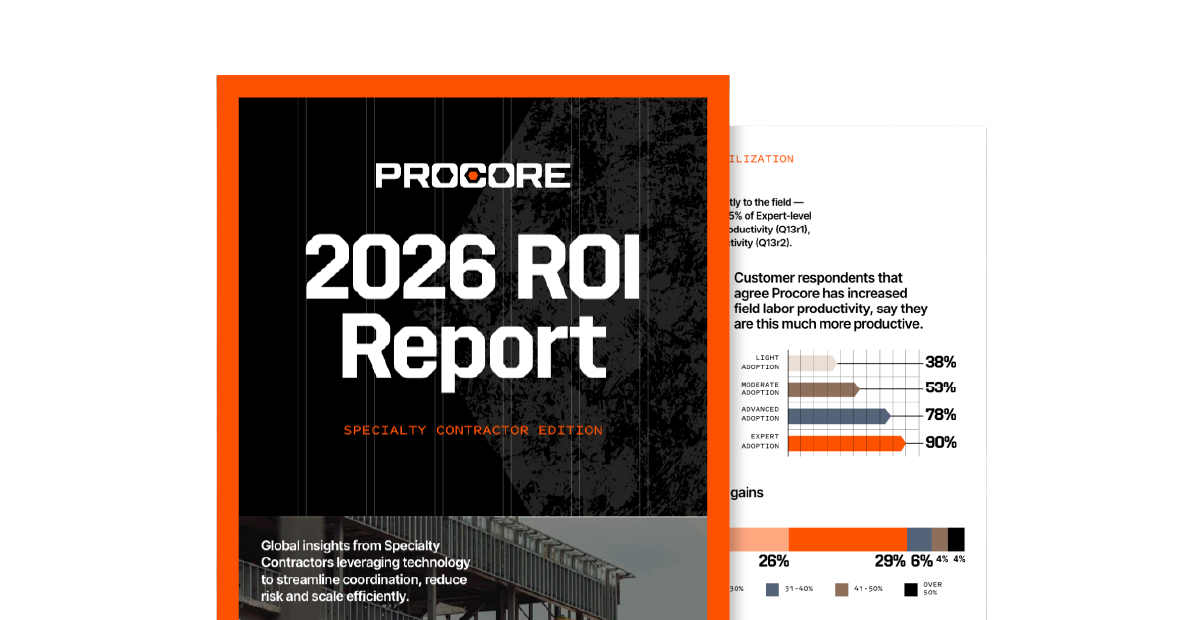
Turn tech adoption into real ROI.
In this exclusive 2026 ROI report from Procore and Dodge Analytics, learn the strategies of top specialty contractors who are achieving measurable gains through data ownership, management, and analysis.
Creating a reputation to build on
As construction becomes more demanding, attention to detail protects good reputations. With technology’s all-seeing eye, MEP subcontractors have the power to track, distill, and share the metrics of success and promote enterprise-wide integrity that fuels prosperity and strategic growth.
The "technology buddy" system does more than just bridge a generational gap: It can help fortify the important character reputation that sets leading MEP firms apart while allowing leadership to create a culture of mutual respect and continuous learning by valuing and using the "old wisdom" of the trades as much as new digital proficiency.
Was this article helpful?
Scroll less, learn more about construction.
Subscribe to The Blueprint, Procore’s construction newsletter, to get content from industry experts delivered straight to your inbox.
By clicking this button, you agree to our Privacy Notice and Terms of Service.
Categories:
Written by
Jacob Kunken
Solutions Engineer, Heavy Civil | Procore Technologies
29 articles
Jake Kunken currently works as Solutions Engineer for Procore's Heavy Civil division. He brings 14 years of experience working in various construction roles in New York and Colorado, including laborer, assistant carpenter, carpenter, assistant superintendent, superintendent, construction manager, safety manager, and project manager. Jake also spent time in EHS as an environmental engineer for Skanska. He’s worked on more than 40 commercial projects from ground-up, to heavy civil, hospital work, and tenant improvement. Jake studied Ecological Technology Design at the University of Maryland.
View profileDiane McCormick
Writer | Procore Technologies
57 articles
Diane McCormick is a freelance journalist covering construction, packaging, manufacturing, natural gas distribution, and waste oil recycling. A proud resident of Harrisburg, PA, Diane is well-versed in several types of digital and print media. Recognized as one of the premier voices in her region, she was recognized as the Keystone Media Freelance Journalist of the Year in 2022 and again in 2023.
View profileExplore more helpful resources
What I Learned the Hard Way: Fred Mills on changing the narrative of construction
Fred Mills, founder of The B1M, set out to change how the world sees construction. What began as an ambitious idea on a Post-it note grew into one of the...

Does your asset management workflow actually work?
Every fixed asset installed on a project generates data long before handover. Is your team capturing it as it happens, or scrambling to reconstruct it after the fact? That question...

From spec book chaos to single source of truth
Picture this: An expansion is going in directly beside a high-volume line that cannot stop producing. Structural steel lands in March, mechanical completion is promised for August, and your only...
The hidden risk of relying on your EPC partner for project visibility
Many owners have thought some version of “We don’t need a capital project management platform — our EPC partner manages all of this for us.“ It’s a reasonable position. Your...
Free Tools
Calculators
Use our calculators to estimate the cost of construction materials for your next project.
Templates
Find a template to help you with your construction project tasks.
Material Price Tracker
Get the latest U.S. retail prices and view historical trends for common building materials.
Glossary
Explore key terms and phrases used in the industry.