
Using AI to transform construction safety


Last Updated Apr 14, 2026
Hugh Seaton
CEO
Hugh is CEO of The Link.ai, an AI consulting and software company for the construction industry. Prior to The Link.ai, Hugh served as a general manager at the Construction Specifications Institute (CSI). His career has spanned 30 years in technology, at Sony, AOL, Philips Electronics and Google, among others. Hugh is author of The Construction Technology Handbook, host of the Constructed Futures Podcast, and the AI in Construction Youtube channel, and Procore’s Data in Construction e-learning module. Hugh lives in Austin, Texas with his dog, Bob.
Kristen Frisa
Contributing Writer
126 articles
Kristen Frisa is a contributing writer for Procore. She also contributes to a variety of industry publications as a freelance writer focused on finance and construction technology. Kristen holds a Bachelor of Arts in Philosophy and History from Western University, with a post-graduate certificate in journalism from Sheridan College. She lives in Ontario, Canada.
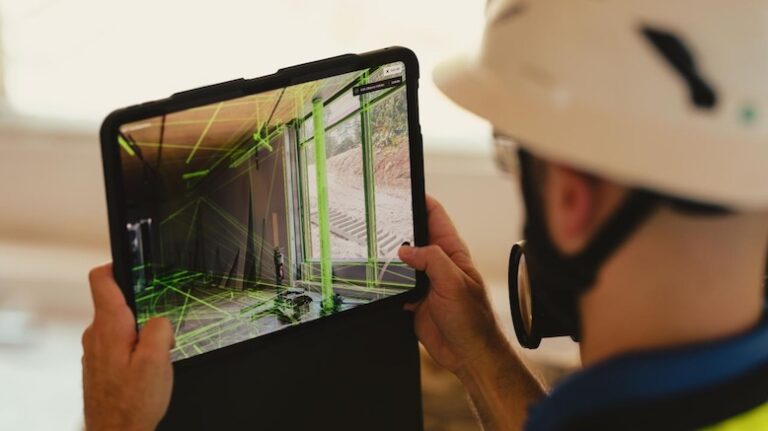
Despite a great deal of attention given to the importance of construction safety in the past years, construction remains the deadliest industry for US employees to work in.
Emerging artificial intelligence (AI) technologies can work in many different ways to improve safety on construction sites — like real-time hazard detection and PPE compliance — to help construction teams recognize risks earlier for more efficient mitigation.
This article will detail how construction teams can integrate AI into their daily construction workflows to make their sites safer. It will discuss the benefits of AI and the key roles it plays in safety, as well as the tools one might use to implement AI on the jobsite.
Table of contents
5 key ways AI can enhance construction safety
Construction leaders are fighting a constant battle to balance their time and budget with the safety measures they adopt. Here's a detailed look at six key ways AI is making construction sites safer.
1. Robotic automation
AI-driven robotic automation has the power to significantly reduce risks associated with dangerous and physically demanding tasks on construction sites.
Robots equipped with sensors can navigate hazardous areas to perform demolition, excavation, or material handling tasks to keep human workers out of harm's way. For example, using autonomous vehicles in construction zones minimizes the risk of accidents caused by human error.
2. Predictive analytics
Construction companies can use AI to analyze historical safety data to identify patterns and trends that predict potential safety risks. Armed with this information, managers can take proactive measures to reduce the likelihood of accidents.
For instance, by analyzing data from specific locations or weather conditions, AI systems can forecast high-risk days or activities so site managers can take extra precautions.
For the most accurate predictions, AI needs access to a historical data set. The problem has traditionally been a lack of overall data to predict risks.
To be predictive about safety, a person has to be walking around a lot, taking notes to gather the data. However, camera technology has made it possible to use cameras mounted for security or placed on a hardhat, to capture a lot of data, which AI can then analyze for safety hazards.
The quantity of good data that gets produced on jobsites is increasing.
Hugh Seaton
CEO
The Link.ai
Combined with a record of detailed daily logs on similar projects, in which field staff noted not just accidents or injuries, but safety issues and near-misses, the team will have a record for the software to flag preceding circumstances for closer inspection on current and future projects.
3. Jobsite security
Drones and smart cameras give managers a bird’s-eye view of site activities to help improve worker safety. Drones can survey large areas very quickly to identify safety hazards or unauthorized personnel.
Smart cameras equipped with AI can monitor for unsafe practices, such as workers not wearing protective gear, and alert supervisors in real-time. This continuous monitoring ensures that risks are mitigated before they escalate into serious incidents.
4. Real-time hazard detection
Making jobsites safer is about mitigating the risks inherent to the job, first by recognizing them, and then by ensuring workers take all necessary precautions to avoid injury.
AI can help ensure those precautions are taken using the same photos and videos many contractors use for progress tracking and security purposes, and analyzing them to identify hazards or flag instances of employees who aren’t wearing proper PPE in designated areas. Combining all the available data helps managers better manage compliance.
Additionally, AI-powered wearables can alert workers to hazardous conditions like toxic gases or excessive noise levels.
5. Automated reporting and compliance
AI can quickly review safety documentation, assessing its compliance with company HSE protocols or incident reports to enforce building safety acts and construction compliance.
Stay updated on what’s happening in construction.
Subscribe to Blueprint, Procore’s free construction newsletter, to get content from industry experts delivered straight to your inbox.

The benefits of using AI to aid construction safety.
The ultimate benefit? AI breaks down information so that safety managers can take fast, decisive action.
Improving construction safety depends on creating a culture that believes in the importance of safety protocols. Presenting data-based statistics about workers’ compliance habits can be an effective way to show them where their behaviors need improvement.
Digital systems mean contractors have more data to work with than ever, as employees use sensors, photos, and videos to better track everything that happens on a construction job site. AI can help analyze and organize the data to make it a useful, and powerful tool for changing behavior.
Here are some of the ways that data can lead to improved construction safety.
Proactive risk mitigation
AI can analyze past project information to provide insights into coming projects, allowing managers to avoid many risks early on.
Faster response times
As AI analyzes large amounts of data, construction managers can quickly react to risks before any incidents occur.
Improved safety culture
Widespread adoption of safety measures requires a high level of buy-in. When workers receive accurate and timely feedback about their performance on safety protocols, it could lead to faster behavioral change.
Reduced costs
Using AI to analyze footage and photos from cameras and drones can produce more insights with fewer people, allowing other employees to use their time more effectively.
AI can help humans sift out information from really long documents. A good role for AI right now is adding it into your process and supporting thought, judgment, and decisions.
Hugh Seaton
CEO
The Link.ai
AI tools that promote enhanced construction safety
Wearables
Some tech can further advance jobsite safety through mounted cameras that AI can use to detect hazards, while other wearble technologies can be used to track workers’ vital signs such as heart rate, temperature and movement, sending notifications to managers to prevent any incidents.
What are wearables?
Wearable technology — also known simply as "wearables" — includes devices people wear to monitor key health metrics, including core body and skin temperatures, exertion and heart rate, step counts and even fall and impact detection.
Other related health monitors — sometimes called “nearables" — can be placed around workplaces to detect high levels of toxic gases, particulate matter, emissions and other hazards.
These devices link to software platforms, enabling the power to issue real-time alerts for people in distress while implementing long-term strategies that advance the mental health and well-being of the construction workforce.
Learn more about how wearable tech can optimize construction safety.
Drones
Drones are able to capture real-time images and videos of construction sites, providing aerial views from a vantage point that is often difficult to achieve otherwise. AI can then assess the footage that help identify potential hazards or safety violations.
Smart cameras
Smart cameras are equipped with AI technology to monitor construction sites continuously, analyzing video feeds in real-time. They can detect unsafe behavior and potential jobsite problems before they occur.
Companies are building more of a safety culture because oversight can be so much more regular. AI can catch when workers aren’t wearing their PPE
Hugh Seaton
CEO
The Link.ai
Future trends for AI in construction safety
Technology has the power to change many aspects of construction operations, from planning all the way to closeout. But for any technology to have a real impact, it has to prove useful in real-life situations.
For instance, technology could make it possible for a manager concerned with safety compliance to automate text messages to employees who haven’t put on the required PPE within five minutes of having arrived at a work area.
In practice, that capability might not prove to be very useful, because employees who feel micromanaged tend to become less productive over time.
Any technology innovations that happen in construction will have to work with the culture of the construction industry, one that elevates individual thinking, problem-solving, and experience. Rather than replacing that thought process, technological advances should enable and elevate it.
Always think of AI as an input, not as the final output. It is a powerful evolution of software, but it’s still software, and it’s surprising what it can sometimes miss. AI compliments, but doesn't substitute for, human work.
Hugh Seaton
CEO
The Link.ai
Was this article helpful?
Scroll less, learn more about construction.
Subscribe to The Blueprint, Procore’s construction newsletter, to get content from industry experts delivered straight to your inbox.
By clicking this button, you agree to our Privacy Notice and Terms of Service.
Categories:
Written by
Hugh Seaton
CEO | The Link.ai
Hugh is CEO of The Link.ai, an AI consulting and software company for the construction industry. Prior to The Link.ai, Hugh served as a general manager at the Construction Specifications Institute (CSI). His career has spanned 30 years in technology, at Sony, AOL, Philips Electronics and Google, among others. Hugh is author of The Construction Technology Handbook, host of the Constructed Futures Podcast, and the AI in Construction Youtube channel, and Procore’s Data in Construction e-learning module. Hugh lives in Austin, Texas with his dog, Bob.
View profileKristen Frisa
Contributing Writer | Procore
126 articles
Kristen Frisa is a contributing writer for Procore. She also contributes to a variety of industry publications as a freelance writer focused on finance and construction technology. Kristen holds a Bachelor of Arts in Philosophy and History from Western University, with a post-graduate certificate in journalism from Sheridan College. She lives in Ontario, Canada.
View profileExplore more helpful resources
Does your asset management workflow actually work?
Every fixed asset installed on a project generates data long before handover. Is your team capturing it as it happens, or scrambling to reconstruct it after the fact? That question...
From spec book chaos to single source of truth
Picture this: An expansion is going in directly beside a high-volume line that cannot stop producing. Structural steel lands in March, mechanical completion is promised for August, and your only...
The hidden risk of relying on your EPC partner for project visibility
Many owners have thought some version of “We don’t need a capital project management platform — our EPC partner manages all of this for us.“ It’s a reasonable position. Your...

Why manufacturing owners are still managing capital projects like it’s 2010
There is a machine on your plant floor right now that knows it’s going to break. A sensor is reading a vibration signature on a bearing about three weeks before...
Free Tools
Calculators
Use our calculators to estimate the cost of construction materials for your next project.
Templates
Find a template to help you with your construction project tasks.
Material Price Tracker
Get the latest U.S. retail prices and view historical trends for common building materials.
Glossary
Explore key terms and phrases used in the industry.