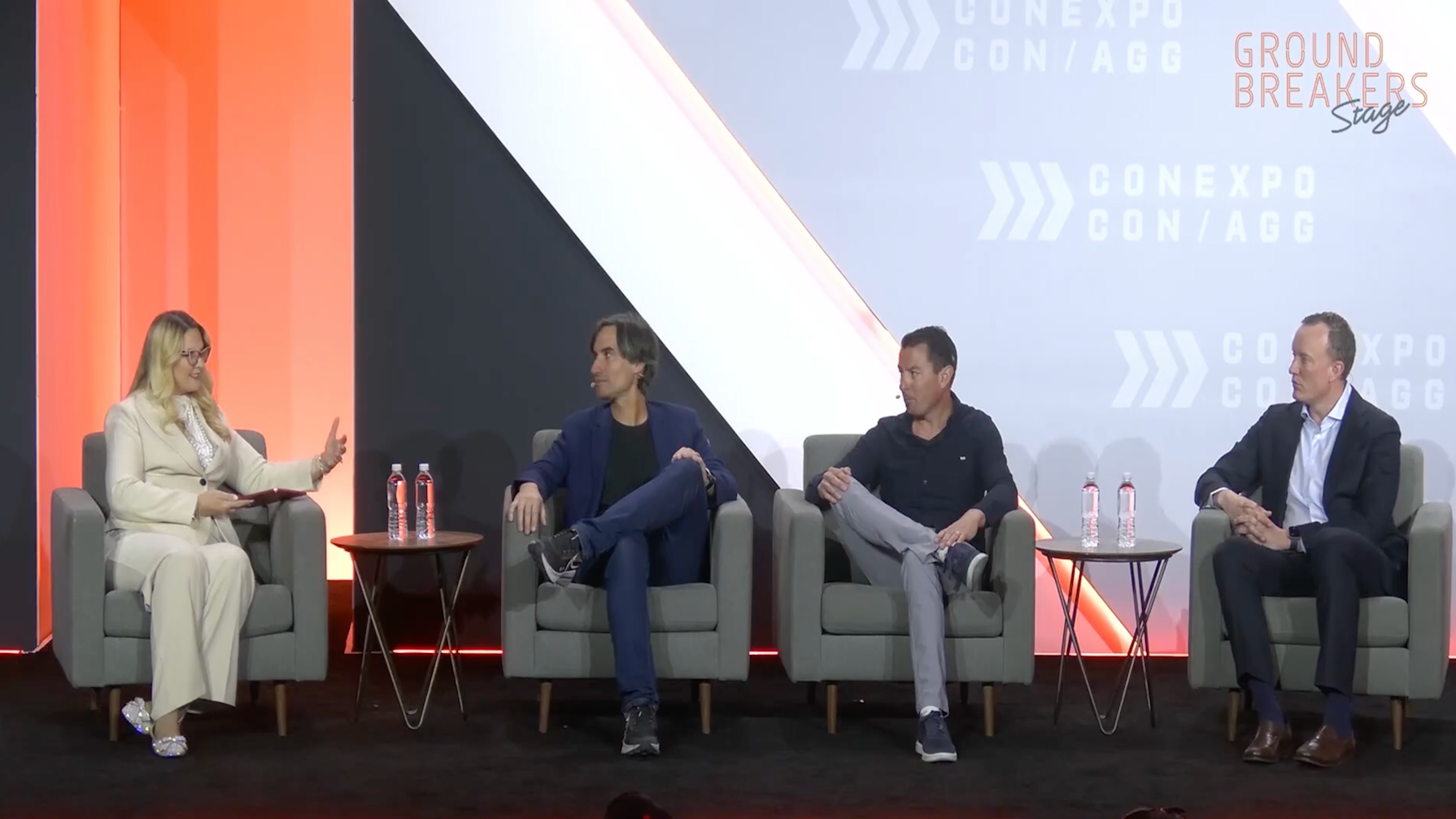
At ConExpo 2026, the air wasn't just filled with the dust of heavy machinery; it was electric with a sense of urgency. As the construction industry faces a "perfect storm" of labor shortages and retiring expertise, a panel of pioneers took the stage to redefine the relationship between humans and machines.
The Procore keynote, "Iron, Data, and Dust," moved beyond the hype of "robots replacing humans." Instead, it laid out a roadmap for a future where technology amplifies human talent, preserves tribal knowledge, and creates a more sustainable industry.
Meet the Visionaries
The panel brought together a cross-section of the construction ecosystem:
Sasha Reed (Moderator), Procore: A visionary leader focused on the intersection of technology and human potential in construction.
Laurent Hautefeuille, Bedrock Robotics: COO of a company leading the charge in heavy equipment autonomy, bringing advanced robotics to the jobsite.
Gene Hodge, VP of Innovation, Mortenson: A forward-thinking contractor at the cutting edge, currently piloting Bedrock Robotics and utilizing Procore’s AI and DataGrid tools.
John Mongan, VP of Advanced Solutions, United Rentals: Representing the world’s largest rental company, focusing on data-driven fleet management and the new Procore telematics integration.
The Crisis: An Industry Losing Its Wisdom
The session opened with a sobering look at the workforce. "Our industry is considered inefficient," noted Sasha Reed, pointing out that even with modern tech, professionals still spend roughly one day per week just looking for the right data.
The stakes are higher than just lost hours. Reed highlighted a looming "retirement cliff":
53% of the workforce is expected to retire by 2036.
The industry needs to hire 800,000 new workers in the next two years.
Alarmingly, the highest demographic leaving the industry is workers age 25 and under.

"We have to stop being firefighters and start being smoke detectors," Reed urged, quoting industry veteran Todd Wynn. The goal is to move from reactive "firefighting" to proactive, data-driven "smoke detecting".
Physical AI: Teaching Machines to Think
While many fear automation, Laurent Hautefeuille of Bedrock Robotics reframed it as "Physical AI." Rather than rigid coding, Bedrock uses machine learning to train models on thousands of hours of human expertise.
"We train our models with thousands of hours that we collect from human operators... you can teach the model how to curl a bucket, how to load a truck efficiently, or how to handle a big boulder you hit when you excavate."
— Laurent Hautefeuille
Infrastructure for the Autonomous Future
A common misconception is that automation requires a total fleet replacement. Laurent Hautefeuille debunked this by explaining that Bedrock’s "Physical AI" can be retrofitted onto existing "yellow iron" in just a couple of hours. This "autonomy-ready" approach means contractors don't need a massive capital investment to begin their journey.
However, the hardware is only half the battle; the machine is only as good as the data it receives. John Mongan emphasized that having real-time, actionable equipment data—whether owned or rented—is the essential "ready-state" for a productive jobsite. When a machine is connected to the cloud and the project schedule, it transitions from a passive tool to an intelligent agent.
As Sasha Reed summarized, the industry is moving from simply "digitizing" (carrying iPads instead of clipboards) to truly "digitalizing"—where every piece of equipment and data point is connected to a central system.
Field-First Innovation: Mortenson’s Approach
For Gene Hodge, innovation isn't about the gadgets—it's about the people. Mortenson’s strategy is to involve field teams in the design process so that technology solves real pain points.
"We're starting with steps that we could automate or semi-automate," Hodge explained. He shared a story from a solar site where an automated process distributes piles for installation. The result? "Our guys have a leaderboard, and every day, they're comparing who did more today... there’s a lot of excitement around that".
Hodge emphasized that for automation to work, it must remove the "dreary" tasks—like triple-entering data or staying up all night on estimates—to allow workers to "level up" to more impactful work.
The Power of Integrated Data
A major hurdle to automation has been "data silos"—information trapped in separate scheduling, estimating, and project management tools. John Mongan, United Rentals VP, addressed this by announcing a landmark telematics integration with Procore.

"Now [customers] can see a complete picture of equipment they rent and equipment they own all in one place, and tie that in with project planning to try to be more efficient."
— John Mongan
This visibility allows contractors to move from passive equipment management to predictive planning, ensuring the right iron is on-site and ready the moment a crew needs it, maximizing every hour of available labor.
The Shift from Project to Portfolio The true power of this integrated data—from United Rentals’ fleet to Mortenson’s field insights—is the ability to move beyond a "project-by-project" mindset to unlock actionable intelligence. Historically, construction has been reactive, with valuable lessons often lost when a crew moves to a new site.
With construction management software like Procore, leaders can finally gain visibility into the "hidden" inefficiencies. Gene Hodge noted that while major safety or quality events are obvious, most waste is buried in "buffers, slack, and waste time" in schedules.
Final Thoughts: Build Better Together
The panel concluded with a powerful rejection of the "replacement" narrative. Hautefeuille cited Jevons' Paradox: as a resource (like excavation) becomes more efficient, the demand for it actually increases.
"Automation is going to create more jobs, not replace these jobs," Hautefeuille stated. These new roles — autonomy technicians, fleet orchestrators, and data analysts — will make the industry more attractive to the 25-and-under demographic.
Gene Hodge ended on an optimistic note: "We’re better together, and we need to be transparent. The whole industry is going to get better".
Written by