The most valuable record on your project isn't created at handover. It's created during construction — or it's never reliably created at all.
Today, we're closing that gap. We're introducing Procore Asset Management, a new solution that builds a verified, structured record of a project's physical assets as they're designed and built, ready to hand over the moment a facility opens. And the foundational tool of that solution, the Asset Register, is now generally available across all regions, at both the company and project level.
Asset Management is built for the design and build phases of an asset's life. The Asset Register is where it starts: the foundation that captures what's installed, links it to the work that verifies it, and carries that record cleanly into operations. More capabilities will join the solution over time.
Here's what the Asset Register does today, why it matters for your teams, and what's next.
Move from reactive handover to proactive lifecycle readiness
Ask anyone who's commissioned a facility what handover looks like. The answer usually involves a mess someone else has to clean up.
A new facility changes hands as a chaotic mix of binders, spreadsheets, and disconnected files. A "data dump" someone has to untangle before operations can start. Facilities teams spend weeks re-entering data that already existed on site. Owners inherit a record that's difficult to trust. And the documentation that should have been captured at installation gets reconstructed from memory, months after the site crews have left.
The problem isn't a missing report; it's a missing system of record. Every other part of a project generates data about something. A submittal approves it, an inspection verifies it, an RFI clarifies it. But there's been nothing to tie that activity to the physical thing it describes. So the proof scatters, and the chain of evidence breaks.
Where Asset Management starts: The Asset Register
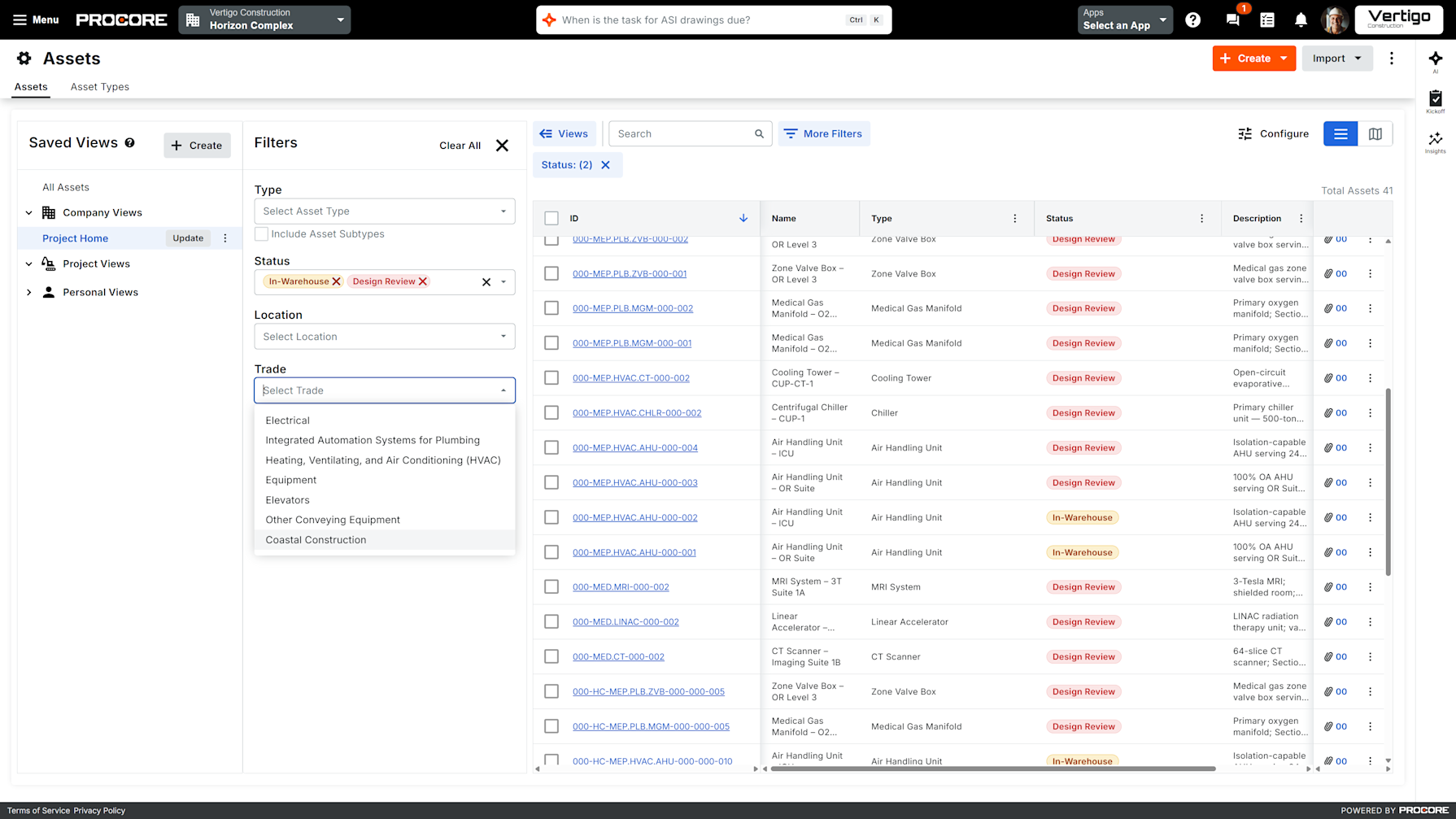
The Asset Register is the foundation of Asset Management: a centralised record of every fixed, installed, maintainable asset on your project. Not a spreadsheet, not a binder, but a live, structured register that takes shape from the construction workflows your teams are already doing.
Instead of compiling a handover package at the end, your teams link installed fixed assets (HVAC systems, chillers, switchgear, fire protection, boilers) directly to the inspections, RFIs, submittals, schedule activities, and documents that give them context, as the work happens.
The result is a continuous digital thread for every asset: what was installed, who recorded it, when it was inspected, and the O&M documentation that sits behind it. When close-out arrives, there's nothing to scramble for. The record is already built.
What the Asset Register delivers at general availability
The Asset Register reaches general availability across all regions: a full-featured foundation, not a minimal first release. Four handover problems that have cost teams for decades, fixed from day one.
Set your standards once, not on every project. Most teams start each job with a blank spreadsheet, so the same pump gets named five ways, and nothing adds up across projects. Set your asset types, fields, statuses, and naming rules once at the company level, and every project automatically follows them. Assets roll up to a portfolio view or drill down to a single job, and when one moves, its history goes with it. You get consistency without policing it by hand.
Capture verified data in the flow of work. Handover data is untrustworthy because it's pieced together at the end, after the crews who did the work are gone. Instead, link every asset to the inspections, RFIs, submittals, and schedule activities that verify it, as the work happens. Every change is timestamped and stamped with a name. So when a warranty claim or dispute lands months later, you point to the passed inspection and the approved submittal instead of arguing from memory.
Move fast at scale. Keep the register current without a dedicated admin. On a big job, building an asset register by hand is a non-starter. Create, edit, and delete in bulk, and import or update straight from Excel, including the exact file you just exported. Save the views your team actually uses, and push asset data into 360 Reporting and Procore Analytics to see how everything's performing across your portfolio. The register keeps up with the work instead of falling a month behind it.
Hand over a record they can use on day one, not a data dump they have to decode. This is the whole point. Instead of a hard drive full of PDFs, you deliver a structured, verified record that the owner's facilities team can load straight into their systems. Export filtered assets to Excel or a structured ZIP, submittal and related-item attachments included, from the list or BIM view. In the field, scan a QR code to pull up an asset's full record on the spot, and find any asset through Global Project Search. Permissions carry through everywhere, so people only see what they're cleared to. Day one is actually day one.
The Asset Register doesn't replace your EAM or CMMS, and it isn't trying to. It works during design and construction, then hands your operational systems a clean, structured record to run with. And it tracks one thing well: fixed, installed, maintainable assets like HVAC, switchgear, and fire protection, not loose materials or movable equipment.
What it means for your teams
It's the same record doing the work, but the story looks different depending on which side of handover you're standing on.
For owners: Achieve operational readiness on day one
Picture the alternative most owners live with today. The contractor hands over a hard drive and a stack of binders, and your facilities team spends the first few months of occupancy reverse-engineering their own building: chasing down which pump was actually installed, hunting for a warranty that may or may not exist, re-keying data into the CMMS by hand. The building is open, but the record isn't ready.
Asset Register flips that sequence. Because every fixed asset has been verified and linked throughout construction, what you receive on day one isn't a data dump — it's a living register your team can trust. The chiller in the register is the one on the roof, with its submittal, inspection history, and documentation already attached. Your facilities team starts from a known baseline instead of a question mark, and full operational readiness arrives on day one instead of months in.
That record keeps earning its place long after commissioning. The same verified data enhances asset evaluations over time, informing maintenance, replacement, and capital strategy across a 30–50 year lifecycle. It's the bridge from building the asset to running it, and it's why Asset Register is built to feed the enterprise systems Owners already run, not to replace them.
For general and specialist contractors: Hand over clean, get paid faster, win the next job
The pain of handover has always landed at the worst possible moment: at the end, when the crews are demobilising, and final payment is on the line. The old way means someone spends the last weeks of a job assembling O&M manuals from scattered emails, tracking down as-builts, and reconstructing what got installed from memory. Retainage waits on paperwork that doesn't exist yet.
The Asset Register removes that scramble by capturing the record as the work happens. The inspections, RFIs, and submittals your teams are already completing link directly to the assets they describe, so the handover package assembles itself in the background. A specialist crew can scan a QR code at an installed asset and pull up its full record on the spot, confirming they're working from the current, approved information before they install. By the time you reach close-out, the deliverable is already built, in the structured format owners require, with the smart IDs that plug straight into their systems.
The payoff shows up in two places that matter most. Cash flow: a complete, owner-ready handover means retainage is far less likely to stall because documentation doesn't yet exist. And risk: if a warranty claim or a rework dispute surfaces months later, you're not defending yourself from memory. You have a timestamped chain of evidence, the approved submittal version, and the passed inspection that prove the work was done right.
Clean handovers protect the margin on this job. They're also what wins the next one.
Built for compliance-driven markets
The "why" behind Asset Management shifts by region. Everywhere, the core driver is the same: certainty and operational readiness, by capturing verified data as the work happens to protect builder margins and ensure Day 1 facility activation for owners.
In the UK and Europe, that same record carries additional regulatory weight. The change history, linked documents, and structured information captured in the Asset Register map to ISO 19650 information management duties and support the UK Building Safety Act's Golden Thread obligation, a verifiable thread of information Owners and Main Contractors are required to deliver. For Owner-operators managing assets over decades, that construction-phase record also aligns with ISO 55000 / 55001 lifecycle frameworks and becomes the foundation your facility management and sustainability teams build on. Compliance builds up as the work happens, instead of as a scramble at practical completion.
For UK and EU companies, the Assets and BIM integration (Viewer 2.0) is also generally available on new projects, so you can extract assets from 3D models and work with them visually against field reality. Teams in North America and APAC can access this BIM integration open beta by contacting their Procore representative.
What's next
General availability is a milestone, not a finish line, for the Asset Register or for the solution around it. Several capabilities are already in development:
Asset updates from mobile, extending today's read-only field access to let teams edit asset data on site
Asset hierarchies v2.0, adding bulk operations and interactions across Map and BIM views;
Linking related items at the asset-type level with cascade, so a submittal linked once flows down to every associated asset;
A unified attachment taxonomy across documents, inspections, and submittals.
The BIM integration will also expand from its UK and EU general availability toward broader GA across the rest of Europe, North America, and APAC.
As Asset Management grows, more capabilities will join the core Assets offering. Additionally, we're building towards direct integrations with EAM and CMMS systems, so the record built during construction flows straight into the tools that run operations. The destination is lifecycle continuity: a single, verified asset record that starts on the first day of construction and supports the asset for decades. The Asset Register is the first step towards it.
Get started with Procore Asset Management
The Asset Register, the foundational tool of Procore's Asset Management solution, is now available to customers on Project Execution (Standard and Enterprise) and Project Lifecycle Management (PLM) for Owners. If you have an eligible package, you can start working with Assets today by opening the tool from your Procore account at both the company and project level.
For existing customers: Open the Asset Register tool in your project today. Before you build out your first register, take a few minutes with the support documentation and step-by-step tutorials for the company-level and project-level Asset Register. They walk through the essentials, so your team can get up and running with confidence.
New to Procore or don't have the Project Execution or PLM package? See how a verified digital thread changes your project close-out: Explore Asset Management
Written by

Senior Product Marketing Manager, Procore
Start growing with Procore today
With tools to make every part of your process more human and a support team excited to help you, getting started with any project has never been easier.