
RFQ, RFP, and RFI in construction: What’s the difference?

Last Updated Jun 18, 2026
Josh Krissansen
122 articles
Josh Krissansen is a freelance writer with two years of experience contributing to Procore's educational library. He specialises in transforming complex construction concepts into clear, actionable insights for professionals in the industry.
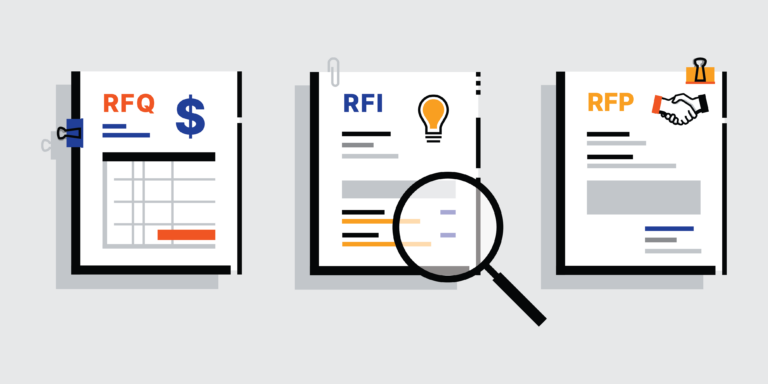
Requests for information (RFIs), requests for quote (RFQs), requests for proposal (RFPs) and requests for tender (RFTs) each serve a different purpose in construction, but the differences between them are not always clear.
When those differences are not clearly understood within a project team, teams can issue the wrong document type, ask for information that is incomplete or irrelevant, and receive submissions that are difficult to compare.
In simple terms, each document serves a different purpose:
- RFI: Gathers information or seeks clarification
- RFQ: Requests a quote or, in some contexts, assesses qualifications
- RFP:Invites proposals where the solution, methodology or delivery approach is still open
- RFT: Calls for competitive tenders against a fully documented scope.
This article breaks down how each document is used, how they differ, and how they should be sequenced across preconstruction and delivery on an Australian commercial project.
In Australia, RFQ most commonly means request for quote. Some organisations also use RFQ to mean request for qualifications, or as part of a broader prequalification process.
Table of contents
RFI vs RFQ vs RFP vs RFT: How they differ
| Document | Purpose | Direction of flow | When issued | Typical output |
| RFI | Seek clarification on drawings, specifications, or contractual requirements | Contractor/ subcontractor to design team or superintendent | During construction delivery when a documented response is needed before work can proceed | Written response or instruction from the design team or superintendent |
| RFQ (quote) | Obtain a price for a defined scope item, variation, provisional sum adjustment or scope change | Superintendent or contract administrator (CA) to contractor; contractor to subcontractor | During delivery when a scope change requires a priced response | Quotation or priced variation submission |
| RFQ (qualifications) | Assess whether a contractor, consultant or subcontractor has the capability to be invited to tender | Client or head contractor to market | Before releasing a tender package | Statement of qualifications, prequalification outcome or tender shortlist |
| RFP | Invite proposals where methodology, team, and price are all under evaluation | Client or principal to market | Where scope is open or the delivery model requires contractor input | Detailed proposal covering methodology, programme, team, and price |
| RFT | Seek competitive fixed-price tenders against a sufficiently documented scope | Client or head contractor to prequalified or open field | When scope, drawings, and contract conditions are fully developed | Lump sum or schedule of rates tender submission |
What is an RFI in construction?
A request for information (RFI) is a formal document used to seek clarification on design, specifications, drawings, or contractual requirements.
In construction delivery, RFIs are typically issued by contractors or subcontractors to the design team, superintendent, contract administrator or relevant consultant. In this context, RFIs are not procurement documents in the traditional sense. They are project control documents used to capture questions, responses and instructions in a formal project record.
RFIs are typically raised when:
- Drawings are ambiguous or conflicting
- Site conditions don't match what was documented
- Specifications have gaps or inconsistencies
- The contractor wants to propose an alternative method, material or product for consideration.
Response timeframes are set in the contract or project procedures. Where a response is delayed, and the RFI sits on the critical path, the contractor has grounds to claim an extension of time.
Some clients and developers also use the term RFI to gather market capability information before issuing a formal tender. This is a separate use of the acronym and a common source of confusion when teams don't distinguish between a procurement-stage RFI and a delivery-stage RFI.
When to use: Issue an RFI when a design, specification, site or contract question needs a formal, documented response before work on that element can proceed.
What is an RFQ in construction?
In Australian construction, RFQ most commonly means request for quote. It is used to obtain a price for a defined scope item, trade package, variation, provisional sum adjustment or scope change.
During procurement, a request for quote may be issued where the scope is clear enough for suppliers, subcontractors or contractors to provide pricing. During delivery, an RFQ may be issued by a superintendent, contract administrator or head contractor when a variation or scope change requires a priced response before it can be formally instructed.
Some organisations also use RFQ to mean request for qualifications.In this context, it operates as a prequalification process used to assess whether a contractor, consultant or subcontractor has the experience, financial standing, safety record and capability required to be invited to tender. In Australia and New Zealand, this type of process may also be described as an expression of interest, registration of interest or prequalification process.
When to use: Issue an RFQ when a defined scope item, trade package, variation or scope change requires a priced response. Use a request for qualifications, expression of interest or prequalification process when you need to assess capability before releasing a tender or proposal package.
What is an RFP in construction?
A request for proposal (RFP) invites contractors, consultants or delivery partners to submit a detailed proposal covering methodology, programme, team, and price for a defined scope. It is used where the solution is not fully specified, and the client wants to evaluate the approach and capability alongside commercial terms.
Typical applications include:
- Early contractor involvement
- Design consultant appointments
- Construction management or managing contractor engagements
An RFP typically includes a project brief, evaluation criteria, submission requirements, a programme for selection, and a commercial terms framework.
The main distinction between an RFP and an RFT comes down to scope definition.
Where scope is still being developed or the delivery model requires contractor input into design, methodology or staging, an RFP allows tenderers to explain how they would approach the work. Where scope is already fully documented and the aim is to obtain comparable fixed-price submissions, an RFT is usually the more appropriate document. Issuing an RFP in that context can result in inconsistent submissions that are difficult to compare fairly.
When to use: Issue an RFP when the delivery model is open, scope is still being developed, or you need to evaluate methodology, team capability and commercial approach alongside price.
What is an RFT in construction?
A request for tender (RFT) is one of the main formal procurement documents used in Australian commercial construction. Outside Australia, teams often use RFP terminology for procurement processes that may locally be issued as an RFT, a distinction worth understanding when working with international partners.
An RFT is issued when the scope is fully documented, and the client or head contractor is seeking competitive lump sum or schedule of rates tenders from a prequalified or open field.
It typically includes:
- Drawings and specifications
- Conditions of tendering
- The proposed form of contract
- A schedule of rates or bill of quantities
- A clarification protocol or tender query protocol.
The process usually follows clear tender rules: submissions are received by the same deadline, clarifications are issued to all tenderers at the same time, and evaluation documented against the stated criteria.
Where a prequalification process has preceded the RFT,, the tender field is already shortlisted. Where no prequalification has occurred, tenderers may be required to demonstrate capability within their tender submission.
When to use: Issue an RFT when scope, drawings and contract conditions are sufficiently developed to support competitive fixed-price or schedule of rates submissions from a defined tender field.
How these documents are sequenced on an Australian commercial project
On a commercial construction project, RFIs, RFQs, RFPs and RFTs are often used at different stages by different parties.
On the client side, procurement may begin with an expression of interest, registration of interest or prequalification process to understand market capability and shortlist suitable tenderers. Where the delivery model is still being developed, this may lead to an RFP. Where scope, drawings and contract conditions are sufficiently developed, it usually leads to an RFT.
The head contractor may also run a separate process for trade packages:
- subcontractors may be assessed through a prequalification process before tender packages are released
- once the trade scope and drawings are ready, RFT or RFQ packages may follow, depending on the size, complexity and pricing requirements of the package
- an RFI register runs from project commencement through to completion, capturing design, specification, site and contract queries as they arise during construction.
Across the delivery phase, change management triggers a separate document workflow. The superintendent, contract administrator or head contractor may issue an RFQ to the to obtain a price for a variation provisional sum adjustment or scope change. The contractor may then seek prices from relevant subcontractors for their part of the change..
Common mistakes in practice and how to resolve them
These are the most common points of failure across the four documents, and how to address them.
Issuing an RFP when scope is fully documented
When scope is sufficiently documented for tender but an RFP is issued anyway, tenderers may structure their submissions around their own individual assumptions, methodologies or exclusions. That makes pricing difficult to compare consistently and weakens the purpose of the tender process.
In this situation, an RFT is usually the more appropriate instrument.
Before an RFT is issued, confirm that drawings, specifications, and contract conditions are sufficiently developed to support fixed-price submissions or schedule of rates submissions. If they are not, the project team needs to resolve whether the scope requires further development, or whether the procurement strategy should deliberately seek contractor input through an RFP, early contractor involvement or another collaborative procurement model.
Reserve RFPs for engagements where methodology, delivery approach, team capability or contractor input into design still forms part of the evaluation process.
Skipping prequalification
When projects go to tender without a prequalification process, evaluation teams spend time reviewing submissions from contractors who may not have the capability, financial standing, or safety record to deliver the work. If procurement decisions are questioned later, there is also no documented basis showing how the tender field was assessed.
To avoid this, run a qualifications process before the RFT goes out.Set clear criteria across relevant experience, financial standing, safety performance and delivery capability, then use the responses to build a shortlist. Some organisations may describe this as a request for qualifications, expression of interest or registration of interest. Whatever the label, the purpose is the same: to confirm that tenderers are suitable before they are invited to submit a full tender.
The upfront time spent on prequalification can make the later tender evaluation process faster, cleaner and easier to defend.
Treating RFIs as low priority during construction
An unresolved RFI on the critical path can create a delay risk. If a documented response is needed before work can proceed, a late response may support a contractor’s claim for an extension of time, depending on the contract and the circumstances.
Mitigate this risk by setting response timeframes in the contract before the project starts and assigning ownership for each RFI as it is raised. Maintain a live RFI register and prioritise critical path queries separately from routine documentation clarifications.
Getting RFI, RFQ, RFP, and RFT right
Each document exists because different stages of a project require different types of information, pricing, evaluation, or clarification from the market or the project team at different stages. When RFIs, RFQs, RFPs and RFTs are used at the right stage and in the right sequence, procurement is easier to manage, submissions are more consistent, and commercial risk is easier to control.
When the distinctions are applied loosely, the gaps tend to surface later, through non-comparable tenders, weak prequalification records, unresolved RFIs, and variation disputes during delivery.
Categories:
Written by
Josh Krissansen
122 articles
Josh Krissansen is a freelance writer with two years of experience contributing to Procore's educational library. He specialises in transforming complex construction concepts into clear, actionable insights for professionals in the industry.
View profileExplore more helpful resources

Scaling with SIERA: Building for now and what comes next
SIERA Founder and Director Brent Thompson has always known that the right people, systems and hands-on approach are fundamental to scaling his business successfully. In Part 1, Brent and Head...

Getting Your Construction Data Ready for AI – What Every Business Needs to Consider Before Launching AI
This is the first of two articles. This part sets out the considerations: what clean and trusted data actually means, how to measure it, how the two systems most businesses...

The Contractor’s Guide to Concrete Inspections
Concrete: It’s the key building block of nearly every structure’s foundation — and it’s the world’s most widely used building material. For most head contractors, understanding how to assess concrete...

Computer-Aided Design (CAD): What It Is — and Why It’s Important
When most people envision a construction worker, they see a person at a construction site wearing a hard hat and a high-vis vest. Perhaps this person is putting up plasterboard,...