Laying the Foundations: Reforms To Unlock Residential Prefab at Scale




Last Updated Jul 3, 2026
Shauna Hurley
21 articles
Shauna is never short of questions when it comes to construction, tech and science. A professional writer, researcher and podcast producer, she loves sitting down with industry insiders for in-depth interviews that uncover the latest developments, debates and emerging trends. Having worked with organisations like Microsoft and the European Bank of Reconstruction, Shauna joined Procore to explore the complex issues facing construction and share fresh, research-rich insights that help professionals navigate a rapidly evolving industry.
Waco Tao
Executive Chair
Waco Tao is the Founder and CEO of PowerHouse Homes. He also serves as the Executive Chair of the Prefab Council Australia, a role he has held since August 2025. With over three decades of experience in the property development sector, Waco began his career in May 1993 by establishing Models Inc (formerly d-art PRODUCTIONS). In this role, he provided handcrafted architectural 3D models, signage, and illustrations for commercial and residential projects globally. From January 2005 to January 2010, he served as the CEO of SCM Global Pty Ltd, where he managed integrated supply chain solutions between China and Australia. In March 2009, Waco launched PowerHouse Homes, a Melbourne-based company specializing in the research, development, manufacturing, and construction of prefabricated buildings. Under his leadership, the company has focused on "sustainaffordable" housing, utilizing steel structures and automotive-style prefabrication methodology to deliver eco-friendly, low-carbon homes. His work at PowerHouse Homes centers on creating high-efficiency, high-energy-star-rated housing solutions for low, medium, and high-density applications. Waco holds a Master’s Degree in Supply Chain and Business Administration from Monash University. He lives in Melbourne.
Adam Jordan
Asia-Pacific Lead
Adam Jordan is Asia Pacific Lead for Bryden Wood. Previously based in London, Adam established Bryden Wood’s Singapore office in 2014 before returning to head up the Australian business. Adam’s expertise lies in developing innovative design solutions for clients around the world using BIM, digital technologies and Design for Manufacture and Assembly (DfMA). He holds a Bachelor of Architecture (BArch) and Bachelor of Science (BSc) in Architecture from the University of Sydney.
Andy Rampton
Industry Transformation Leader (APAC)
10 articles
As the APAC Industry Transformation Lead for Procore, Andy Rampton utilises his 30+ years' global experience in engineering, construction and property development to influence industry change and help create a pathway towards the long-awaited digital transformation of construction. Having sat in the industry and experienced the evolution of technology as a user, procurer and strategist, Andy saw first-hand the challenges that companies have in defining and sustaining meaningful technology- and data-enabled change in the face of overwhelming technology choices. He joined Procore with the intent to both promote the benefits of technology and data and also to improve the relationship between tech provider and customer such that the transition to the future of construction becomes a lot easier to navigate.
The Productivity Commission's latest report on housing construction concluded prefab and modular construction are “unlikely to be a silver bullet” for Australia’s productivity and housing challenges. In response, prefab industry advocates argue the potential is real — but it can’t be realised until our regulatory systems evolve to support factory-based delivery at scale.
The structural barriers they point to include a National Construction Code drafted for onsite construction that creates uncertainty around how prefab can meet planning regulations designed for traditional homes. Compounding that, certifiers are conservative. Rules that vary significantly by jurisdiction mean that investment in factory-based housing becomes a commercial risk few are willing to take.
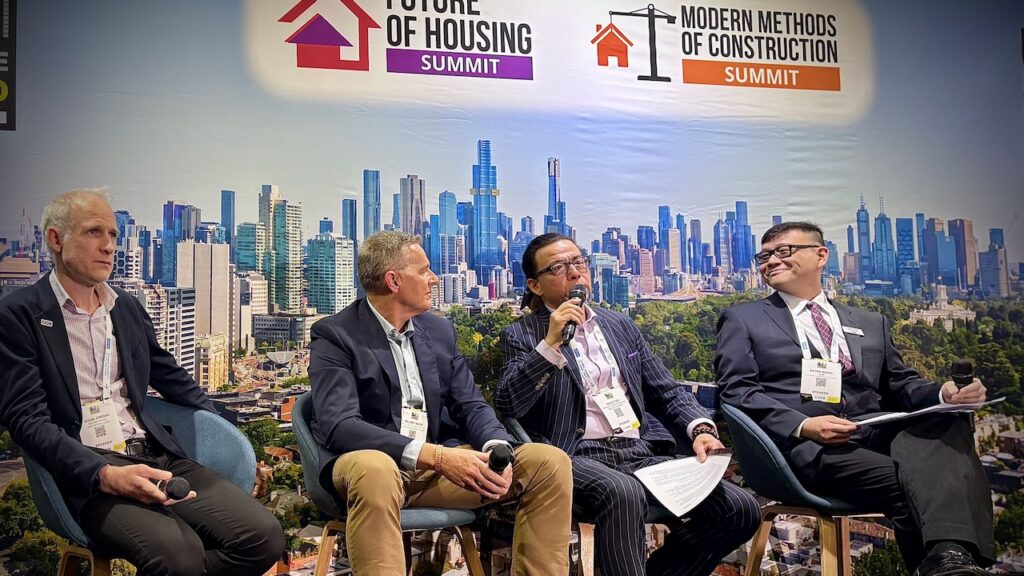
Adam Jordan (far left) and Waco Tao (second from right) join Hillary Naish and Professor Peter Wong on a prefab panel at Melbourne Build Expo — part of ongoing industry discussions about the future of factory-built housing.
In this final instalment of our prefab deep dive, Adam Jordan, Asia Pacific Lead at Bryden Wood, brings a global perspective to our conversation with Executive Chairman of Prefab Council Australia, Waco Tao.
Editor's Note: This is the third article in a 3-part series on prefabrication in Australia. Catch up on the rest of the series:
- Part 1: From Projects to Pipelines: How Prefab Could Reshape Residential Construction explores how and why prefab offers a fundamentally different way of delivering homes at scale to reach ambitious National Housing Accord targets.
- Part 2: Proof vs Popular Perception: Busting the Myths That Are Holding Prefab Back explores prefab's ‘image problem’ and why its persistent reputation for cheap, low quality structures continues to impact investment, uptake and public interest.
Table of contents
Three barriers to scaling prefab in residential construction
Waco begins by identifying three key barriers that are holding prefab back in Australia, and frames them as “a vicious cycle”.
Firstly, we have a fragmented, state-based, and often archaic planning and building codes designed for site-built homes, not manufactured products.
Secondly, financiers and developers are locked in a cost-first mentality and struggle to value the whole-of-life benefits of prefab.
And thirdly, the construction industry is deeply conservative and risk-averse, while the public misconception that prefab is cheap and low-quality persists.
Waco Tao
Executive Chair
Prefab Council Australia
Having worked on some of the world’s most innovative prefab projects – the athletes’ village for the 2012 Olympics in London, igus headquarters in Germany, the Gutenborg development in Russia – Adam Jordan sees this negative public perception as a widespread problem for the industry globally.
These kinds of misconceptions aren't unique to Australia. People in all corners of the globe equate prefab with low-quality, temporary buildings.
We need to demonstrate the benefits of prefab across design, sustainability and risk mitigation and raise the profile of prefab across the board. We have a great industry here in Australia, but traditional construction simply isn't up to the task of meeting our housing and sustainability targets.
Adam Jordan
Asia-Pacific Lead
Bryden Wood
Fixing a fragmented system, building innovation and collaboration
Adam sees Australia's regulatory fragmentation as both an obstacle and a missed opportunity.
"It does sometimes seem like different jurisdictions around Australia are trying to develop their own solutions to very similar problems," he says. "With some federal oversight, there could be real opportunities to cross-pollinate ideas for the national good — while tapping into the scale and pipeline the industry needs nationally."
System 600, a joint initiative between Homes NSW and Building 4.0 CRC, is a good local example of what that collaboration can produce. The initiative applies a kit-of-parts approach — standardised, interchangeable components rather than entire modules — enabled by the same digital design platforms that make precision manufacturing possible.
"Think of it like an Amazon-style marketplace for building components, where parts can come from any number of manufacturers," Adam says. "That opens up the market to more suppliers, reduces procurement complexity, and creates opportunities for more Tier 2 contractors to get involved."
The System 600 model draws from Bryden Wood's UK experience, where platform-based, digitally-driven design has been applied to a wide range of building types including offices, hospitals and prisons.
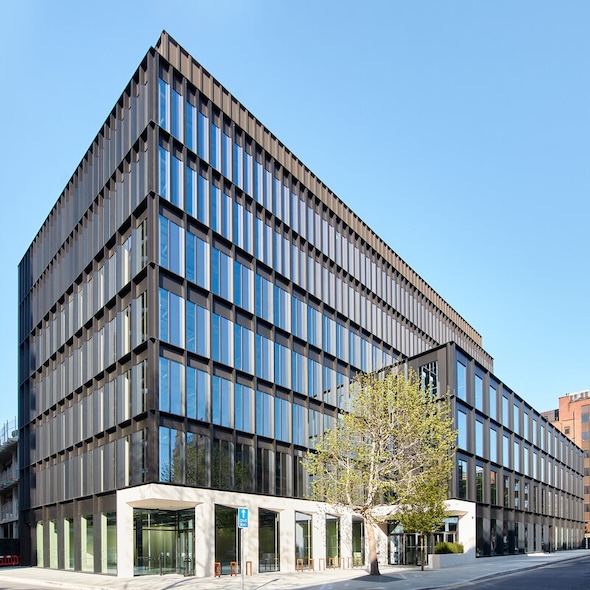

The Forge, a net zero carbon commercial building in London, achieved a 39 per cent reduction in upfront carbon and significant gains in construction speed and cost using Bryden Wood’s Platform approach to Design for Manufacture and Assembly — proof, Adam argues, that the approach scales well beyond housing.
For Australia, where fragmentation is the problem, that kind of replicable, cross-sector model is what's traditionally been missing.
Prefab and manufacturing methodologies are reshaping what's possible across design, delivery and sustainability.
Even ten years ago, prefab was still quite a niche topic of conversation in construction. It's much more mainstream now, and we're seeing clear evidence of what these methods are delivering at scale. That's reflected in the fact that governments are sitting up and taking notice.
Adam Jordan
Asia-Pacific Lead
Bryden Wood
Three shifts that could change everything
Waco is clear on what needs to change on the regulatory front. National harmonisation of building codes is his first priority.
We need a performance-based national code that allows certified products to be approved once and deployed anywhere — exactly as the automotive industry handles vehicle registration.
Second, we need fast-track approval pathways for pre-certified prefab designs. If a home has been engineered, tested and certified to NCC compliance, why does it have to endure the same planning scrutiny as a one-off site build?
And third, procurement reform. Lowest-price tendering continues to penalise prefab's whole-of-life value. Value-based models that account for delivery speed, lifecycle carbon and waste reduction are overdue.
Waco Tao
Executive Chair
Prefab Council Australia
On finance, he says the reframe is equally fundamental.
"We need to move from project-based lending to asset-based financing," Waco says. "A factory is a productive asset with long-term value. Green bonds and infrastructure funds can play a role here, treating manufacturing capacity as the national infrastructure it truly is."
“For developers, the argument is different but equally commercial: prefab de-risks projects," he says. "Certainty of schedule, certainty of cost, certainty of quality translate directly to bottom-line protection. Once developers internalise that, the model sells itself."
Can momentum build fast enough?
The federal government's $900 million National Productivity Fund — which includes $120 million specifically to remove barriers to modern construction methods — is a sign that government support is growing. For Waco, the destination is clear, but the pace of regulatory reform and financial realignment remains critical.
For Adam, the path forward is fundamentally collaborative.
When builders, designers, manufacturers, contractors, policymakers and clients start working together across disciplines and jurisdictions, that's when we can really start to unlock change — both for prefab and the broader built environment in Australia.
Adam Jordan
Asia-Pacific Lead
Bryden Wood
Having talked throughout this series about what construction can learn from the car industry, Waco's parting analogy is particularly fitting.
"We know prefab is the engine," he says. "But without policy paving the highway and finance providing the fuel, it just sits in the garage."
this is part of the series
The Prefab Revolution
Categories:
Written by
Shauna Hurley
21 articles
Shauna is never short of questions when it comes to construction, tech and science. A professional writer, researcher and podcast producer, she loves sitting down with industry insiders for in-depth interviews that uncover the latest developments, debates and emerging trends. Having worked with organisations like Microsoft and the European Bank of Reconstruction, Shauna joined Procore to explore the complex issues facing construction and share fresh, research-rich insights that help professionals navigate a rapidly evolving industry.
View profileWaco Tao
Executive Chair | Prefab Council Australia
Waco Tao is the Founder and CEO of PowerHouse Homes. He also serves as the Executive Chair of the Prefab Council Australia, a role he has held since August 2025. With over three decades of experience in the property development sector, Waco began his career in May 1993 by establishing Models Inc (formerly d-art PRODUCTIONS). In this role, he provided handcrafted architectural 3D models, signage, and illustrations for commercial and residential projects globally. From January 2005 to January 2010, he served as the CEO of SCM Global Pty Ltd, where he managed integrated supply chain solutions between China and Australia. In March 2009, Waco launched PowerHouse Homes, a Melbourne-based company specializing in the research, development, manufacturing, and construction of prefabricated buildings. Under his leadership, the company has focused on "sustainaffordable" housing, utilizing steel structures and automotive-style prefabrication methodology to deliver eco-friendly, low-carbon homes. His work at PowerHouse Homes centers on creating high-efficiency, high-energy-star-rated housing solutions for low, medium, and high-density applications. Waco holds a Master’s Degree in Supply Chain and Business Administration from Monash University. He lives in Melbourne.
View profileAdam Jordan
Asia-Pacific Lead | Bryden Wood
Adam Jordan is Asia Pacific Lead for Bryden Wood. Previously based in London, Adam established Bryden Wood’s Singapore office in 2014 before returning to head up the Australian business. Adam’s expertise lies in developing innovative design solutions for clients around the world using BIM, digital technologies and Design for Manufacture and Assembly (DfMA). He holds a Bachelor of Architecture (BArch) and Bachelor of Science (BSc) in Architecture from the University of Sydney.
View profileAndy Rampton
Industry Transformation Leader (APAC) | Procore
10 articles
As the APAC Industry Transformation Lead for Procore, Andy Rampton utilises his 30+ years' global experience in engineering, construction and property development to influence industry change and help create a pathway towards the long-awaited digital transformation of construction. Having sat in the industry and experienced the evolution of technology as a user, procurer and strategist, Andy saw first-hand the challenges that companies have in defining and sustaining meaningful technology- and data-enabled change in the face of overwhelming technology choices. He joined Procore with the intent to both promote the benefits of technology and data and also to improve the relationship between tech provider and customer such that the transition to the future of construction becomes a lot easier to navigate.
View profileExplore more helpful resources

The Contractor’s Guide to Concrete Inspections
Concrete: It’s the key building block of nearly every structure’s foundation — and it’s the world’s most widely used building material. For most head contractors, understanding how to assess concrete...

Computer-Aided Design (CAD): What It Is — and Why It’s Important
When most people envision a construction worker, they see a person at a construction site wearing a hard hat and a high-vis vest. Perhaps this person is putting up plasterboard,...

Can You Trust the Number? Why reliable cost information matters when construction margins are under pressure.
Construction businesses are investing in digital tools, yet many still rely on spreadsheets and manual reconciliation to understand how their projects are performing. In part 1 of this series, Procore...

Do You Have Time to Act? Why better forecasting gives construction teams an early warning when costs start moving.
Construction costs rarely blow out overnight. Productivity slips. Programs move. Labour and materials cost more than expected. Payments arrive late. The warning signs are often there. In part 2 of...