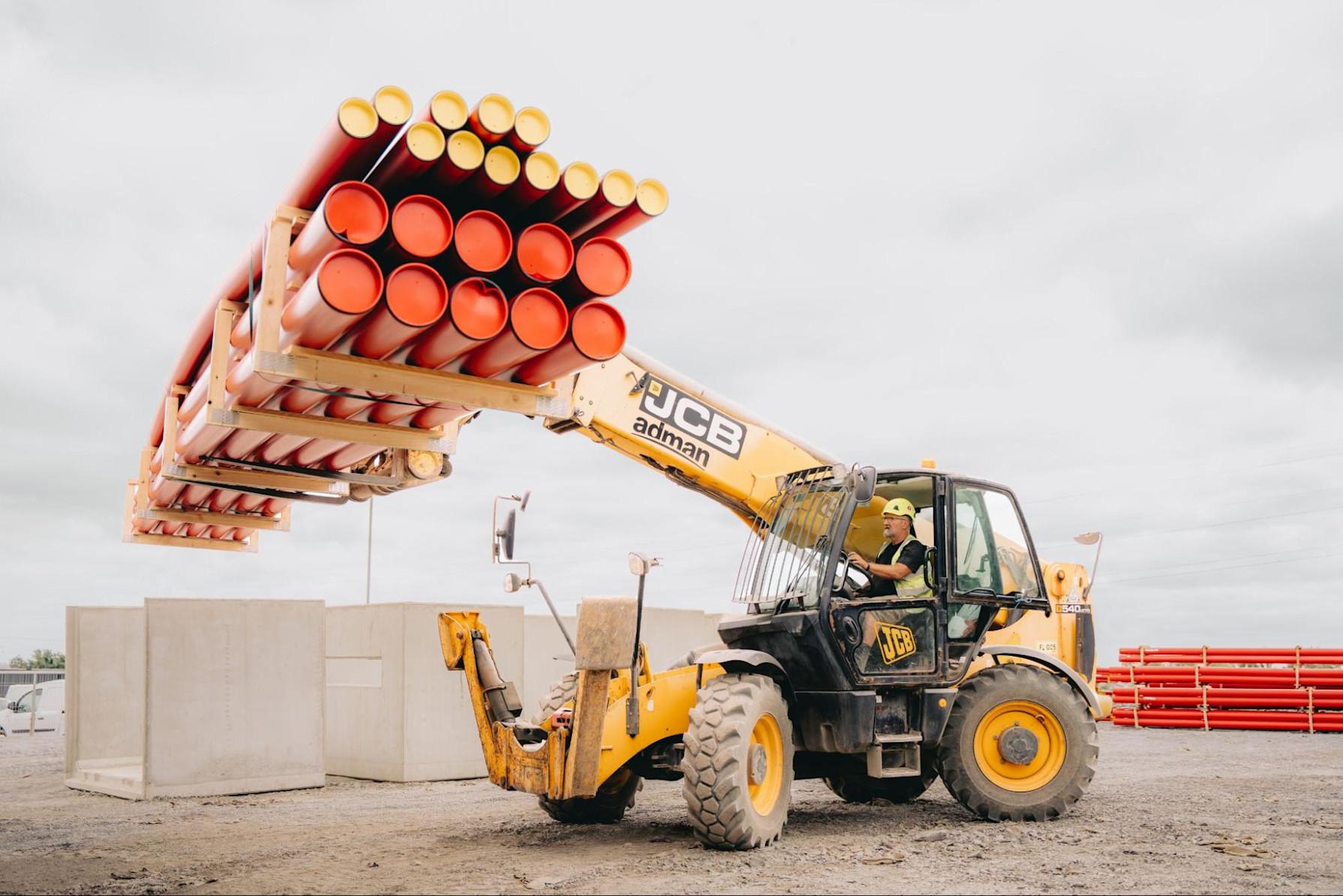
The Kilshane substation near Dublin will provide enough power to support both local communities and the growing number of data centres being built in the area when it is online.
The project, being delivered by main contractor Adman, involves huge amounts of heavy work taking place on wet ground and in occasional treacherous weather conditions. This includes excavation to lay ducts, building blast walls, and laying the high-voltage cable before burying everything under tons of concrete. And given the 4.6km excavation route runs past existing oil, gas, and electricity lines, safety is the highest consideration.
Civil construction on this scale can be dangerous work. Ireland recorded 10 construction-related deaths in 2025, double the figure from the year before.
Stephen Faye is Adman’s site lead check advisor on the Kilshane substation project and the boots-on-the-ground safety conscience of the site. In simple terms, that means helping support site practices to get workers home safely every evening.
Faye warns of the lethal risk of performative safety.
“If you're just going to tick a box, you're not guiding safety by putting in place real guidelines,” Faye explains. “What you're doing is trying to cover tracks and that's essentially where fatalities or high-risk injuries can happen.”
His day-to-day reality is identifying hazards and risks for site operatives, and implementing controls before something goes wrong.
“You cannot put a price on someone’s life,” he says. “And think about that phone call you'd have to make. Who is it that you're going to ring? It's going to be a family member. It's going to be the next of kin. That call is something that I never, ever want to be involved in.”
Digitising safety for proactive risk management
Safety used to be a manual and disconnected process. Handwritten incident reports hidden in lever arch binders or left in the glove compartments of work vans. Or forms simply never completed. Adman wanted a better approach: one that would improve access to information and enable its safety team to identify and manage risk more easily.
The organisation adopted the Procore common data environment (CDE) to help it take an analytical and more proactive approach to improving site safety.
“To have all that data on a digital platform is worth its weight in gold,” says Faye. “When you’re able to go back and review what was happening maybe two months ago, we might pick up on something and do better next time.”
The team uses live, geo-stamped photographs to provide evidence-based data. Once in the CDE, it’s there for anyone to cross-check to help confirm that inspections are valid. The digital platform also integrates with Adman’s different management systems, whether project management or EHS (Environment, Health, and Safety). That means each division can see what's going on at any time.
“Logging the inspection data is really important,” explains Faye. “I was recently running a check on CSCS skills cards for operatives. We could easily see that the skills card was running out. So I was able to identify that, go straight down to the operative and inform him that his training data needs to be updated. From the PM's perspective, it's about stopping these kinds of things happening before they become risky or hazardous.”
Stephanie Coyle is Adman’s continuous improvement manager. Each month she pulls together monthly reports for the directors. What was once a manual and time-consuming process can be performed quicker and with greater flexibility using the Procore CDE.
Pulling in the data on the platform, she can run the data down on accidents, incidents, and general overall performance, as well as running the rule over the quality side.
“We're looking at quality inspections, ITPs, safety inspections, construction quality reviews,” adds Coyle. “We're looking at the site management team's weekly inspections. Anything that we want to pull from that data can go into internal reports.”
Turning data into foresight
On a lengthy project like Kilshane, keeping operatives safe today often relies on learning the lessons from yesterday. With a rich store of insights and data gathered over many months, the team uses the CDE to help them identify risks early.
Stephanie believes that better visibility on data is transforming safety on site.
“Having a single source of information is so helpful… On the analytical side, we're really starting to see the value from the incident tool. We can see patterns and that makes it easier for us to target future improvements. And better still, we can communicate that through our Procore tools.”
One insight Coyle’s team discovered was that Adman’s subcontractors recorded more safety incidents than its own staff. That allowed the team to target a developmental training initiative to help reduce risk overall. “It doesn’t mean that they were doing a bad job. It just means that as they’re a different business, they need a different education,” she says.
Adman began to run business audits rather than just site audits to try and identify risk. A recent audit for a subcontractor that performs high-risk activity at height, including abseiling, quickly discovered actionable insights.
“Their company director called me after the audit and said he was going to ensure all his staff complete a NEBOSH occupational safety diploma, which they have now started.
What makes the difference for Adman is the awareness that projects can only run well if they're run safely. There is good investment in the contracts managers and the project managers. They will all be trained, not just in the engineering side of it, but on the safety side of things. Six or seven of our team have just achieved their NEBOSH qualifications. That’s a fantastic achievement.”
Having clear, accessible, and real-time data to oversee and guide your safety is a powerful way to help support the safety of your site operatives. Ask yourself:
Can you see live, time and geo-stamped data as evidence of inspections? Or are you still relying on paper forms filled in long after the event?
Are you able to identify on-site or business patterns that point to a hazardous activity that needs to be addressed?
Do your EHS and PM teams access the same, up-to-date data? Or are they out of sync?
If the answer is ‘No’ to any of these questions, your operatives and subcontractors are at risk. Stop chasing paper and start supporting a safer environment for your employees.
Written by

Content Manager, UK, Procore