Can You Trust the Number? Why reliable cost information matters when construction margins are under pressure.

Last Updated Sep 30, 2026

Preeya Selvarajah
Senior Product Marketing Manager
Preeya is a Senior Product Marketing Manager at Procore, where she leads go-to-market strategy, product positioning, and competitive intelligence across the APAC region. With nearly two decades of experience in enterprise SaaS, she has worked across construction management tech, industrial automation, telematics & fleet management, and ERP solutions, bringing domain expertise and a customer-centric approach to her work. At Procore, she partners with product, sales, and customer teams to articulate how Procore's platform capabilities such as digital project delivery, quality & safety, and construction financials drive measurable impact on-site and in the office. Preeya is passionate about helping construction businesses unlock digital transformation and make smarter, data-driven decisions at scale.

Construction businesses are investing in digital tools, yet many still rely on spreadsheets and manual reconciliation to understand how their projects are performing. In part 1 of this series, Procore Solution Specialist Clint Burgess argues financial control means knowing you can trust the number in front of you.
Table of contents
1. The Cost of Not Knowing
I’ve been yelled at by project directors across boardroom tables on more than one occasion.
That’s not the only reason I care about good construction data, but it’s certainly one of them.
I spent my early career as a quantity surveyor and cost controller. A lot of the work was manual. I spend years working for contractors measuring and marking up drawings with highlighters, walking the site with the same drawings in hand and then punching numbers into spreadsheets.
I also spent years representing owners, receiving highlighted drawings to, once again, punch numbers into different spreadsheets. The information chain felt broken, the work was tedious when everyone was under pressure, and project directors were often furious. I always thought: they wouldn’t be furious if they weren’t surprised.
Because when financial information arrives late, the problem isn’t simply reporting. Time to respond has already been lost.
And construction businesses don’t have much margin for error.
Margins Under Pressure
3.1% increase in gross operating profits in 2025
6.6% increase in wages and salaries in 2025
“In the 2025 calendar year, business gross operating profits for the construction industry remained flat at $33.9 billion… the decline of gross profit margin facing residential builders [is] currently below the five-year average and among the lowest of any measured industry group.”
Source: HIA 2026 Annual Wage Review submission, 2026.
The key thing for us is basically confidence in information to be able to make decisions.
Clint Burgess
Solution Specialist, Financials
Procore Technologies
2. Where the Numbers Go Wrong
Construction companies have been talking about getting rid of spreadsheets for years.
Spreadsheets themselves aren’t the problem. They can be incredibly useful. But often they are a symptom of an underlying problem.
It is not uncommon for me to encounter sophisticated construction businesses running legacy enterprise resource planning systems stitched together with enormous spreadsheets. The ERP does not give project teams everything they need, so spreadsheets become the glue.
There might be 10 tabs covering forecasts, variation registers and other project information. Someone extracts data from one system, puts it into another and then builds a report from the combined information.
Every manual step creates another opportunity for something to be changed, duplicated, missed or simply become out of date.
One chief financial officer we spoke to recently described the problem:
“With Excel spreadsheets, the formulas are hard coded. Sometimes [people] will just type over it or add lines and the formula doesn’t add up again. It’s quite a mess.”
The result can be a curious contradiction: a business can have enormous amounts of financial data and still lack confidence in the number.
I’ve seen project reports arrive halfway through the following month. By then, teams may be spending as much time reconciling and questioning the information as responding to what it says.
Where Cost Confidence Breaks Down
| What happens | What can go wrong |
|---|---|
| Site activity is recorded | Information is incomplete or delayed |
| Job costs are entered | Costs are rekeyed or miscoded |
| Spreadsheets are updated | Formulas break or versions diverge |
| Forecasts are prepared | Information is already out of date |
| Reports reach leadership | Teams debate the number instead of acting on it |
3. From Site to Financials
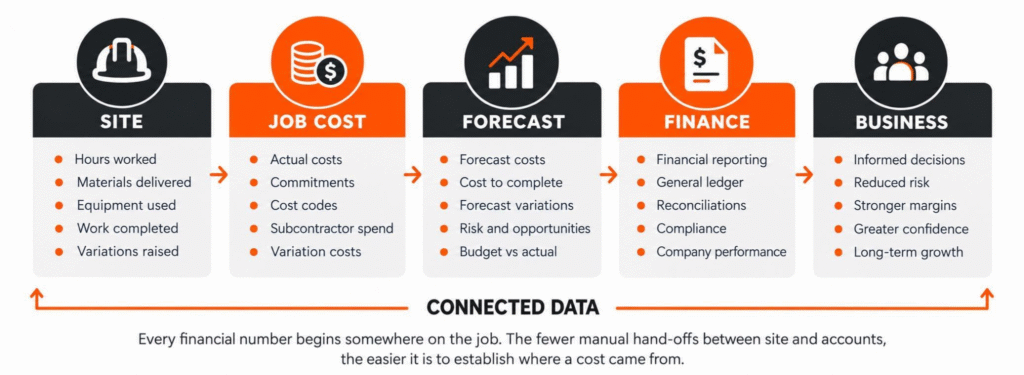
Every financial number ultimately starts with something tangible happening on a job.
People work hours. Materials arrive. Equipment is used. Work is completed. Scope changes.
All these things ultimately have a cost. But their financial consequences aren’t always immediately visible to the people making decisions.
That matters particularly in Australian construction, where project delivery involves long chains of contractors, subcontractors and suppliers. Clean, timely information needs to move from the site to the project team and then on to finance.
The more times that information is manually transferred or reconciled along the way, the greater the opportunity for delay and error.
This is where construction cost management and accounting do different jobs.
Accounting software needs to provide an accurate picture of the company’s finances. Project teams need much more forward-looking granular information about this job: commitments, actual costs, forecast costs and changes as they happen.
Connecting those two views means the financial picture can remain grounded in what is actually happening on the project.
From Job To Accounts
4. Why Verifiability Matters
“Real-time visibility” has become one of construction technology’s favourite promises. But I think verifiability is at least as useful.
A dashboard can show you a number instantly. That doesn’t necessarily mean the number is right. Can you interrogate it?
If a cost looks wrong, can you click through and see what sits behind it? Can you establish where it came from? Or determine whether it reflects the latest information from the project?
Verifiability means, instead of asking “Can somebody check this number?”, the project team can instead ask “What are we going to do about it?”
This matters as construction businesses spend more on technology and generate more data.
Infrastructure Australia’s 2025 Market Capacity Report found 64% of building and construction organisations had invested in data and digitalisation over the previous year.
Digitisation creates more information, but more information is not automatically more trustworthy information. If anything, the proliferation of systems and data makes provenance more important.
Rather than asking whether construction is becoming more digital – because it is – we should question whether that investment is giving us information that we can trust.
Construction is Investing in Digital
64% invested in data and digitalisation
35% invested up to 5% of revenue
22% invested 5–10% of revenue
Source: Infrastructure Australia, 2025
5. What Better Looks Like
Reliable cost control doesn’t require project teams to do more paperwork.
It requires a clearer connection between what is happening on the job and what appears in the financials.
With Procore, teams have site data linked to detailed job costs while the accounting system continues to manage company accounts. Budget information can be interrogated down to the underlying detail by the project team or leadership rather than treated as a static figure in a report.
The same principle applies to risk. Early financial risk indicators enter the system from site early, giving teams the tools they need to identify and forecast that risk early too.
The clues are often there long before a project gets into trouble. The challenge is spotting them among thousands of transactions, commitments and changes.
Two Procore AI tools show what this can look like. The Company Spend on General Conditions Insight tracks burndown of preliminaries against a company's benchmark burndown rate, helping to identify high-risk projects early enough to course correct and protect margins.
The Project Risk Monitor Agent looks for risks that humans might miss. It is another set of eyes on the project, surfacing the signals earlier and giving teams time to mitigate and report the reality before it appears as a surprise down the track.
Pro Tip
Interrogate the number: Click into budget figures to see the detail behind a cost and where it came from so you can refine your budget views.
Modernise the stack: Running job costing end to end in Procore enables you to ditch that legacy ERP freeing finance up to choose a modern generic system.
Standardise reporting: Give project and leadership teams a consistent view of financial information across projects.
Surface risk earlier: Use Procore's AI-powered Contract Review Agent and Project Risk Monitor to identify issues that may have financial consequences.
The goal isn’t another dashboard. It’s being able to look at a number, understand where it came from and decide what to do next.
6. Key Takeaways
- Trust starts at the source: Every financial number begins with something happening on the job.
- Manual hand-offs create risk: Every time information is rekeyed, reconciled or moved between systems, there is another opportunity for delay or error.
- Real-time isn’t enough: A number is only useful if teams can trust it, interrogate it and establish where it came from.
- Connect the job to ledger: Project teams need granular cost information while the business still needs an accurate company-wide financial picture.
- Spend less time checking, more time acting: Better cost information shifts the conversation from “Can somebody check this number?” to “What are we going to do about it?”
Once we stop debating the number, we can start deciding what to do about it.
Clint Burgess
Solution Specialist, Financials
Procore Technologies
This is the first instalment of Beyond the Budget, Procore’s three-part series exploring what turns construction cost data into useful cost intelligence. Next up: why the best forecast isn’t the one that predicts the future perfectly. It’s the one that gives you time to act.
Categories:
Written by
Reviewed by
Preeya Selvarajah
Senior Product Marketing Manager | Procore
Preeya is a Senior Product Marketing Manager at Procore, where she leads go-to-market strategy, product positioning, and competitive intelligence across the APAC region. With nearly two decades of experience in enterprise SaaS, she has worked across construction management tech, industrial automation, telematics & fleet management, and ERP solutions, bringing domain expertise and a customer-centric approach to her work. At Procore, she partners with product, sales, and customer teams to articulate how Procore's platform capabilities such as digital project delivery, quality & safety, and construction financials drive measurable impact on-site and in the office. Preeya is passionate about helping construction businesses unlock digital transformation and make smarter, data-driven decisions at scale.
View profileExplore more helpful resources

Scaling with SIERA: Building for now and what comes next
SIERA Founder and Director Brent Thompson has always known that the right people, systems and hands-on approach are fundamental to scaling his business successfully. In Part 1, Brent and Head...
Getting Your Construction Data Ready for AI – What Every Business Needs to Consider Before Launching AI
This is the first of two articles. This part sets out the considerations: what clean and trusted data actually means, how to measure it, how the two systems most businesses...

The Contractor’s Guide to Concrete Inspections
Concrete: It’s the key building block of nearly every structure’s foundation — and it’s the world’s most widely used building material. For most head contractors, understanding how to assess concrete...

Computer-Aided Design (CAD): What It Is — and Why It’s Important
When most people envision a construction worker, they see a person at a construction site wearing a hard hat and a high-vis vest. Perhaps this person is putting up plasterboard,...