
Can You Trace the Cost? Why managing variations means connecting the financial consequence back to what happened on site.

Last Updated Sep 28, 2026

Preeya Selvarajah
Senior Product Marketing Manager
Preeya is a Senior Product Marketing Manager at Procore, where she leads go-to-market strategy, product positioning, and competitive intelligence across the APAC region. With nearly two decades of experience in enterprise SaaS, she has worked across construction management tech, industrial automation, telematics & fleet management, and ERP solutions, bringing domain expertise and a customer-centric approach to her work. At Procore, she partners with product, sales, and customer teams to articulate how Procore's platform capabilities such as digital project delivery, quality & safety, and construction financials drive measurable impact on-site and in the office. Preeya is passionate about helping construction businesses unlock digital transformation and make smarter, data-driven decisions at scale.

Changes are inevitable in construction. Losing track of what they cost isn’t. In part 3 of this series, Procore Solution Specialist Clint Burgess looks at why the commercial trail needs to begin long before a variation is approved.
Table of contents
1. Construction is a Chain of Contracts
For most Australian builders, commercial control is largely about managing a chain of subcontracts. Infrastructure Australia estimates subcontracting accounts for around 41% of infrastructure construction, with lower-tier and specialist providers delivering a substantial share of work beyond the principal.
The Commercial Chain
41% of infrastructure construction delivered by subcontractors
#1 challenge is cost overruns when managing subcontracting and labour-hire relationships.
Source: Infrastructure Australia, 2025.
Each subcontract has its own scope, commitments, claims and changes. Multiply that across a project and it becomes very easy for what is happening on site and what is showing up in the financials to drift apart.
Most construction businesses I meet don’t have a lack-of-data problem.
They have a cause-and-effect problem.
Something happens on site. Someone sends a message. A subcontractor raises an issue. A condition is discovered that nobody expected. A price is requested. Weeks later, a number changes in the forecast.
The information exists. The problem is connecting those events.
The hardest part is documenting the variations. There can sometimes be misinformation or unaccounted costs that pop up during the process.
Clint Burgess
Solution Specialist, Financials
Procore Technologies
2. Don’t Wait for the Variation
Variations don’t begin as variations. They begin with something happening.
Imagine excavation starts and the team discovers old foundations that weren’t expected. Removing those old foundations requires additional time and equipment. Then contaminated soil is uncovered and needs different handling and disposal.
One unexpected site condition has now created multiple potential costs.
At this point, nobody may know exactly what the final financial impact will be. But that doesn’t mean the project has to wait until a variation is priced and approved before recognising the risk.
That early window matters.
If you only look at approved variations, you may be looking at the past.
We had a trade partner who tried to claim a big variation… we just went through all the Procore logs, found the right individuals, sent that back … So that saved me over $1 million by having that Procore log.
Clint Burgess
Solution Specialist, Financials
Procore Technologies
3. The Rework Blind Spot
Rework is another example of how something that happens on site can become a significant financial problem.
Infrastructure Australia estimates rework can reduce annual company profits by up to 28%. Yet just 8% of building and construction businesses measure it.
That’s a remarkable blind spot.
Knowing rework happened is one thing. Commercially, it is more useful to know what caused the rework, what was affected and where the resulting cost landed. Once you have this data over a portfolio of projects, you can really drive margins through intervention programs.
The Cost Nobody Counts
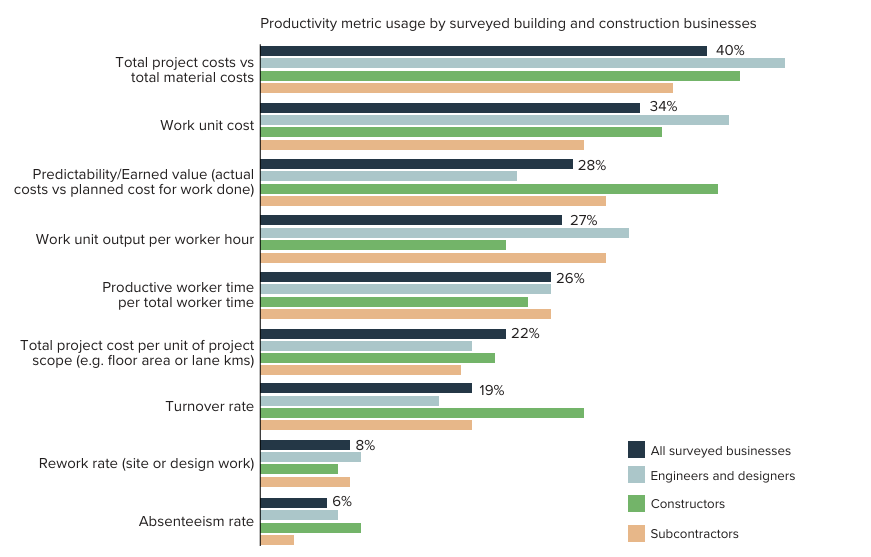
Productivity metric usage by building and construction businesses surveyed by Infrastructure Australia Source: Infrastructure Australia, 2025.
4. Follow the Cost Back to Site
Rework, variations and unexpected site conditions are different problems. But commercially, they present the same challenge: connecting a financial consequence back to its cause.
This is where change management becomes much more than keeping a variation register.
The site team knows what happened. The subcontractor knows there is additional work. Someone requests a price. The commercial team assesses the impact. Eventually, the forecast changes and there may be a variation to the contract.
If every step sits in a different email, spreadsheet or system, somebody must reconstruct that story.
And the longer the distance between the original site event and the eventual financial consequence, the harder that becomes. Try reconstructing what happened a year later when a dispute arises.
5. The Cost of a Broken Paper Trail
When people agree about a change, imperfect records can look like an administrative inconvenience. When they disagree, those records become evidence.
What changed? Was it in scope? When was it identified? Who was notified when? What work was undertaken? What did it cost? What was approved?
Consult Australia has warned the prevalence of claims on Design & Construct projects has turned the model into “design, construct and litigate”.
A digital paper trail doesn’t prevent disagreement. But it can preserve the relationship between the site record, pricing, approvals and resulting contract change, rather than leaving people to piece it together months later.
6. Follow the Golden Thread
Let’s go back to our excavation example. I don’t only want to know that removing old foundations and dealing with dirty soil added $50,000 to the forecast. I want to know why. I want to be able to follow that $50,000 back through the pricing and change process to the conditions encountered on site.
In Procore, a Change Event can provide the starting point.
The unexpected foundations can be recorded when they are discovered on site. An early estimate can be added before the final price is known. As the commercial position develops, that Change Event can lead to a request for pricing, move through the contract change process and ultimately flow into the budget.
The same information doesn’t need to be recreated at every stage.
7. What Better Looks Like
The best change register isn’t simply a list of approved variations.
It should help teams see risks and opportunities that could change the financial position before the final number is known.
That means capturing a change when it emerges, putting an early value against potential exposure, updating that value as better information becomes available and preserving the history as it moves through the commercial process.
It also means recording movements that don’t increase the overall budget.
Moving money between budget lines may have a net-zero effect on the project total, but it still tells us something changed. Keeping the reason for that movement connected to the budget preserves the commercial history.
Pro Tip
Price risk or opportunity early: Use a Rough Order of Magnitude estimate to put an early value against a Change Event. Pull this into the budget as a risk and opportunity column.
Keep budget movements visible: Record net-zero as well as non-net-zero Budget Changes so reallocations don’t disappear from the commercial history.
Optimise Change Management : Optimise and standardise change event views and use bulk creation features to manage change efficiently.
Connect the Origin to the Change Event: Link all Change Events with the relevant Origin, Photos and Documents to keep the thread intact. so teams can see why money moved.
8. Key Takeaways
- Changes start before the paperwork: The commercial impact often begins with an event on site, well before a variation is priced or approved.
- Unmeasured costs are a blind spot: Rework shows why identifying the cost is only part of the job. Teams also need to understand its cause.
- Capture risk while it can still be managed: An early estimate can make potential exposure visible before the final price is known.
- Preserve the commercial history: Site records, pricing, approvals, contract changes and budget movements should tell one connected story.
- Traceability matters most when people disagree: A clear record can turn months of reconstruction into evidence.
- Follow the money back to the job: Knowing the number changed is useful. Knowing what changed it is cost intelligence.
Don’t just show me that the number changed. Show me what changed the number.
Clint Burgess
Solution Specialist, Financials
Procore Technologies
This is the final instalment of Beyond the Budget, Procore’s three-part series exploring what turns construction cost data into useful cost intelligence: information you can trust, receive in time to act on, and trace back to its source.
Categories:
Written by
Reviewed by
Preeya Selvarajah
Senior Product Marketing Manager | Procore
Preeya is a Senior Product Marketing Manager at Procore, where she leads go-to-market strategy, product positioning, and competitive intelligence across the APAC region. With nearly two decades of experience in enterprise SaaS, she has worked across construction management tech, industrial automation, telematics & fleet management, and ERP solutions, bringing domain expertise and a customer-centric approach to her work. At Procore, she partners with product, sales, and customer teams to articulate how Procore's platform capabilities such as digital project delivery, quality & safety, and construction financials drive measurable impact on-site and in the office. Preeya is passionate about helping construction businesses unlock digital transformation and make smarter, data-driven decisions at scale.
View profileExplore more helpful resources

Scaling with SIERA: Building for now and what comes next
SIERA Founder and Director Brent Thompson has always known that the right people, systems and hands-on approach are fundamental to scaling his business successfully. In Part 1, Brent and Head...
Getting Your Construction Data Ready for AI – What Every Business Needs to Consider Before Launching AI
This is the first of two articles. This part sets out the considerations: what clean and trusted data actually means, how to measure it, how the two systems most businesses...

The Contractor’s Guide to Concrete Inspections
Concrete: It’s the key building block of nearly every structure’s foundation — and it’s the world’s most widely used building material. For most head contractors, understanding how to assess concrete...

Computer-Aided Design (CAD): What It Is — and Why It’s Important
When most people envision a construction worker, they see a person at a construction site wearing a hard hat and a high-vis vest. Perhaps this person is putting up plasterboard,...