
Do You Have Time to Act? Why better forecasting gives construction teams an early warning when costs start moving.

Last Updated Sep 28, 2026

Preeya Selvarajah
Senior Product Marketing Manager
Preeya is a Senior Product Marketing Manager at Procore, where she leads go-to-market strategy, product positioning, and competitive intelligence across the APAC region. With nearly two decades of experience in enterprise SaaS, she has worked across construction management tech, industrial automation, telematics & fleet management, and ERP solutions, bringing domain expertise and a customer-centric approach to her work. At Procore, she partners with product, sales, and customer teams to articulate how Procore's platform capabilities such as digital project delivery, quality & safety, and construction financials drive measurable impact on-site and in the office. Preeya is passionate about helping construction businesses unlock digital transformation and make smarter, data-driven decisions at scale.

Construction costs rarely blow out overnight. Productivity slips. Programs move. Labour and materials cost more than expected. Payments arrive late. The warning signs are often there. In part 2 of this series, Procore Solution Specialist Clint Burgess asks whether project teams can spot the warning signs early enough to respond.
Table of contents
1. The Pressure on Project Costs
By the time you know you’ve lost the money, it’s too late.
That sounds obvious. But I’ve seen construction businesses discover a deteriorating financial position weeks after the things that caused it started happening.
The report arrives. The number is bad. Everyone asks: “What happened?” Really, they should be asking: “When could we first have known?”
This matters in a market where contractors are being squeezed from several directions and productivity continues to flatline.
According to the Australian Bureau of Statistics, construction hours worked rose by 3.0% in 2024–25, while labour productivity fell by 2.9%.
For an individual project, that industry-wide pressure plays out in very practical ways. A crew takes longer than expected. Equipment stays on site for another week. Costs keep accumulating.
Together, these factors can start changing where the project will land financially, long before anything appears in a month-end report. That’s why a forecast built from last month’s information isn’t much of a forecast.
I'm only finding out about the issues if we've blown budget at the end of every month.
Clint Burgess
Solution Specialist, Financials
Procore Technologies
Construction’s Productivity Problem
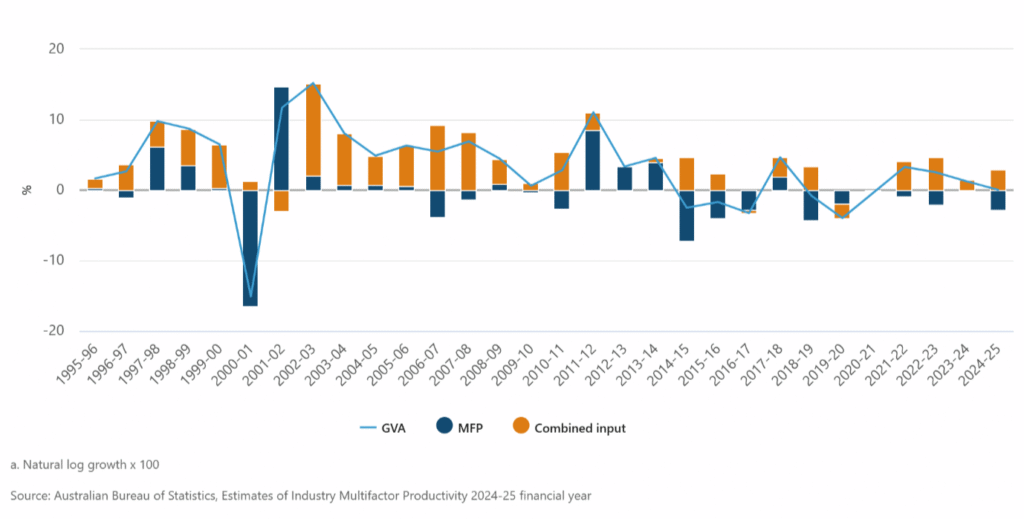
Construction industry gross value add, multifactor productivity and combined input, 2024-2025Source: Australian Bureau of Statistics, 2026.
2. Look for the Leading Indicator
Below is the classic case we hear from contractors that directly employ crews and equipment.
There is a budget for an activity and, every day, people on site are consuming time, materials and equipment to deliver it.
The site supervisor wants to know whether the work is being completed at the rate expected. The site engineer or quantity surveyor wants to use that data for forecasting purposes. Achieving the above either creates a massive manual burden on the project team or is out of reach. They don’t have their finger on the pulse of the highest risk to their profits.
When a robust streamlined system is in place, the project team can see a drop in productivity early, prompting the team to investigate what has changed and whether people, equipment or other resources need to be reallocated. Forecast cost to complete is grounded in project realities, which means leaders have more accurate reports to review.
These are leading indicators. And the earlier we spot them, the more choices we have.
There’s always what you think you’re going to spend. And then what crops up are the seemingly little unknown things that can actually add a whole lot of cost.
Clint Burgess
Solution Specialist, Financials
Procore Technologies
3. What Will It Cost to Finish?
Cost to finish is exactly what it sounds like: What do we still expect to spend to complete the remaining work?
Combine that with costs already incurred and we get a clearer picture of where the project is likely to land.
But construction forecasts can’t stand still, because projects don’t. Dates change. Procurement changes. Work is delayed or brought forward. Costs expected this month slide into the next.
Procore’s mobile easy-to-use Resource Management tools pair with forecasting tools, allowing teams to use leading indicators to improve the accuracy of their cost to complete.
Once the numbers are accurate, schedule dates assigned to cost items and distribution curves can spread the expected expenditure forecasts across the project timeline.
Not all costs behave the same way. Some are spread evenly across a period, while others are front- or back-loaded. Some are mapped on a bell curve, while necessary manual overrides allow for the occasional lump sum cost. The point isn’t the maths. It’s having a forecast that accurately reflects how much is to be spent and when the project expects to spend that money.
Keeping clients abreast of forecasts also helps them manage their own cashflow, building the confidence that underpins strong relationships and repeat business.
Categories:
Written by
Reviewed by
Preeya Selvarajah
Senior Product Marketing Manager | Procore
Preeya is a Senior Product Marketing Manager at Procore, where she leads go-to-market strategy, product positioning, and competitive intelligence across the APAC region. With nearly two decades of experience in enterprise SaaS, she has worked across construction management tech, industrial automation, telematics & fleet management, and ERP solutions, bringing domain expertise and a customer-centric approach to her work. At Procore, she partners with product, sales, and customer teams to articulate how Procore's platform capabilities such as digital project delivery, quality & safety, and construction financials drive measurable impact on-site and in the office. Preeya is passionate about helping construction businesses unlock digital transformation and make smarter, data-driven decisions at scale.
View profileExplore more helpful resources

Scaling with SIERA: Building for now and what comes next
SIERA Founder and Director Brent Thompson has always known that the right people, systems and hands-on approach are fundamental to scaling his business successfully. In Part 1, Brent and Head...
Getting Your Construction Data Ready for AI – What Every Business Needs to Consider Before Launching AI
This is the first of two articles. This part sets out the considerations: what clean and trusted data actually means, how to measure it, how the two systems most businesses...

The Contractor’s Guide to Concrete Inspections
Concrete: It’s the key building block of nearly every structure’s foundation — and it’s the world’s most widely used building material. For most head contractors, understanding how to assess concrete...

Computer-Aided Design (CAD): What It Is — and Why It’s Important
When most people envision a construction worker, they see a person at a construction site wearing a hard hat and a high-vis vest. Perhaps this person is putting up plasterboard,...