Breaking Ground Part 1: The True Cost of Land, Infrastructure & Housing Supply

Last Updated Jul 16, 2026
Shauna Hurley
22 articles
Shauna is never short of questions when it comes to construction, tech and science. A professional writer, researcher and podcast producer, she loves sitting down with industry insiders for in-depth interviews that uncover the latest developments, debates and emerging trends. Having worked with organisations like Microsoft and the European Bank of Reconstruction, Shauna joined Procore to explore the complex issues facing construction and share fresh, research-rich insights that help professionals navigate a rapidly evolving industry.

In the first of this three-part Procore State of Housing series, we look at why Australia’s housing crisis starts with land, not construction, and how early coordination across land, infrastructure and civil works is vital to unlocking new housing supply.
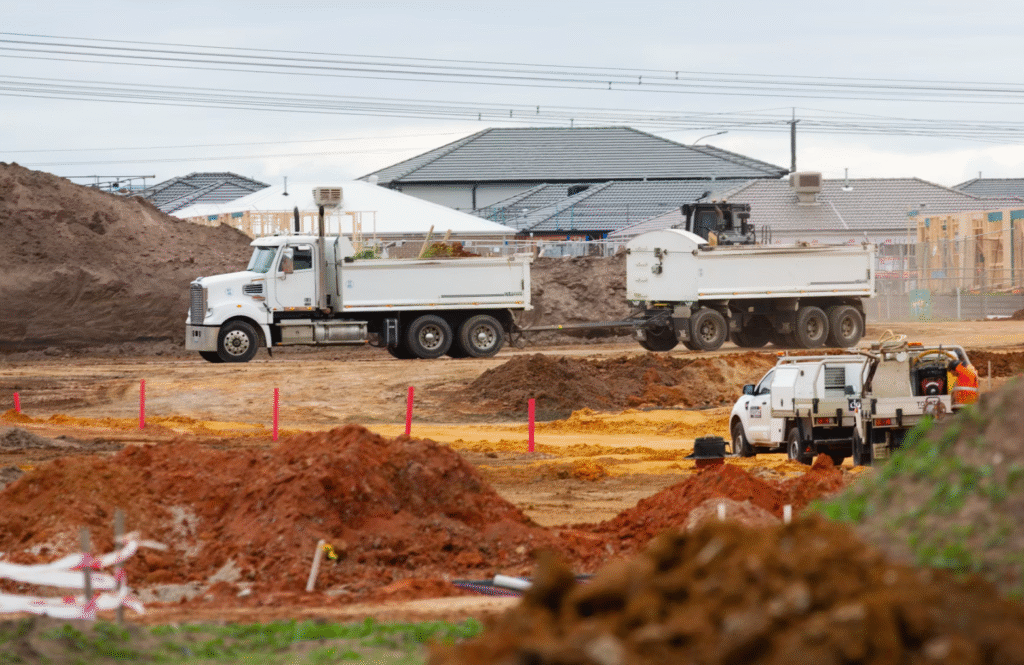
Australia’s deepening housing crisis is commonly framed around missed targets, productivity challenges and worsening affordability. But another equally critical constraint gets far less attention: the land, infrastructure and civil works that need to be ready before the construction of new homes can begin.
Table of contents
Why solving the housing crisis starts with land, infrastructure and civil works
That was the focus of Procore’s Breaking Ground: The True Cost of Land, Infrastructure & Housing Supply webinar, which brought together industry leaders Andrew Hay, Group Executive, Head of McNab Property, and Nicholas Proud, CEO of the Civil Contractors Federation. Host Andy Rampton, Industry Transformation Lead, APAC at Procore, set the scene early with a central question.
We often hear about the housing crisis in terms of the availability and affordability of the finished product,” Andy said. “But does the housing crisis actually begin long before a single brick is laid – that is, does it actually begin in the dirt?
Andy Rampton
Field COO (International)
Procore
In search of answers to that, he asked Andrew and Nicholas where they see the biggest bottlenecks, and how closer collaboration across civil, infrastructure and residential construction could help unlock supply.
Civil is the hidden blockage that is just not considered by most people. When they look at a subdivision, they see 50, 100 or 200 homes, or in a master plan community, thousands. They start thinking about the block they might choose, the type of house they want, and how many bedrooms they’ll have. But the grade of pipe, the fill and the work that goes before that slab is poured isn’t part of that equation. For those of us in the business of supplying homes, we know this is what actually has to come first.

Nicholas Proud
CEO
Civil Contractors Federation
Nicholas’s starting point was that civil works need to come first. Andrew showed what that means for developers trying to make projects stack up.
Why infrastructure readiness shapes feasibility and delivery
As Group Executive, Head of McNab Property, one of Australia’s largest privately-owned construction, supply and property development groups, Andrew sees firsthand how land, planning, infrastructure and construction needs to come together on the ground. Asked how civil works, infrastructure approvals and enabling works affect whether a project stacks up financially, he says certainty is essential.
“Obviously, the line of sight to the infrastructure is critically important,” Andrew says. “I’m viewing it through a Queensland lens, but I’m sure this applies to much of Australia. We’ve arguably hit a housing inflection point. Property is expensive, population growth and household formation are strong, and interstate migration remains very robust.”
“Despite all of that, our housing supply responsiveness has weakened. Nationally, we’re still building around 180,000 homes per year, which is far below demand. Debt servicing levels are high compared to incomes, construction costs and future escalation are elevated, and infrastructure plays a massive role in that.”
While infrastructure pipelines are expanding across both the public and private sectors, Andrew says the sequencing of that infrastructure against housing delivery remains a major blocker.
It’s reasonable to suggest that there is sequencing misalignment of infrastructure, and infrastructure approvals are slow and complicated. In Queensland, councils are acutely aware of the supply-side pressures and generally quite supportive in terms of approvals, but the approvals for trunk infrastructure, water, sewer, power and so on, are challenging.
Ultimately it’s not just a housing affordability question or conversation anymore. It’s a delivery system challenge, or demand and supply dislocation.

Andrew Hay
Group Executive, Head of McNab Property
McNab Property
The problem with costs being continuously pushed downstream
Infrastructure also shapes whether projects can proceed financially. As Andy highlighted, civil and building costs, developer contributions, utility charges and council requirements all flow through the delivery chain. Eventually, someone has to carry them. Asked whether rising infrastructure and construction costs can simply be absorbed through higher home prices, Andrew says there is a limit.
We know pricing is passed on through to the end user. There’s an elastic nature to that, and the analogy there is the rubber band. It snaps at some point. We can’t keep heaping prices onto the end user. Myself, like many people, have children. I want them to own a home. So we need to ensure that this is done in a really efficient way. We need to change the way we deliver housing.
Andrew Hay
Group Executive, Head of McNab Property
McNab Property
To do that, Andrew suggests governments need to distinguish between policies that stimulate demand and those that help unlock supply. Buyer incentives can help people enter the market, but if supply remains constrained, they can also add pressure to an already stretched system.
On the supply side, infrastructure charges, levies and other upfront costs can affect whether projects proceed. Reducing those pressures does not solve every problem, but it can help create the conditions for more homes to move from plan to delivery.

Certainty and confidence: the critical ingredients for supply
For both Andrew and Nicholas, the link between infrastructure investment and housing delivery is clear. Land can only accommodate new homes when roads, services, approvals and civil works are ready to support them.
“When investment is made, both public and private, in roads, highways and subdivisions, you can actually see the flow-on to housing commencements,” Nicholas says. “Once you have the investment in those spaces, it unlocks it. It unblocks the slabs being poured and the work that happens after that trunk infrastructure.”
For Andrew, reducing infrastructure risk gives developers the confidence to move.
“When infrastructure risk reduces, developers can accelerate the output with confidence,” Andrew says. “And that’s what people in the industry need: certainty.”
But he also cautions against oversimplifying the causes of Australia’s housing crisis or the remedies for it.
“It’s sensible to remain open-minded to the fact that it is still a confluence of issues, as opposed to a single driver,” Andrew says. “There isn’t really one silver bullet.”
Next up: Andy, Nicholas and Andrew look at what needs to change to increase supply, and why stronger collaboration between civil and residential construction is critical to unlocking housing supply.
Categories:
Written by
Shauna Hurley
22 articles
Shauna is never short of questions when it comes to construction, tech and science. A professional writer, researcher and podcast producer, she loves sitting down with industry insiders for in-depth interviews that uncover the latest developments, debates and emerging trends. Having worked with organisations like Microsoft and the European Bank of Reconstruction, Shauna joined Procore to explore the complex issues facing construction and share fresh, research-rich insights that help professionals navigate a rapidly evolving industry.
View profileExplore more helpful resources

Scaling with SIERA: Building for now and what comes next
SIERA Founder and Director Brent Thompson has always known that the right people, systems and hands-on approach are fundamental to scaling his business successfully. In Part 1, Brent and Head...
Getting Your Construction Data Ready for AI – What Every Business Needs to Consider Before Launching AI
This is the first of two articles. This part sets out the considerations: what clean and trusted data actually means, how to measure it, how the two systems most businesses...

The Contractor’s Guide to Concrete Inspections
Concrete: It’s the key building block of nearly every structure’s foundation — and it’s the world’s most widely used building material. For most head contractors, understanding how to assess concrete...

Computer-Aided Design (CAD): What It Is — and Why It’s Important
When most people envision a construction worker, they see a person at a construction site wearing a hard hat and a high-vis vest. Perhaps this person is putting up plasterboard,...