Riding the wave: How Arch10 is preparing for construction’s AI future

Last Updated Aug 12, 2026
Shauna Hurley
22 articles
Shauna is never short of questions when it comes to construction, tech and science. A professional writer, researcher and podcast producer, she loves sitting down with industry insiders for in-depth interviews that uncover the latest developments, debates and emerging trends. Having worked with organisations like Microsoft and the European Bank of Reconstruction, Shauna joined Procore to explore the complex issues facing construction and share fresh, research-rich insights that help professionals navigate a rapidly evolving industry.
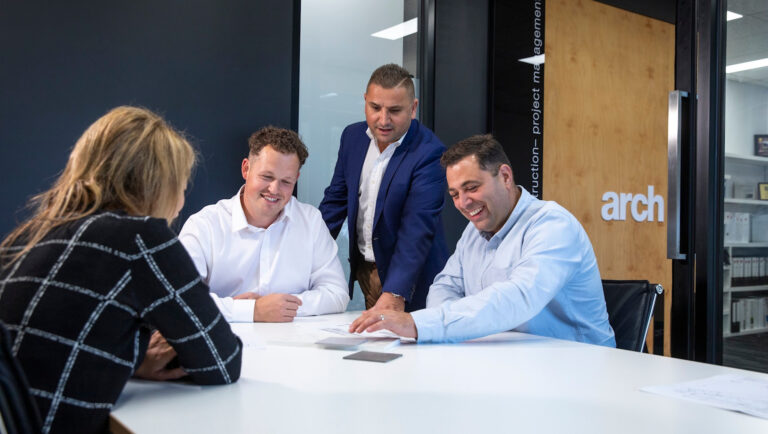
Arch10 founder David Filice has shifted from tech skeptic to digital advocate. By organising data now, Arch10 is positioning itself to leverage AI to transform critical tasks like tendering and estimation, ensuring the firm is prepared for the future of construction.
David Filice, founder of Melbourne construction firm Arch10, is the first to admit he wasn’t an early adopter when it came to technology. As a new graduate at Multiplex more than two decades ago, much of David’s day was spent printing, folding, stamping and filing drawings by hand.
“It’s funny to think about now, but it was just when fax machines came in. You’d get a design advice or site instruction by fax, scan it, save it to file and then attach it to an email. I thought it was a bit of a waste of time,” David laughs. “Why not just write everything down on a piece of paper and hand it over? You could say I started out pretty averse to technology.”
“Looking back, there wasn’t one moment where I thought, ‘Right, technology is the answer,’” David says. “I just started to see the real benefits."
You realise it’s saving time and that translates to money, because you’re free from all these time-consuming manual tasks. These days, I see AI and automation as the next wave that’s coming to transform the industry for builders and consumers alike in an entirely different way.

David Filice
Founder
Arch10
That perspective now shapes how Arch10 approaches technology. As the business takes on larger and more complex residential projects, David sees connected systems as more than an operational upgrade. They are a way to keep information visible, reduce risk and put the business in a stronger position for what comes next.
Read Arch10's story: How they built stronger systems, clearer workflows and greater visibility across their project portfolio
Table of contents
No more guessing who’s holding the ball
For David, the value of technology is clearest when it helps the business save time, reduce risk and keep work moving. At Arch10, that starts with making project information easier to access, track and act on.
If you think about what construction used to be like, it was often a case of: ‘Oh, someone forgot that email,’ or you’d be asking, ‘Who’s got that? Where’s that at? What are we waiting on?’ Now we have a centralised Procore dashboard where you can see where every project is at and who’s holding the ball on any issues.
David Filice
Founder
Arch10
That visibility is critical, given a missed drawing revision, delayed approval or missing documentation can quickly turn into a time-consuming paper chase, rework or dispute risk.
David points to drawing management as one practical example of where connected systems have changed the way the business operates.
“We had one project where a client uploaded 41 revisions and it was only a small residential project,” David says. “But with Procore, all the drawings go into the repository and we can immediately look at what changed rather than having to trawl through every drawing hoping the architect marked up the revisions. You can imagine the time savings from that. Huge.”
“The same goes for site diaries and photos that are uploaded to our central repository, giving both our team and clients a clear view of progress,” David says. “One of our clients in Dubai often hops on to see what’s going on on site. There are real benefits and efficiencies there.”
For Arch10, the immediate benefits are practical: less chasing, fewer information gaps and a clearer record of what has happened across each project. The longer-term value is that project information is being captured in a more consistent, connected way — creating stronger foundations for the AI and automation tools David believes are set to transform the industry.

As Arch10 takes on larger and more complex projects like Melbourne’s high-end North Road townhouse development (pictured), connected systems are helping the team build the visibility, workflows and project data needed for what comes next.
Readying to ride the AI wave
David sees significant potential for AI and automation to transform the construction industry, but builders first need the right systems, workflows and project information in place to make the most of them.
“I see AI as this huge wave that’s coming, and I think it’ll come a lot faster than the transition we’ve seen in IT over the last 20 years,” he says. “With the exception of laying the brick, everything that involves calculation, decision making, design, tendering, estimating and procurement has potential for AI. I can identify a hundred different things in our business where if a computer could do that, it’ll change the game.”
Tendering is one example where David sees the commercial potential.
“We look at a tender for a project worth $10 million that might cost us nominally $20,000 to do, because it takes time to look through the drawings, read the spec, understand the bill of quantities and make decisions about prelims and site logistics,” David says.
But if AI can take all that information, simulate it and look at the last 10 jobs about how you would approach it, there’s enough computing power to spit that out in a matter of hours. That’s weeks of work saved.
David Filice
Founder
Arch10
David sees AI benefitting both builders and clients alike, especially when it comes to making the building process clearer, pricing more transparent and different approaches easier to understand.
“Over time, AI and automation will bring more transparency and standardisation across the industry and also help clients looking to build,” he says. “We know one of the biggest challenges they face is trying to vet builders and understand why there are discrepancies in pricing and approaches. I think AI will help clean that up and make a real difference.”
Ultimately, David sees AI and automation reshaping how builders tender, estimate, procure and make decisions. Those best placed to benefit will be the ones doing the groundwork now: getting their systems, workflows and project information in better shape.
“The builders and businesses that have their systems and data in order will be best placed to ride that wave,” he says.
For Arch10 that work is already well underway.
Categories:
Written by
Shauna Hurley
22 articles
Shauna is never short of questions when it comes to construction, tech and science. A professional writer, researcher and podcast producer, she loves sitting down with industry insiders for in-depth interviews that uncover the latest developments, debates and emerging trends. Having worked with organisations like Microsoft and the European Bank of Reconstruction, Shauna joined Procore to explore the complex issues facing construction and share fresh, research-rich insights that help professionals navigate a rapidly evolving industry.
View profileExplore more helpful resources
Scaling with SIERA: Building for now and what comes next
SIERA Founder and Director Brent Thompson has always known that the right people, systems and hands-on approach are fundamental to scaling his business successfully. In Part 1, Brent and Head...
Getting Your Construction Data Ready for AI – What Every Business Needs to Consider Before Launching AI
This is the first of two articles. This part sets out the considerations: what clean and trusted data actually means, how to measure it, how the two systems most businesses...

The Contractor’s Guide to Concrete Inspections
Concrete: It’s the key building block of nearly every structure’s foundation — and it’s the world’s most widely used building material. For most head contractors, understanding how to assess concrete...

Computer-Aided Design (CAD): What It Is — and Why It’s Important
When most people envision a construction worker, they see a person at a construction site wearing a hard hat and a high-vis vest. Perhaps this person is putting up plasterboard,...