
What is a procurement management plan in construction?

Last Updated Jun 18, 2026
Josh Krissansen
122 articles
Josh Krissansen is a freelance writer with two years of experience contributing to Procore's educational library. He specialises in transforming complex construction concepts into clear, actionable insights for professionals in the industry.
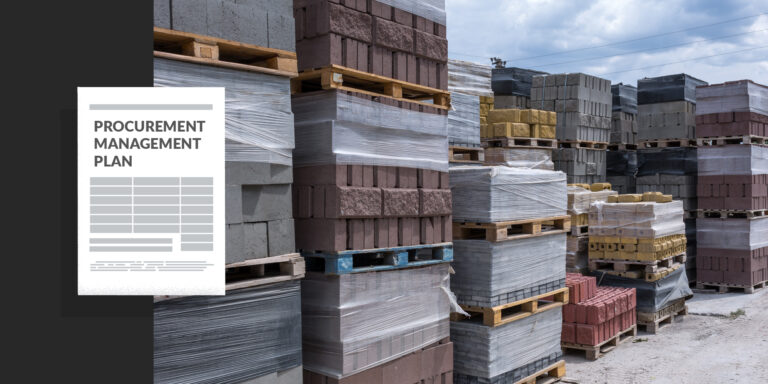
A procurement management plan sets out how procurement will be managed across a project, including what packages will be procured, when they need to be tendered and awarded, who is responsible for them, and what contract and procurement methods will apply.
Without a clear plan, long-lead items can be ordered too late, subcontract packages can fall out of sequence with the construction programme, and scope gaps may not become visible until delivery is underway.
This article explains what a procurement management plan is, what it should contain, and how to build one for an Australian commercial construction project.
Table of contents
What is a procurement management plan?
A procurement management plan is a project-specific document that maps every procurement activity from package identification through tender, award, and delivery. The plan functions as the single source of truth for procurement decisions across the project lifecycle, recording:
- Who is responsible for each package
- What contract type applies
- What procurement method will be used
- When each milestone must occur relative to the construction programme
It is distinct from a procurement schedule. The schedule is one output of the plan, while the plan itself governs process, roles, and strategy. In doing so, it helps reduce scope gaps at tender and maintain alignment between procurement and the construction programme, improving cost certainty during delivery.
Key components of a procurement management plan
A well-structured procurement management plan covers five core components. Each one addresses a distinct aspect of procurement control across the project lifecycle.
Procurement register
The procurement register lists every package by trade or supply category, covering:
- Estimated value
- Contract type (lump sum, schedule of rates, or cost-plus)
- Procurement method (open tender, select tender, or direct appointment)
- Responsible party
- Current status
It connects directly to the cost plan and scope of works, giving the project team a consolidated view of procurement commitments and where cost exposure is being established.
Procurement programme
The procurement programme maps procurement milestones to design freeze dates, authority approvals, and construction start requirements.
Its most important function is flagging long-lead items early. Structural steel, mechanical plant, façade systems, and lifts all have procurement timelines that run well ahead of the construction programme's on-site requirements.
The programme also separates procurement float from construction programme float, so the team can accurately assess how much a tender delay affects site delivery, and where that delay can translate into programme and cost pressure.
Tender and contract strategy
The tender and contract strategy defines which packages go to open tender, which go to a select panel, and which are negotiated directly. It also sets standard subcontract terms and payment schedule requirements consistent with Security of Payment legislation in the relevant state or territory, helping reduce downstream payment and compliance risk during delivery.
Roles and responsibilities
The plan must specify who is responsible for:
- Preparing tender packages
- Managing the tender process
- Awarding contracts
- Tracking delivery against the register
When roles are not clearly assigned, people often assume someone else is handling it, and tasks are missed, which can lead to gaps in procurement coverage and delays in programme delivery.
Supplier and subcontractor management
The final section of the procurement management plan covers prequalification requirements, performance evaluation processes, and how the plan manages packages where preferred subcontractors are unavailable or market capacity is constrained, helping maintain procurement continuity in constrained markets.
Procurement management plan vs procurement strategy
A procurement strategy sets the high-level direction, outlining which packages go to open tender, which are negotiated, and how risk is allocated across the subcontract structure.
The procurement management plan takes that decision and makes it executable. It documents the process, assigns responsibilities, sets timelines, and creates the register against which progress is tracked.
Both are necessary. A strategy without a plan means the project knows what it wants to do, but has no mechanism to do it, which can lead to delays and loss of control during delivery.
How to build a procurement management plan for a construction project
These six steps cover the full process of building a procurement management plan, from package identification through to subcontract execution.
Step 1: Identify all packages from the scope of works and cost plan
Work through every trade and supply category (including civil, structure, façade, fit-out, and services), and cross-reference each one against the cost plan to confirm nothing is missing, and that every package has an estimated value assigned.
Missed packages show up later as scope gaps in the subcontract structure, unbudgeted variations, or work that falls between trade boundaries with no clear owner. The cost plan and scope of works should agree at the package level before procurement begins.
Start with the major trade packages and work down to smaller supply categories, checking that every line item in the cost plan maps to a defined package in the scope of works. Where a cost plan line item has no corresponding package, it should be treated as a gap to resolve before procurement begins.
Step 2: Assess lead times and sequence packages against the construction programme
Identify which packages sit on the critical path and work back from required on-site dates to set tender milestone dates.
Flag long-lead items immediately. Structural steel, mechanical plant, lifts, and façade systems have procurement timelines that run months ahead of when the construction programme requires them on site.
Step 3: Determine contract type and procurement method for each package
Base the contract type and procurement method on the level of scope definition, the risk profile of the package, and current market conditions.
For instance, if scope is not yet resolved, lump sum contracts may not be appropriate. A schedule of rates or cost-plus contract is more appropriate and can reduce the risk being priced back through variations during delivery.
Step 4: Assign ownership and set tender milestone dates
Every package needs a named responsible party and a dated tender programme. For each package, record the responsible party in the procurement register alongside four key dates:
- Tender issue
- Tender close
- Award
- Required on-site date
Work back from the on-site date to set each milestone, and build in adequate tender periods. As a general guide, minor subcontract packages warrant a minimum of two to three weeks, while major or complex packages need four to six weeks or more depending on scope complexity and market conditions.
Without named ownership, nobody is monitoring the tender programme against the construction programme, and by the time someone notices a package is behind, the tender period has already been cut to recover time.
That can have a direct cost. Subcontractors with full order books will walk away from short tender periods, and those who remain have less time to price accurately, which shows up in inflated risk allowances or missed scope.
Step 5: Establish the procurement register as a live document
The register needs to be updated continuously through tender, award, and delivery, and reviewed in project meetings alongside the construction programme.
At a minimum, each row in the register should capture:
- Package name
- Trade category
- Estimated value
- Contract type
- Procurement method
- Responsible party
- Tender issue date
- Tender close date
- Award date
- Required on-site date
- Current status
As packages progress, the register should also record the awarded subcontractor, the awarded value, and any variance against the budgeted estimate.
Assign someone to own the register and update it as each package moves through tender, award, and delivery. At every project meeting, slippage against tender milestone dates should be flagged and a recovery action recorded.
A register that falls behind current status can quickly stop being useful, and package status can end up being tracked informally across emails and spreadsheets instead.
Step 6: Align subcontract terms with the head contract
Back-to-back alignment on programme, variations, and payment terms does not happen automatically.
When reviewing subcontract terms against the head contract, check that the subcontract programme obligations mirror the head contract milestone dates, that the variation process follows the same notice periods and approval requirements, and that payment terms reflect the head contract payment schedule.
Confirm that payment claim intervals and payment timeframes comply with Security of Payment legislation in the relevant state or territory, as these vary across jurisdictions and non-compliant schedules can affect a subcontractor's ability to exercise their payment rights.
Procurement management plans keep procurement on track and costs under control
A procurement management plan gives a project team a structured process for managing every package from identification through to subcontract execution. Without one, scope gaps, missed milestones, and misaligned subcontract terms can be difficult to prevent and harder to recover from once delivery is underway.
Categories:
Written by
Josh Krissansen
122 articles
Josh Krissansen is a freelance writer with two years of experience contributing to Procore's educational library. He specialises in transforming complex construction concepts into clear, actionable insights for professionals in the industry.
View profileExplore more helpful resources

Scaling with SIERA: Building for now and what comes next
SIERA Founder and Director Brent Thompson has always known that the right people, systems and hands-on approach are fundamental to scaling his business successfully. In Part 1, Brent and Head...
Getting Your Construction Data Ready for AI – What Every Business Needs to Consider Before Launching AI
This is the first of two articles. This part sets out the considerations: what clean and trusted data actually means, how to measure it, how the two systems most businesses...

The Contractor’s Guide to Concrete Inspections
Concrete: It’s the key building block of nearly every structure’s foundation — and it’s the world’s most widely used building material. For most head contractors, understanding how to assess concrete...

Computer-Aided Design (CAD): What It Is — and Why It’s Important
When most people envision a construction worker, they see a person at a construction site wearing a hard hat and a high-vis vest. Perhaps this person is putting up plasterboard,...