
Automation in Construction: A Guide for Australian Project Teams

Last Updated Jul 2, 2026
Josh Krissansen
122 articles
Josh Krissansen is a freelance writer with two years of experience contributing to Procore's educational library. He specialises in transforming complex construction concepts into clear, actionable insights for professionals in the industry.
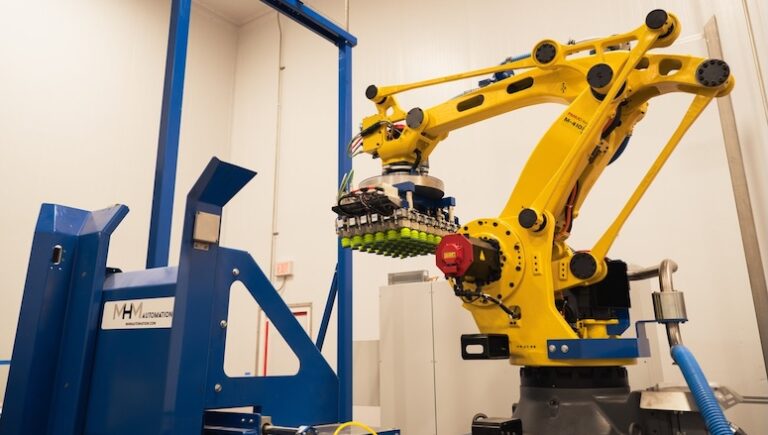
Automation is being introduced on more Australian commercial projects, and project managers and contracts administrators are being asked to assess, procure, and manage it without clear guidance on what is proven, what is emerging, and what is not yet ready for a live project.
Construction automation refers to machines, software, and connected systems executing tasks with reduced manual intervention across design, documentation, fabrication, site execution, and quality control.
In this article, we cover which automation technologies are genuinely in use on Australian commercial projects, how they affect delivery across the project lifecycle, and what project teams need to understand before committing to them in a scope or programme.
Table of contents
What is automation in construction?
Construction automation is the application of machines, software, and connected systems to execute project tasks with reduced reliance on manual labour. The defining characteristic is not the technology itself but the degree to which human intervention is removed from execution, whether that is a software workflow routing approvals without manual follow-up or a robotic system completing repetitive site tasks to a programmed specification.
The degree of automation varies widely between different tools.
Some tools assist workers by reducing manual effort on discrete tasks, while others operate without human intervention during execution once commissioned. Understanding where a proposed technology sits on that spectrum is important when assessing capability requirements, interface risk, and contractual obligations before purchasing.
Types of automation in use on commercial projects today
Not every technology being marketed as construction automation is proven on commercial sites.
The following categories reflect what is genuinely established or actively emerging in Australian commercial construction, and what project teams can reasonably expect to encounter in tenders and subcontractor scopes.
- BIM and model-based coordination: Building information modelling uses integrated 3D modelling to coordinate design across disciplines and detect clashes between structural, mechanical, and services elements before construction begins, reducing design errors.
- Prefabrication and modular construction: Prefabrication moves component manufacture off-site into a controlled factory environment, where automated production processes and fixed quality hold points replace the variable conditions of site-based construction.
- Construction management software automation: Construction management platforms automate the routing, approval, and recording of project documentation, including RFIs, variations, and submittals, reducing admin burden across the delivery team.
- Construction robotics: Construction robots perform specific on-site tasks by executing programmed instructions with a level of consistency and repeatability that manual labour can’t match at scale.
- Autonomous and semi-autonomous equipment: Autonomous earthworks and civil equipment use GPS positioning, machine control systems, and onboard sensors to grade, excavate, and compact without continuous operator input.
- Drones and aerial survey: Drones automate site data capture by flying pre-programmed flight paths to collect photogrammetric data, thermal imagery, and progress photography.
How automation affects delivery across the project lifecycle
Automation isn't used across all phases of a project in the same way, nor does it have the same impact.
Here's how automation affects delivery across the project lifecycle and what needs to be considered at each stage.
Preconstruction and design
BIM coordination
BIM coordination resolves conflicts in the model before work begins, which means information that might otherwise emerge through RFIs during traditional delivery needs to exist upfront for the model to function. If project documentation is incomplete, the model can’t be coordinated, and the process breaks down.
Prefabrication
Where prefabrication or modular construction is in scope, design must be resolved to manufacturing standards before fabrication commences. Unlike site-based construction, where some design gaps can be resolved during delivery, prefabricated components are committed to specific dimensions and configurations at the point of manufacture.
Drone use
Drone surveys and photogrammetry can accelerate site investigation at the feasibility stage and reduce cost plan uncertainty before a project brief is finalised.
Procurement and contracting
Prefabrication
When a subcontractor is delivering their scope using automated methods, the contract documentation needs to reflect how that work actually happens.
Take a prefabrication subcontractor, for example. A traditional carpentry specification describes materials, fixing methods, and workmanship standards because the work happens on-site where it can be observed and corrected. A prefabrication spec needs to define tolerances, module dimensions, finish standards, and hold point requirements, because by the time components arrive on site, manufacturing is complete and defects are significantly harder to rectify.
Variation management
On a traditional scope, a variation to a wall location or a fitting specification can often be absorbed during delivery with minimal notice. On a prefabricated scope, the same change may require a new fabrication run, a revised shop drawing approval cycle, and additional lead time of several weeks.
Contracts administrators need to understand this before executing subcontracts, and the variation clause should reflect the actual cost and time consequences of changes to manufactured components.
Programme
Prefabrication
Prefabrication compresses the on-site programme for repetitive elements, but the overall programme does not simply get shorter. The time saved on site gets replaced by lead time at the front end. Design needs to be locked in earlier, shop drawings need to be approved, and the factory needs to be running before site work begins. Teams that plan the programme from the back end of site and ignore that front-end lead time routinely find themselves expediting fabrication at a premium.
Autonomous equipment
Autonomous earthworks equipment can improve output consistency and reduce labour exposure on civil packages, but sequencing still needs to be resolved before works commence.
Autonomous plant must operate within defined exclusion zones, which impacts how other trades access the work area. Those zones need to be planned into the site methodology.Drones
Drone-based progress monitoring replaces periodic manual surveys with regular, timestamped site records. Those records reduce the time and cost of assessing progress claims and provide a more accurate snapshot of site conditions at any given point in time. Where an EOT is later disputed, that record can provide stronger supporting evidence than a site diary entry alone.
Quality and compliance
Off-site prefabrication means quality verification changes from site inspection to factory hold points and ITPs.
The change here is that any non-conformance identified after components arrive on site may require the module to be returned to the factory or written off entirely. Contracts administrators need to confirm ITP requirements, inspection access rights, and notification procedures before fabrication begins.
Automated construction methods must comply with the NCC and relevant Australian standards regardless of the method used. Where a novel automated technique is proposed, the head contractor should confirm NCC compliance pathways and local authority acceptance before the method is locked into the programme.
Automated systems also generate more complete data records than traditional construction. RFI logs, approval timestamps, photogrammetric surveys, and factory ITPs all produce documentation that can support EOT and variation substantiation.
Challenges and limitations of construction automation (and how to overcome them)
Automation adds genuine value on the right project, but there can be a gap between what vendors demonstrate and what performs reliably on a live commercial site. The challenges below are not reasons to avoid automation, but they are the issues that project teams consistently underestimate when committing to it.
Subcontractor capability is uneven
Not all subcontractors offering automated or prefabricated work have the systems, quality management, and financial capacity to perform on a commercial project.
A compelling tender price and polished presentation do not reveal whether a subcontractor's factory has the capacity to meet your programme, whether their ITP process is mature, or whether they have successfully delivered comparable work before.
Prequalification should assess factory capacity, ITP maturity, and prior project performance before a subcontractor is included on a tender list.
Cost benchmarking is immature
Reliable Australian cost data for automation is limited. AIQS guidance and Rawlinsons provide reference rates for prefabrication, but they don't yet capture the full range of automated methods now appearing in tenders.
Treat desktop benchmarks as a starting point only. Build in a contingency that reflects the novelty of the work rather than applying standard allowances, and test pricing at tender rather than assuming published rates will hold.
Labour and EBA considerations
Enterprise agreements on Australian sites may contain provisions that affect how automated or autonomous equipment is introduced, particularly where it displaces or changes the nature of established trade work.
Confirm applicable provisions before autonomous or semi-autonomous equipment is programmed into the site methodology, and engage the relevant unions early where the scope involves significant change to how work is traditionally performed.
Regulatory acceptance varies by jurisdiction
Building surveyor and certifier familiarity with automated construction techniques is not uniform across Australian states and territories. A method accepted without issue in Victoria, for instance, may require additional compliance evidence in Queensland or Western Australia.
Engage the certifier before the automated methodology is locked into the programme, and confirm NCC compliance pathways and any additional documentation requirements before fabrication or construction commences.
Automation in construction rewards teams that plan for it early
Construction automation is not a single technology but a broad set of methods that affect how projects are designed, procured, programmed, and delivered.
Teams that understand where each type of automation changes the delivery equation and plan their contracts, programmes, and quality processes accordingly are better positioned to capture the benefits and avoid the pitfalls.
Categories:
Written by
Josh Krissansen
122 articles
Josh Krissansen is a freelance writer with two years of experience contributing to Procore's educational library. He specialises in transforming complex construction concepts into clear, actionable insights for professionals in the industry.
View profileExplore more helpful resources

Scaling with SIERA: Building for now and what comes next
SIERA Founder and Director Brent Thompson has always known that the right people, systems and hands-on approach are fundamental to scaling his business successfully. In Part 1, Brent and Head...
Getting Your Construction Data Ready for AI – What Every Business Needs to Consider Before Launching AI
This is the first of two articles. This part sets out the considerations: what clean and trusted data actually means, how to measure it, how the two systems most businesses...

The Contractor’s Guide to Concrete Inspections
Concrete: It’s the key building block of nearly every structure’s foundation — and it’s the world’s most widely used building material. For most head contractors, understanding how to assess concrete...

Computer-Aided Design (CAD): What It Is — and Why It’s Important
When most people envision a construction worker, they see a person at a construction site wearing a hard hat and a high-vis vest. Perhaps this person is putting up plasterboard,...