
Earthworks in construction: a delivery guide for Australian project teams

Last Updated Aug 31, 2026
Josh Krissansen
122 articles
Josh Krissansen is a freelance writer with two years of experience contributing to Procore's educational library. He specialises in transforming complex construction concepts into clear, actionable insights for professionals in the industry.
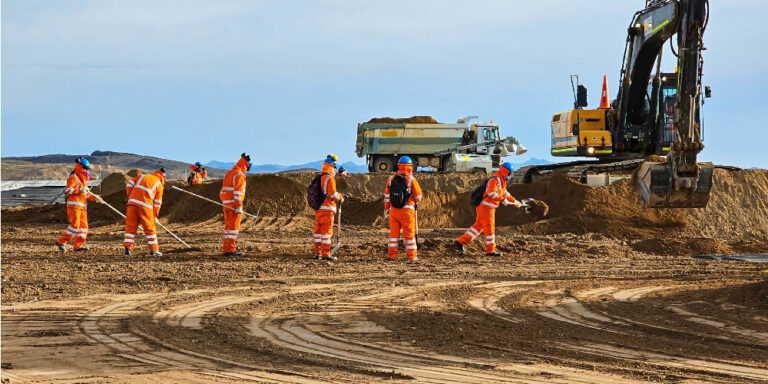
Earthworks are the operations that shape a site's soil and rock to the levels and bearing conditions the design requires, covering cut, fill, grading, and compaction.
They are the first major package on most projects and the foundation every downstream trade depends on, meaning they sit on the critical path.
Earthworks are priced from geotechnical reports and drawings, yet actual ground conditions regularly diverge from those assumptions. Unexpected rock, unsuitable fill, and unstable subgrades drive variations that hit cost and programme before structural work begins.
In this article, we explain what earthworks are, how they differ from excavation, the types and process involved, and how to plan and control an earthworks package so you can protect cost and programme before machines arrive on site.
Table of contents
What is earthwork in construction?
Earthworks are the operations that move, shape, and stabilise soil and rock. The work brings a site to the design levels and bearing capacity, and covers cut, fill, grading, and compaction.
Scope runs from initial site stripping through to the final trimmed and certified subgrade.
Earthworks are the first major package on most projects and the base that every downstream trade relies on. Slab levels, footing depths, pavement design, and service runs all set out from the surface earthworks produce, so an out-of-tolerance subgrade can end up causing rework for packages that have already been priced and programmed.
Spotlight on AS 3798
In Australia, AS 3798 governs earthworks on commercial and residential developments, setting the requirements for fill placement, compaction testing, and the level of supervision each fill classification demands. NCC Part 3.1.1 covers site preparation, including drainage and the removal of unsuitable material before construction proceeds.
What is the difference between earthworks and excavation?
Excavation is one activity within earthworks. It is the removal of soil or rock to form a void, trench, or reduced level, and it ends when the material leaves the ground.
Earthworks are the broader package. They take in excavation along with filling, grading, compaction, and stabilisation, which means the work continues well past the point where excavation finishes.
Where this distinction matters most is at tender.
A package priced as excavation only can miss fill supply, haulage, disposal, and compaction scope, and that omitted work still has to be done. Check that the subcontract scope covers material placement and compaction testing, not just removal, before you award the package.
What are the different types of earthwork?
Earthworks packages are made up of six activity types, and most projects involve several of them running in sequence or in parallel. Knowing which types apply to your site helps you determine what the package should cost and how long it should take.
Excavation:
removes material to reduce levels or form voids. It covers bulk excavation to a reduced level, detailed excavation for footings and pits, and trenching for services.
Filling:
places material to raise levels. Engineered fill is placed in specified layers and tested to a nominated density, while structural fill carries load beneath slabs, footings, and pavements. Both require material that meets the specification, so check whether the fill can be won on site or has to be imported before pricing.
Cut and fill:
balances excavated material against fill requirements across the site. A balanced design keeps material on site and reduces both import and disposal cost, so review the cut and fill quantities early and identify where the surplus or shortfall sits.
Grading and levelling:
shape the ground to design falls and levels. This sets the surface drainage, so falls that miss tolerance send water where the design did not intend it.
Compaction:
densifies placed material to achieve the specified bearing and stability. It is verified by testing under AS 3798, and untested or under-compacted fill settles once load is applied.
Stabilisation:
treats soil to improve its engineering properties where the in situ material is unsuitable. Lime and cement treatment are the common methods, and stabilising in place often costs less than excavating unsuitable material and importing replacement.
How earthworks progress from site investigation to handover
Earthworks run as a sequence where each stage depends on the data and quality of the one before, meaning the coordination between them is where problems arise for cost and programme.
1. Site investigation and geotechnical assessment
The geotechnical report establishes the soil profile, rock levels, groundwater, and bearing conditions across the site.
This data drives both the earthworks design and the cost plan. Where borehole coverage is sparse, or the investigation stopped short of the depths the design requires, what the report failed to cover appears later as variations.
2. Design and earthworks planning
Design sets the target levels, the cut and fill strategy, and the fill specification. The earthworks plan translates that design into a sequence, haul routes, and a disposal strategy.
The disposal position is resolved at this stage. Where surplus material has to leave site, the classification, the receiving facility, and the haulage distance all sit in the rate.
3. Excavation and cut
Material is removed to design levels and classified as it comes out of the ground. Rock classification and unsuitable material are the common cost triggers at this stage. Classification depends on the method agreed before excavation starts. Once material has been removed and hauled off site, disputes over what counted as rock become far harder to resolve.
4. Filling and compaction
Fill is placed in layers and compacted to specification. Layer thickness is set by the specification and the plant in use, and each layer has to meet the nominated density before the next one goes down.
Compaction testing confirms the result before proceeding with the next step. Where fill runs ahead of testing, remediating a failed layer under metres of placed material costs far more than the delay would have.
5. Testing, certification, and handover
Compaction test results and fill certification document the quality of the work and support building approval.
Incomplete documentation at this stage creates defect liability exposure. Where settlement appears later, and no test record covers that area, the head contractor has to argue the case without evidence to back it up.
Planning and controlling an earthworks package
Whether an earthworks package finishes near its tendered cost depends on how it was planned before award and how it was controlled during delivery.
Scope the package against the geotechnical data, not just the drawings
Read the geotechnical report alongside the earthworks drawings and confirm what the investigation actually covered. Check the number and spacing of boreholes, the depths reached, and whether groundwater was monitored over time or recorded once.
Price the uncertainty the report leaves open rather than assuming conditions are uniform between boreholes. Where the investigation is thin across part of the site, carry an allowance for that area or flag it as a qualification in the tender.
Match the contract and cost structure to the level of ground certainty
Use provisional sums or a schedule of rates where ground conditions are uncertain. Both handle latent conditions better than a lump sum, which transfers unpriced risk to whoever holds it when conditions turn out differently.
Confirm the latent condition provisions under AS 4000 or AS 2124 before executing the subcontract. Check what triggers a claim, what notice the subcontractor has to give, and whether the head contract passes the same entitlement up the chain.
Protect the programme against critical-path exposure
Build wet weather float into the earthworks programme rather than absorbing the lost days as delay later. Earthworks stop in sustained rain and the site takes time to dry before plant can work again, so float placed here protects every package that follows.
Set hold points at compaction testing and subgrade certification. These stop the sequence at the points where a failure is still recoverable, rather than after further work has been placed over it.
Track progress and quality as the work proceeds
Maintain compaction records, a variation register, and progress measured against the cut and fill plan. Reconcile the volumes moved against the plan weekly so that a shortfall shows up while there is still time to add plant or extend shifts.
Build the records during delivery rather than reconstructing them for a dispute. Test results, site instructions, and dated survey pickups carry weight in a claim because they were created when the work happened, not after the argument started.
Earthworks in construction cover far more than excavation
Earthworks run from site stripping through cut, fill, grading, compaction, and stabilisation to a certified subgrade, and each stage depends on the quality of the one before it.
Scoping the package against the geotechnical data, matching the contract structure to the level of ground certainty, and tracking compaction and volumes through delivery are what keep the package under control.
Categories:
Written by
Josh Krissansen
122 articles
Josh Krissansen is a freelance writer with two years of experience contributing to Procore's educational library. He specialises in transforming complex construction concepts into clear, actionable insights for professionals in the industry.
View profileExplore more helpful resources

Scaling with SIERA: Building for now and what comes next
SIERA Founder and Director Brent Thompson has always known that the right people, systems and hands-on approach are fundamental to scaling his business successfully. In Part 1, Brent and Head...

Getting Your Construction Data Ready for AI – What Every Business Needs to Consider Before Launching AI
This is the first of two articles. This part sets out the considerations: what clean and trusted data actually means, how to measure it, how the two systems most businesses...

The Contractor’s Guide to Concrete Inspections
Concrete: It’s the key building block of nearly every structure’s foundation — and it’s the world’s most widely used building material. For most head contractors, understanding how to assess concrete...

Computer-Aided Design (CAD): What It Is — and Why It’s Important
When most people envision a construction worker, they see a person at a construction site wearing a hard hat and a high-vis vest. Perhaps this person is putting up plasterboard,...