The Time, Cost, Quality Triangle: Key to Construction Success

Last Updated May 7, 2026
Brendan McGurk
Strategic Product Consultant - Construction Financials
22 articles
Brendan is a Strategic Product Consultant for Procore Financials, where he enjoys leading and innovating internal company processes to deliver on both public and private projects. He brings 12 years of experience working in various construction roles ranging from builder's hand to quantity surveyor and project manager on both the owner and main contractor side.
Originally studying Accounting, he changed direction to quantity surveying after the Christchurch Earthquake in 2011. He is now qualified and an NZIQS-recognised Quantity Surveyor. He’s since worked on projects from feasibility, concept design, and value engineering right through to construction and post-construction support.

Nicholas Dunbar
Content Manager
78 articles
Nick Dunbar oversees the creation and management of UK and Ireland educational content at Procore. Previously, he worked as a sustainability writer at the Building Research Establishment and served as a sustainability consultant within the built environment sector. Nick holds degrees in industrial sustainability and environmental sciences and lives in Camden, London.

Zoe Mullan
27 articles
Zoe Mullan is an experienced content writer and editor with a background in marketing and communications in the e-learning sector. Zoe holds an MA in English Literature and History from the University of Glasgow and a PGDip in Journalism from the University of Strathclyde and lives in Northern Ireland.

Every construction project involves juggling the competing priorities of meeting tight deadlines, staying within budget and ensuring top-notch work. In other words, it revolves around balancing three factors: time, cost and quality. The time, cost, quality triangle provides a practical framework for navigating the relationship between all three.
Table of contents
Understanding the Iron Triangle
On any construction project, time, cost and quality are deeply interconnected – altering one inevitably affects the other two. The Project Management Triangle, also known as the Triple Constraint, defines the boundaries of these three constraints, often summarised by the rule: "Pick two."
What is the Project Management Triangle?
Time, cost and quality together make up the total scope of a project. An adjustment to one element requires adjustments to the others. Think of the triangle as a three-legged stool: shorten one leg – like cutting costs – and you must adjust the other two to keep the stool balanced. For example:
- Reducing costs can extend the project programme or compromise quality
- Prioritising high-quality outcomes requires more time and budget
What is the Iron Triangle in Construction?
The Iron Triangle describes what happens when the balance of time, cost and quality breaks down. In construction, this imbalance forces trade-offs that can derail a project, leading to delays, budget overruns, or compromised standards. When one factor is pushed too far, the others suffer, and the project risks falling apart.
On a project I was on, premium materials were chosen to meet stringent aesthetic demands. While the result was visually striking, the decision stretched out the programme and significantly increased costs, ultimately leading to stakeholder dissatisfaction.
Brendan McGurk
Strategic Product Consultant - Construction Financials
Procore Technologies
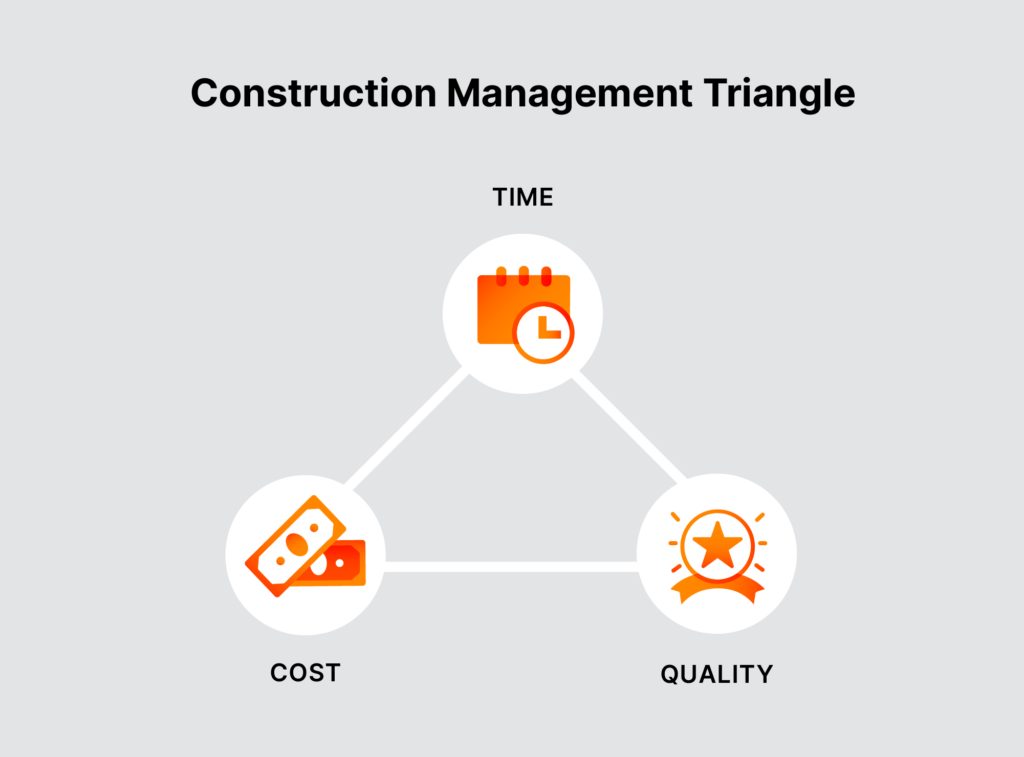
The Iron Triangle is a reminder of the challenges construction professionals face in maintaining equilibrium. Success requires carefully managing trade-offs to keep projects both feasible and high-quality.
Common Misconceptions
The Project Management Triangle is frequently misunderstood, leading stakeholders to hold unrealistic expectations. The most common myth is that you can maximise time, cost and quality without making trade-offs – something that is far from reality. Ignoring the interconnected nature of these three factors almost always leads to:
- Delays: Unrealistic deadlines set without adjusting budget or scope
- Cost Overruns: Failure to assess trade-offs results in ballooning expenses
- Quality Compromises: Rushing to meet a programme or cut costs produces substandard work or excessive snagging
Defining Quality: Scope, Compliance & Finish
When balancing the triangle, teams must define quality clearly. This means managing scope and deliverables alongside non-negotiable compliance requirements – as mandated by UK Building Regulations and the Building Safety Act – while also balancing the more negotiable aesthetic finish.
Managing Trade-offs
Trade-offs are an inevitable part of any tender submission. As a tenderer navigates the interplay between time, cost and quality, identifying these trade-offs early in the process is essential. Common examples of trade-offs on a construction project include national infrastructure projects like HS2 facing delays that affect overall costs, or local housing developments dealing with sudden material shortages.
Specific examples include:
Unworkable Proposals
Tenderers often identify elements of a project brief that are not feasible, such as overly complex designs.
Cost Constraints
A tenderer's expected finishes may not match the available budget. Proposing lower-cost materials or streamlining processes can bring the project within budget, but at the expense of reduced durability or longer programmes.
Tight Programmes
Rushing to meet aggressive deadlines can involve higher labour costs or compromise the quality of workmanship.
These trade-offs shape the submission itself, influencing how feasible and trustworthy the proposal appears to the client.
When the tenderer says, "This all works out on paper, but it just isn't buildable," it forces the tenderer to accept adjustments that impact cost, quality or delivery.
Brendan McGurk
Strategic Product Consultant - Construction Financials
Procore Technologies
Learn about the future of the built environment - Read Procore's Future State of Construction report
Learn how contractors, subcontractors, and project teams can take advantage of new opportunities to boost efficiency and profitability over the next decade. Download the report to get your roadmap to the future state of construction.

Tendering & Value Engineering
The time, cost, quality triangle plays a central role in shaping decisions during the tender process. Each project is different, and contractors must ensure their tenders align with the programme and demonstrate that their proposal represents fair value. The triangle influences both how tenderers approach their submissions and how clients assess proposals against the project's constraints and goals. In practice, the triangle's influence varies by project type:
Cost-focused Projects
Public projects, such as government-funded infrastructure, often emphasise cost to meet strict budget requirements. However, prioritising cost can lead to compromises on quality or extended programmes.
Quality-driven Builds
Premium projects, such as luxury developments, tend to prioritise quality. These tenders typically allow for higher costs and longer programmes to achieve superior results.
Balancing these factors effectively requires the detailed involvement of a Quantity Surveyor (QS) during the tender process, ensuring cost and quality remain aligned throughout.
Value engineering – the process of rethinking designs or materials to achieve project goals more efficiently – is central to aligning tender proposals with the triangle. For instance, switching to modular construction methods can reduce both time and costs without compromising quality, helping the team meet budget constraints while maintaining safety and design standards. Value engineering enables tenderers to craft competitive submissions by demonstrating innovative ways to balance client priorities with project demands.
How Contracts Fix the Triangle
Different contract types allocate risk and constraints in different ways. Understanding how each fixes the triangle is essential for successful project delivery. Key examples include JCT Design and Build or Standard Building contracts (Lump Sum), NEC4 Option C Target Cost and NEC4 Option E Cost Reimbursable agreements.
Digital Tools for Better Decision-Making
Modern technology can play a significant part in helping construction professionals manage the time, cost and quality balance. Tools such as estimating software, architectural platforms and Building Information Modelling (BIM) provide deeper insights that enhance decision-making throughout the project life cycle.
While technology does not replace human expertise, it equips professionals with the data needed to make informed trade-offs. Particularly important are Common Data Environments (CDEs) for ISO 19650 compliance, real-time budget tracking and BIM for clash detection. The most widely used tools include:
Construction Estimating Software
Estimating tools allow project teams to refine cost projections as more information becomes available, ensuring better alignment with budget constraints.
Building Information Modelling (BIM)
BIM has progressed from basic 2D CAD (BIM Level 0) to detailed 3D models linked to programme data (4D BIM), including specific product specifications such as brick size and colour. These tools help visualise projects and reduce costly errors by identifying clashes or design flaws early.
Architectural Software
Tools like CAD and ArchiCAD streamline the design process, making it easier to integrate cost and time considerations into project planning.
Developers are increasingly tailoring these tools to meet local compliance standards and address market-specific challenges such as fluctuating material costs and labour shortages.
Risk Management During Tendering
Effective risk management is key during the tender process, and analysis should begin as early as possible. Addressing risks at the outset reduces the likelihood of costly surprises and improves the feasibility of submissions.
Pro Tip
Identify trade-offs upfront, or you will encounter problems later – whether delays, cost overruns or rework and snagging.
Some construction firms build contingency planning into the tender process, setting aside buffers for unexpected costs or delays. Others adopt collaborative approaches such as Early Contractor Involvement (ECI), which allows potential risks to be flagged and proposals refined before submission.
Technology's Role in Tender Optimisation
Technology has become indispensable in tender optimisation, giving construction teams the tools to make more informed decisions. Construction management platforms such as Procore and BIM software allow teams to simulate different scenarios, forecast costs and identify potential bottlenecks before work begins.
The role of data-driven tools is to reduce inefficiencies. The right software can show you where trade-offs are needed and help you plan accordingly, even before the project starts.
Brendan McGurk
Strategic Product Consultant - Construction Financials
Procore Technologies
Tools that incorporate local compliance standards and current market conditions – such as material cost fluctuations – are particularly valuable, helping firms tailor their tenders to specific project requirements.
Mastering the Project Management Triangle
The Project Management Triangle sits at the heart of every construction project, shaping decisions about time, cost and quality from planning through to execution. Success lies not in chasing perfection, but in making informed trade-offs that align with project goals and client priorities.
Categories:
General Industry, Project Management, Safety and Compliance, Tech and Data
Written by
Brendan McGurk
Strategic Product Consultant - Construction Financials | Procore Technologies
22 articles
Brendan is a Strategic Product Consultant for Procore Financials, where he enjoys leading and innovating internal company processes to deliver on both public and private projects. He brings 12 years of experience working in various construction roles ranging from builder's hand to quantity surveyor and project manager on both the owner and main contractor side.
Originally studying Accounting, he changed direction to quantity surveying after the Christchurch Earthquake in 2011. He is now qualified and an NZIQS-recognised Quantity Surveyor. He’s since worked on projects from feasibility, concept design, and value engineering right through to construction and post-construction support.
Reviewed by
Nicholas Dunbar
Content Manager | Procore
78 articles
Nick Dunbar oversees the creation and management of UK and Ireland educational content at Procore. Previously, he worked as a sustainability writer at the Building Research Establishment and served as a sustainability consultant within the built environment sector. Nick holds degrees in industrial sustainability and environmental sciences and lives in Camden, London.
View profileZoe Mullan
27 articles
Zoe Mullan is an experienced content writer and editor with a background in marketing and communications in the e-learning sector. Zoe holds an MA in English Literature and History from the University of Glasgow and a PGDip in Journalism from the University of Strathclyde and lives in Northern Ireland.
View profileExplore more helpful resources

Take Control of Commercial Risk: A Guide to JCT Contracts
On a construction site, the standard forms published by the Joint Contracts Tribunal (JCT) often stand between a profitable project and a costly commercial dispute. Unstructured email threads and messy...

Understanding NEC Contracts in Construction
An excavator hits an uncharted utility line during a foundation pour. Work stops. The moment the engine cuts out, operational and compliance risks begin compounding. Under a traditional contract, teams...

Mastering the Building Safety Act Gateway Points
The Three Gateway Points Explained The Building Safety Act 2022 has permanently altered the risk profile of UK construction. At its core sit three distinct gateway points – absolute, legal...

Drive Compliance & Unify Design Risk Management
Commercial margins are often tight during the preconstruction phase. Main contractors and design leads carry significant responsibility for statutory compliance before a single spade hits the ground, and getting this...