Connected construction: Building smarter through integration

Last Updated Jul 2, 2026
Josh Krissansen
122 articles
Josh Krissansen is a freelance writer with two years of experience contributing to Procore's educational library. He specialises in transforming complex construction concepts into clear, actionable insights for professionals in the industry.

One of the main challenges on construction projects is keeping cost, programme, and site data aligned.
When systems aren’t integrated, teams rely on fragmented or outdated information that often leads to rework, delays, and additional costs.
Connected construction addresses this by linking systems, data, and workflows into a single operating environment. This helps to ensure stakeholders can work from the same, up-to-date information across the project lifecycle.
This article explains how connected construction works in practice, the core components that enable it, and how contractors can apply it to reduce rework, improve schedule reliability, and protect project margins.
Table of contents
What is connected construction?
Construction projects generate data across every function, from design and coordination models to programme updates to everyday correspondence between stakeholders. On many projects, this data lives in separate systems or inboxes, which means teams are routinely making decisions from incomplete or outdated information.
Connected construction is designed to resolve that challenge, so information flows between systems rather than sitting in disconnected tools and records.
Better information flow can change how project teams work::
- Project managers can access a more centralised view of programme, budget, and documentation without chasing updates.
- Site teams have shared access to current drawings, live RFI status, and WHS records accessible from the site.
- Clients and developers can gain visibility across the full project lifecycle rather than point-in-time reporting.
That doesn’t mean, though, that all work is performed within a single platform. Project delivery teams still rely on specialised tools and systems for specific tasks. The value of connected construction comes from how those systems are connected.
Core components of connected construction
Typically, a construction management platform and common data environment (CDE) are used to bring project data together into a single shared project environment. Design, site, and commercial teams work from the same up-to-date information at the same time, rather than maintaining parallel versions across disconnected tools.
In practice, this helps teams coordinate drawings, RFIs, site reporting, approvals, programme updates, and commercial records from the same live project information.
Several technologies capture and transmit project data into that environment:
- BIM (building information modelling) feeds coordinated design and documentation data, giving all disciplines a coordinated model for design review and clash detection.
- IoT sensors may capture site conditions such as equipment location, environmental data or asset performance.
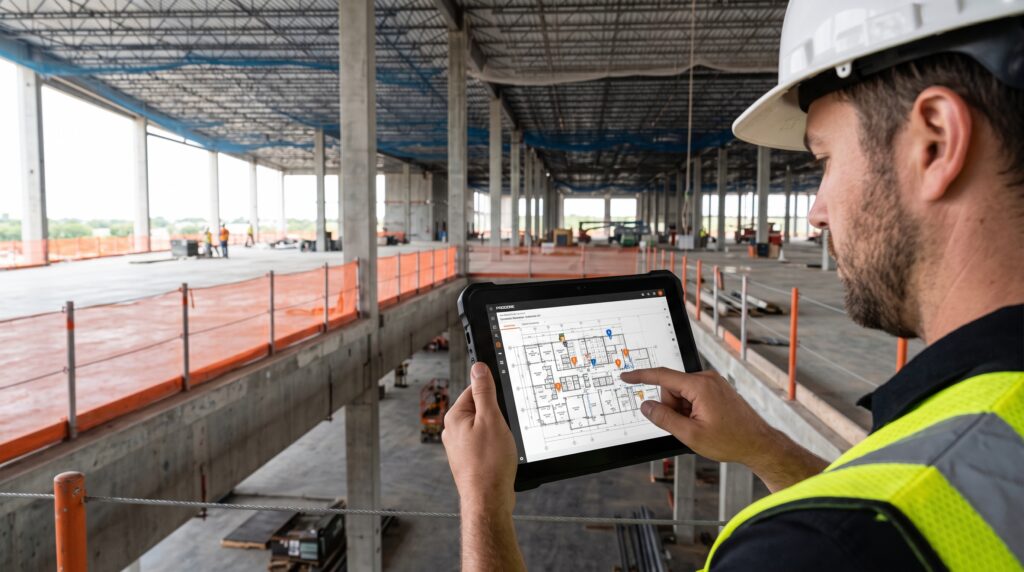
- Mobile field tools give site teams the ability to record inspections, log WHS observations, and update task status directly from the site, putting real-time field data into the platform as work happens.
- Collaboration and communication tools manage the formal exchange of RFIs, submittals, variations, and correspondence through structured workflows, so every decision and instruction is recorded as it occurs rather than reconstructed later.
- AI and analytics process the aggregated data to surface cost and programme risks, support forecasting, and reduce the manual effort required to interpret large datasets.
Why connected construction matters
The commercial case for connected construction is straightforward: when teams are working from current, shared project information, decisions are faster, coordination improves, and the risk of rework and delays is reduced.
Faster decision-making with real-time data
A connected environment gives every project team a live view of the budget, programme, and documentation. For a contract administrator responding to a variation request, that means pulling from a single source and responding quickly, before a subcontractor escalates the issue into a formal claim.
Reduced rework
Rework is expensive and often avoidable. For instance, when a structural steel package reaches site based on a drawing that was superseded six weeks earlier, the cost of fixing it can be substantial, and the cause is traceable back to a document control failure. Connected workflows and document control help ensure teams are working from the latest information, and coordination issues are resolved in the model rather than on-site.
Improved collaboration across project teams
When subcontractors, site teams, and project managers are working across disconnected systems, minor miscommunications can later result in disputes. A verbal instruction, remembered differently by each person involved, leaves no reliable project record to refer back to later.
Connected construction addresses this by using standardised workflows, so communication, submissions, and decisions are recorded as they happen.Stronger compliance with contractual requirements
Connected construction helps teams maintain clearer project records and meet contract and reporting requirements more consistently.
For example, if a delay event occurs, the relevant site record, photo, programme impact, and correspondence can be captured in one place, then used to support an extension of time notice within the required timeframe.
This reduces reliance on memory, inbox searches, and after-the-fact record gathering.
Connected construction also supports digital delivery requirements on government projects.
Government digital engineering and asset information requirements, such as Victoria’s Digital Asset Strategy (VDAS), are pushing some public projects toward more structured digital information management, including BIM and ISO 19650-aligned processes.. In practice, that means teams need controlled digital workflows for issuing, reviewing, revising, and approving project information rather than relying on disconnected files and email chains.
Key challenges of adopting connected construction
Setting up connected construction requires navigating a set of common barriers before rolling it out across a project or business.
- Legacy systems that were never built to connect: Most contractors are already running multiple platforms across estimating, scheduling, document control, and finance. The challenge is not replacing them but getting them to share data cleanly. Systems that were procured independently and configured in isolation rarely integrate without deliberate effort, and that effort needs to be factored into the implementation plan from the start.
- Site adoption: Site teams adopt tools that make their work easier and avoid those that make it harder. Site adoption depends on how well the tool fits site workflows, how clearly expectations are set and how much support teams receive during rollout..
- Data security and access control: Clients and principals are specific about who can access project data, on which device, and under what conditions. These questions should be resolved at the contract stage. Leaving them until after go-live creates friction that is difficult to unpick without disrupting the project.
- Lack of unified digital standards: Outside formal government or client-mandated digital requirements, expectations can vary significantly across Australian projects.. Outside VDAS and the TfNSW Digital Engineering Framework, contractors on private sector work face inconsistent principal expectations and varying head contract data clauses, making platform configuration decisions harder and increasing the risk of building workflows that do not transfer across projects.
- Regulatory requirements are moving: AASB S2, updated NCC provisions, and evolving WHS digital record obligations mean that a platform configured for compliance today may need reconfiguration within 12 to 24 months. Building flexibility into the governance model from the start is cheaper than retrofitting it later.
Recognising these barriers early is what separates implementations that deliver on their promise from those that stall after go-live.
Laying the groundwork for implementing connected construction
Connected construction implementations can stallbecause contractors try to connect every platform and workflow at once without first understanding how information currently moves through the business. Integrating disconnected systems on top of inconsistent processes usually creates more noise, more duplicated data, and more manual work rather than less.
Before selecting platforms or building integrations, contractors first need a clear picture of where project information is being created, where it is being transferred between teams, and where it breaks down.
Audit your existing systems and workflows
Begin by building a list of every software tool you currently use across the business, including:
- Estimating software
- Scheduling tools
- Document control systems
- Site management apps
- Finance platforms
Then start looking for where the gaps are between them, like where data is being duplicated, where it goes missing between handoffs, and where teams are maintaining parallel versions of the same information.
Common culprits include a contracts administrator keeping a separate variation register in Excel because it doesn't connect to the project management platform, or a site supervisor emailing photos and inspection notes that never make it into the document control system.
These are the handoff points where information gets lost, duplicated, or delayed, and they are what the integration needs to solve.
Choose a construction platform and CDE that connects
The construction management platform and CDE need to support the way project information is created, shared and approved and draw in data from the tools already in use.
For these tools, connectivity is one of the most important considerations. If they do not integrate with your existing tech stack, you’ll either have to look for new vendors or deal with manual data entry, defeating the purpose of adopting connected construction in the first place.
When evaluating options, ask vendors specifically which tools they have native integrations with, and map them over to your existing toolset. Where a native integration with a particular tool doesn’t exist, investigate custom connections and any costs or lead-times involved in creating them.
Identify your highest-friction workflows
Look for the two or three workflows where disconnected data is causing the most pain (that might be document control, variation management, or site reporting, for instance) and work on connecting platforms there first.
For many commercial contractors, document control is a classic starting point. Superseded drawings reaching the site, RFIs sitting in inboxes, and approval chains running across email threads are problems a connected platform can address quickly and visibly.
Starting narrow keeps the implementation manageable and produces visible results quickly, which builds the internal case for broader rollout.
Rolling out connected construction and driving adoption
Rolling out connected construction is as much an operational change process as it is a technology implementation. Contractors that try to connect every workflow across the business at once often create confusion, inconsistent adoption, and parallel processes that undermine the system from the start.
The following steps can help.
Pilot on a single project before rolling out across the business
Choose a project that reflects your typical workload but is not the most commercially sensitive or operationally complex project currently under delivery. The goal is to test the workflows under real site conditions without introducing unnecessary delivery risk if issues emerge during implementation.
Use the pilot project to identify where information still falls outside the system and where teams naturally revert back to old habits. In practice, that often shows up as RFIs being answered through email, drawings being stored locally, or site teams bypassing the platform because key workflows are too slow or impractical in the field.
The pilot should also test whether subcontractors are using the workflows correctly, whether approval paths and permissions are functioning properly, and whether the platform realistically supports day-to-day delivery requirements on site.
Resolving these issues during a pilot is significantly easier than trying to reconfigure workflows, retrain teams, or change reporting processes midway through a major live project rollout.
Drive early adoption across site teams and subcontractors
Disconnected workflows usually reappear when subcontractors and site leadership continue coordinating through phone calls, inboxes, and messaging apps instead of the platform itself.
That makes early buy-in critical, particularly from the superintendent and key subcontractors who drive day-to-day coordination on site. If RFIs, approvals, and site instructions continue being managed outside the system, the rest of the project team will usually follow the same pattern regardless of how well the platform is configured.
Contractors need to set that expectation early.
Formal project communication should follow the agreed contract and project communication protocols, with the platform used consistently where it forms part of those protocols.. That means onboarding subcontractors into the workflow before mobilisation and making platform usage part of how the project is managed day to day.
Project leadership also needs to actively reinforce those workflows once delivery begins. When questions, approvals, or instructions come through side channels, teams should be redirected back into the platform so the connected environment becomes the default way the project operates rather than an optional administrative layer.
Build role-specific training into the rollout
Connected construction platforms affect different parts of the project team in very different ways. A contracts administrator managing RFIs and variations interacts with the system differently from a superintendent reviewing drawings on site or a supervisor logging inspections in the field.
Training should reflect those differences.
Teams are far more likely to adopt the platform when the training is tied directly to the workflows they use every day rather than broad platform walkthroughs that try to cover everything at once.
It also helps to identify a small number of platform champions within the project team early in the rollout. These are usually people already engaged with the workflows who can answer questions, reinforce good habits, and help prevent teams from drifting back toward disconnected processes once delivery pressures increase.
Most importantly, training should continue after go-live.
Many adoption problems only emerge once the platform is being used under real delivery conditions, when teams are moving quickly and operational pressure increases. Ongoing support gives contractors the opportunity to refine workflows, close knowledge gaps, and reinforce platform usage before workarounds become embedded into the project.
Connected construction improves coordination and reduces rework
When systems, workflows, and teams operate in one connected environment, decisions are made on current information rather than chasing updates across disconnected tools. That shift reduces rework, improves coordination, and gives contractors a more reliable way to manage delivery from design coordination through to handover.
Categories:
Written by
Josh Krissansen
122 articles
Josh Krissansen is a freelance writer with two years of experience contributing to Procore's educational library. He specialises in transforming complex construction concepts into clear, actionable insights for professionals in the industry.
View profileExplore more helpful resources

Scaling with SIERA: Building for now and what comes next
SIERA Founder and Director Brent Thompson has always known that the right people, systems and hands-on approach are fundamental to scaling his business successfully. In Part 1, Brent and Head...
Getting Your Construction Data Ready for AI – What Every Business Needs to Consider Before Launching AI
This is the first of two articles. This part sets out the considerations: what clean and trusted data actually means, how to measure it, how the two systems most businesses...

The Contractor’s Guide to Concrete Inspections
Concrete: It’s the key building block of nearly every structure’s foundation — and it’s the world’s most widely used building material. For most head contractors, understanding how to assess concrete...

Computer-Aided Design (CAD): What It Is — and Why It’s Important
When most people envision a construction worker, they see a person at a construction site wearing a hard hat and a high-vis vest. Perhaps this person is putting up plasterboard,...