Understanding commercial construction: A guide for Australian project teams

Last Updated Sep 29, 2026
Josh Krissansen
122 articles
Josh Krissansen is a freelance writer with two years of experience contributing to Procore's educational library. He specialises in transforming complex construction concepts into clear, actionable insights for professionals in the industry.
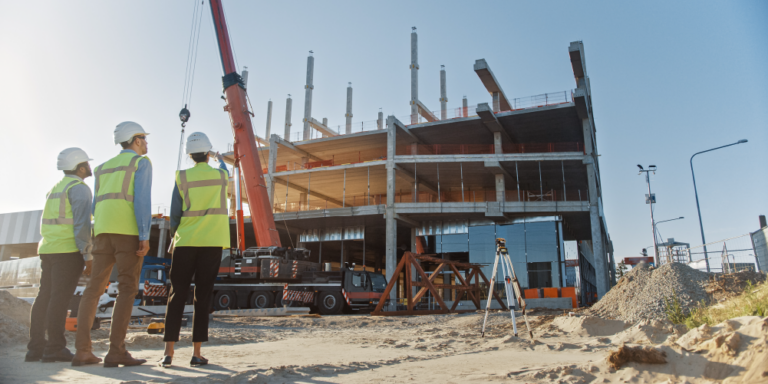
Commercial construction is the design, procurement, and construction of buildings intended for business use, including offices, retail, hospitality, and mixed-use developments.
Commercial projects carry different regulatory, contractual, and delivery demands than residential work, which means that moving between the two without understanding the core differences can create cost and programme risk.
In this article, we explain what commercial construction involves, the project types it covers, how a typical project moves from planning to completion, the roles responsible for delivery, and the challenges teams most commonly face.
Table of contents
What is commercial construction?
Commercial construction is the planning, design, and physical construction of buildings used for business, government, or institutional purposes rather than private residential use.
Compliance and team structure are the main facets that set commercial work apart. Commercial projects involve stricter building code and accessibility requirements, more complex approval processes, and larger, more structured project teams than residential builds.
How is commercial construction different from industrial construction?
Industrial construction prioritises function and heavy-duty infrastructure such as plant and machinery. Commercial construction, by contrast, prioritises usability, presentation, and compliance for occupants and the public.
Types of commercial construction projects
Commercial construction spans a wide range of building types, each carrying its own compliance requirements, delivery risks, and stakeholder demands.
- Office buildings and corporate fitouts, ranging from single tenancy buildings to multi-storey commercial towers
- Retail developments, including standalone stores, shopping centres, and mixed-use retail precincts
- Hospitality projects, including hotels, function centres, and short-stay accommodation
- Healthcare and aged care facilities, delivered to meet specific compliance, accessibility, and operational requirements
- Education facilities, including schools, universities, and training campuses
- Mixed-use developments combining retail, commercial, and residential space within a single project
- Institutional and government buildings, including civic centres and other public infrastructure
The commercial construction project lifecycle
A commercial project moves through a defined sequence of stages.
The decisions made early in the sequence tend to constrain what is achievable later, making understanding the full lifecycle important for keeping cost, quality, and programme outcomes aligned as the project advances.
Development and feasibility
Feasibility is where the client and consultants test whether the project stacks up before committing to design, covering site suitability, planning controls, projected costs, and expected returns.
Feasibility studies at this stage determine the scale and quality of what gets built, and decisions made here set the budget for every phase that follows.
Design and documentation
Design and documentation is where architects, engineers, and specialist consultants develop the drawings, specifications, and reports the project will be priced and built against. The level of detail in documentation at this stage directly affects how accurately the project can be tendered and how many variations arise once construction starts.
Design development typically runs through concept, schematic, and detailed design stages, with cost planning and value management occurring alongside each stage.
Approvals
Securing approvals requires development approval from the relevant council or planning authority before construction can proceed, along with any conditions attached to that approval.
Building approval (confirming the design meets the National Construction Code and relevant Australian Standards) is a separate process from planning approval, but is often managed concurrently.
Authority approvals for services connections, such as water, power, and telecommunications, run in parallel and can delay the construction programme if applications are lodged late, since utility providers set their own approval timeframes independent of the building approval process and construction cannot proceed to final fit-off without them.
Procurement
Procurement begins once the head contractor is engaged under a contract structure suited to the project's risk profile and level of design completion, commonly a lump sum, construction management, or design and construct arrangement.
Subcontractor packages are tendered and awarded once the head contractor has scope certainty, with trade sequencing and lead times factored into the award schedule. Procurement decisions made here, particularly around long lead items, directly affect whether the construction programme can be adhered to or must be adjusted.
Construction
The construction phase is where the head contractor manages the physical build, coordinating trades, managing the programme, and administering the contract through progress claims, variations, and site instructions.
Quality assurance and inspection processes run throughout this phase to confirm work meets the approved design and applicable standards before it is covered up or built over. Site safety, WHS compliance (or Victoria's equivalent OHS Act, which sits outside the harmonised model most other states use), and coordination between trades working concurrently are managed continuously.
Handover and defects
Handover begins with practical completion, assessed against the contract to confirm the works are fit for their intended use even where minor items remain outstanding.
A defects liability period follows practical completion, during which the head contractor rectifies defects identified by the client or during use.
Operation and maintenance manuals, warranties, and as-built documentation are handed to the client as part of this phase, and missing or incomplete records here commonly cause disputes later.
Key roles on a commercial construction project
Commercial projects rely on a defined set of roles, each accountable for a different part of delivery. Understanding where each role's responsibility starts and ends helps teams identify who owns a decision before it becomes a dispute.
Project manager
The project manager owns overall delivery against cost, programme, and quality objectives, and is the primary point of accountability to the client for project outcomes. They coordinate between the client, design team, and head contractor, resolving issues that cut across multiple parties before they affect the programme.
Contracts administrator
The contracts administrator manages the commercial and contractual mechanics of the project, including variations, progress claims, and extension of time claims. They maintain the records, such as site instructions and correspondence, that determine whether a claim or dispute is resolved in the contractor's favour.
Site manager
The site manager runs day-to-day activity on site, including trade coordination, sequencing, and safety supervision. They act as the link between the programme set in the office and what is actually achievable on site, flagging conflicts before they cause delay.
Estimator
The estimator prices the works during tender and procurement, translating design documentation into a cost plan the business can commit to. Accuracy at this stage depends on how complete the design documentation is, and missing or incomplete documentation here is a common source of cost overrun later in delivery.
Subcontractors and trade contractors
Subcontractors and trade contractors deliver specific scopes of work, such as structural, mechanical, or fitout trades, under the head contractor's programme and quality requirements. Their sequencing and coordination with other trades is managed by the site manager.
Common challenges in commercial construction delivery and how to solve them
Commercial delivery carries a recurring set of risks. For most of them, the solution is about timing; putting a control in place to avoid the risk, rather than managing it when it comes up.
Regulatory and compliance obligations
Commercial buildings carry stricter fire safety, accessibility, and building code requirements than residential projects, and non-compliance discovered late in a build can force expensive rework.
Engage a building surveyor or certifier early in design, not just at the approval stage, so compliance requirements are built into documentation.
Procurement timing and lead times
Lead times for materials and equipment vary significantly across trades, and items ordered late can sit on the critical path without the project team realising until the delay has already occurred.
Identify long lead items during design development and lock in procurement dates against the master programme before tenders are awarded.
Cost control and tight margins
Commercial scale projects run on tighter margins than many residential builds, so variations, delays, or scope creep have a more immediate effect on project viability.
Track cost against budget in real time through the build (avoiding fixed reporting intervals), so overruns are caught while there is still room to respond.
Coordination across trades and consultants
The number of parties involved in a commercial build increases the risk of clashes between trades, particularly where mechanical, electrical, and structural elements interact in the same space.
Run coordination reviews, including clash detection where models are available, before each trade package is released for construction to reduce the number of conflicts on site.
Terminology and process gaps for newer practitioners
Practitioners moving from residential work or entering the industry as graduates often lack a clear picture of how roles and processes differ in a commercial setting, which creates friction working alongside experienced colleagues or clients.
Pair less experienced team members with a mentor early in a project and use the project's own documentation, such as the programme and contract, as the basis for on-the-job learning.
Commercial construction demands a different approach to delivery than residential work
Commercial construction carries distinct regulatory, contractual, and delivery demands that separate it from residential work, and overlooking them is where cost and programme risk creep in. Teams that understand the project types, lifecycle stages, key roles, and common challenges covered in this article are better placed to catch those risks before they affect delivery.
Categories:
Written by
Josh Krissansen
122 articles
Josh Krissansen is a freelance writer with two years of experience contributing to Procore's educational library. He specialises in transforming complex construction concepts into clear, actionable insights for professionals in the industry.
View profileExplore more helpful resources

Scaling with SIERA: Building for now and what comes next
SIERA Founder and Director Brent Thompson has always known that the right people, systems and hands-on approach are fundamental to scaling his business successfully. In Part 1, Brent and Head...
Getting Your Construction Data Ready for AI – What Every Business Needs to Consider Before Launching AI
This is the first of two articles. This part sets out the considerations: what clean and trusted data actually means, how to measure it, how the two systems most businesses...

The Contractor’s Guide to Concrete Inspections
Concrete: It’s the key building block of nearly every structure’s foundation — and it’s the world’s most widely used building material. For most head contractors, understanding how to assess concrete...

Computer-Aided Design (CAD): What It Is — and Why It’s Important
When most people envision a construction worker, they see a person at a construction site wearing a hard hat and a high-vis vest. Perhaps this person is putting up plasterboard,...